Why Capability Beats Strategy in Retail Banking Organizations

A positive margin turn versus a rising cost-income ratio, and a real regulatory action in between, show why capability, not strategy, decides outcomes.
Why Capability Beats Strategy in Retail Banking Organizations
The same quarter separated two Indian banks: one converted six quarters of pressure into a positive net interest margin, the other watched digital investment push its cost-income ratio higher, two years after a real governance gap cost it ten months of digital growth. The difference was never the strategy. Both banks had one.
EVIDENCE AT A GLANCE
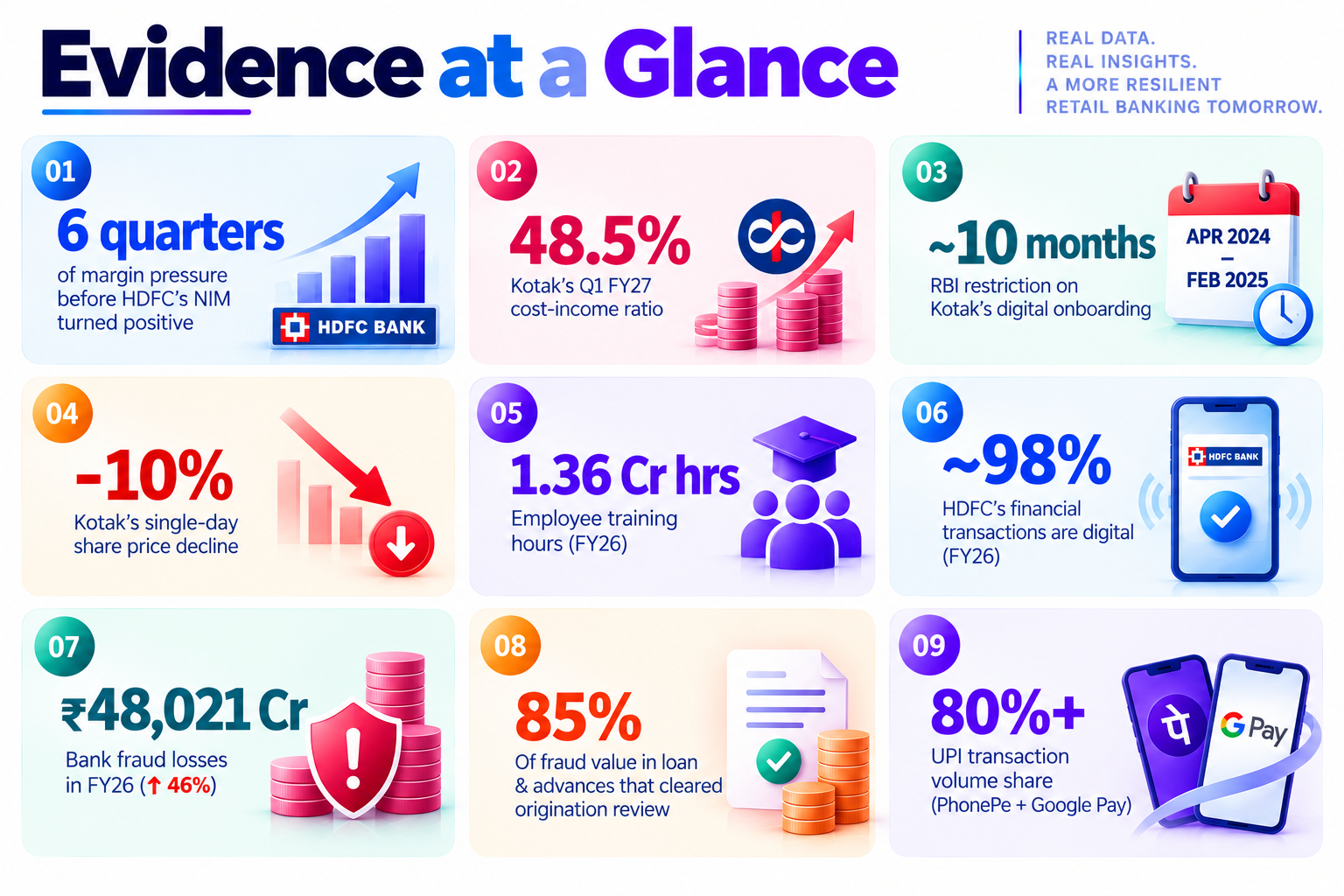
6 quarters Consecutive quarters of margin pressure HDFC Bank faced before its net interest margin turned positive in Q1 FY27 Source: HDFC Bank Q1 FY27 results, August 2026 | 48.5% Kotak Mahindra Bank’s Q1 FY27 cost-income ratio, up as it accelerated digital-infrastructure investment not yet converted to margin Source: Kotak Mahindra Bank Q1 FY27 results, August 2026 | ~10 months Length of RBI’s restriction on Kotak Mahindra Bank’s digital customer onboarding, April 2024 to February 2025 Source: RBI supervisory action notices, 2024–2025 |
-10% Kotak Mahindra Bank’s single-day share price decline after RBI’s restriction was announced Source: Indian financial media, April 2024 | 1.36 Cr hrs Employee training hours HDFC Bank disclosed for FY26, alongside 45,902 new hires Source: HDFC Bank Form 6-K, FY2026 | ~98% Share of HDFC Bank’s financial transactions conducted digitally in FY26 Source: HDFC Bank Form 6-K, FY2026 |
₹48,021 Cr RBI-reported bank fraud losses in FY26, up 46% even as the number of fraud cases fell Source: RBI Annual Report, FY26 | 85% Share of FY26 fraud value concentrated in loan and advances fraud that cleared origination review Source: RBI Annual Report, FY26 | 80%+ Combined UPI transaction volume share held by PhonePe and Google Pay Source: NPCI data, 2026 |
Two Banks, One Quarter, Two Outcomes
In the quarter ending June 2026, HDFC Bank and Kotak Mahindra Bank both reported results built on comparable public commitments: sustained, multi-year investment in digital infrastructure and AI-led banking, communicated to investors well before this quarter’s results. HDFC Bank closed the quarter with its net interest margin turning positive after six consecutive quarters of pressure. Kotak Mahindra Bank closed the same quarter with its cost-income ratio climbing to 48.5%, digital investment that had not yet converted into margin. Both banks had a strategy. Only one had built the capability to convert it into a result.
This is not a story about one bank outspending another. It is evidence for the argument this piece makes directly: capability, not strategy, is what determines whether a bank’s stated direction ever becomes its actual result. The distinction is not academic. Two years earlier, RBI had barred Kotak Mahindra Bank from onboarding new digital customers for nearly ten months, after finding two consecutive years of unaddressed IT governance deficiencies, real evidence that digital ambition and digital capability are not the same thing, and that the gap between them shows up in disclosed, regulator-confirmed results, not investor slides.
What Strategy Actually Is, and Isn’t
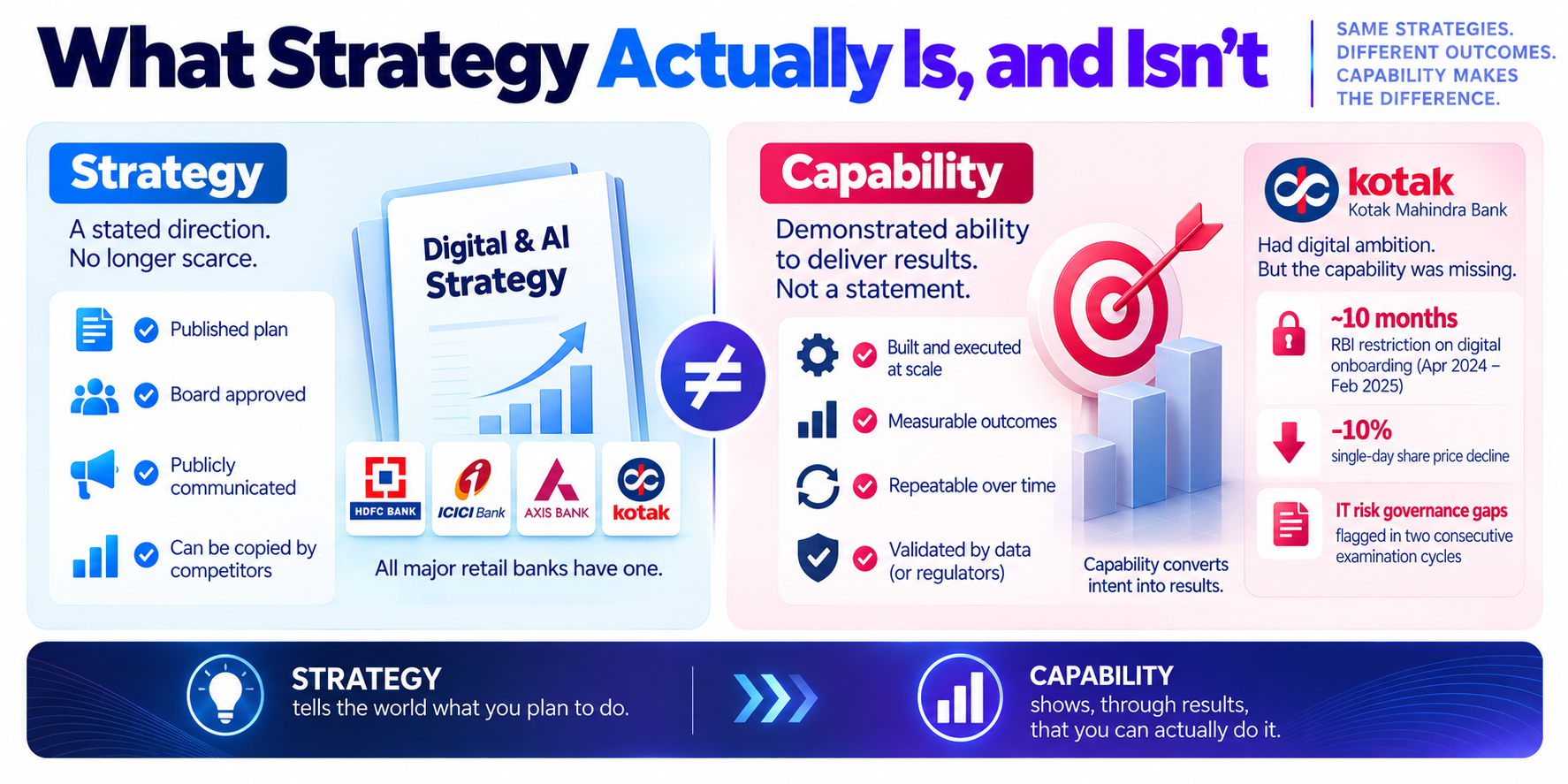
Every major retail bank in India now has a digital and AI strategy in the sense that matters to investors: a stated direction, board approval, and public communication. HDFC Bank, ICICI Bank, Axis Bank, and Kotak Mahindra Bank all disclosed digital and AI-related investment within the same reporting period. Strategy, in this sense, is no longer scarce. Every serious competitor in the industry has one, and a strategy is not something a rival can be prevented from copying; a competitor can read a published digital roadmap and announce a comparable ambition within a single earnings cycle.
Capability is different. It is not a statement of intent; it is the demonstrated, repeatable ability to convert that intent into a result, evidenced by data a bank cannot simply publish without first building it, or in Kotak Mahindra’s case, evidenced by a regulator confirming the opposite. RBI did not restrict Kotak Mahindra Bank because it lacked digital ambition. It restricted the bank because its IT risk and information security governance, the capability required to operate that ambition safely at scale, had not been built, despite two consecutive examination cycles flagging exactly that gap.
The Six Capabilities Are the Difference, Not the Six Strategies
Retail banking’s future depends on six organizational capabilities, spanning digital and AI-enabled banking, risk intelligence, innovation, ecosystem collaboration, outcome-oriented strategy, and governance leadership. Every one of the industry’s major players can, and does, write a strategy that references most or all six. Far fewer have built the underlying capability. HDFC Bank’s 1.36 crore employee training hours and 45,902 new hires in FY26 are not strategic statements; they are the digital and workforce capability, actually built, generating the results its Q1 FY27 margin turn depends on. Kotak Mahindra Bank’s restrictions were not lifted until February 2025, after a comprehensive external audit confirmed the underlying deficiencies had actually been fixed, real evidence of what rebuilding capability, rather than just announcing it, actually requires.
Strategy vs. Capability, Compared Directly
Dimension | Strategy | Capability |
Time to establish | Can be written, approved, and announced within a single quarter | Takes years to build; HDFC Bank’s workforce and digital capability reflects multiple years of sustained training and hiring investment |
Where it lives in the organization | Owned by a small leadership or strategy team, often independent of whether front-line operations have changed at all | Requires the workforce and control environment itself to change; HDFC Bank’s 1.36 crore training hours and 45,902 new hires show capability built at organizational scale, not announced from the top |
Copyability | A competitor can read and adopt the same public digital roadmap within an earnings cycle | Governance capability cannot be copied quickly; Kotak Mahindra Bank’s own restrictions took nearly ten months and a comprehensive external audit to lift, even once remediation began in earnest |
What it produces | A press release, an investor presentation, a stated digital ambition | A disclosed financial or regulatory result, such as HDFC Bank’s margin turning positive, or RBI’s confirmation that Kotak Mahindra Bank’s deficiencies were resolved |
How customers actually respond | A marketing campaign or new product launch drives initial account sign-ups; a stated ambition is often enough to get a customer in the door | Determines whether that customer stays; RBI's own Integrated Ombudsman Scheme recorded 9,34,355 banking-customer complaints in FY24, up 32.81% year on year, with complaints about loans and advances alone rising 42.70%, real evidence that customers notice quickly when a sale was strategy- and incentive-driven rather than genuinely matched to their needs |
Regulatory and compliance exposure | A compliance roadmap or a stated intent to meet governance standards | An actual, audit-validated control environment; RBI examined Kotak Mahindra Bank for two consecutive years before restricting it, then required an external audit before lifting the restriction |
What survives margin pressure | Often walked back or quietly deprioritized under cost pressure | Tends to compound and reinforce itself once built; HDFC Bank’s margin turn arrived after six quarters of sustained pressure, not despite it |
What happens when it stands alone | Investment that does not convert, as Kotak Mahindra Bank’s rising cost-income ratio despite comparable digital spending shows | A durable advantage that is hard for a competitor to close quickly, even after the strategy behind it becomes public |
The Real Cost of Strategy Without Capability
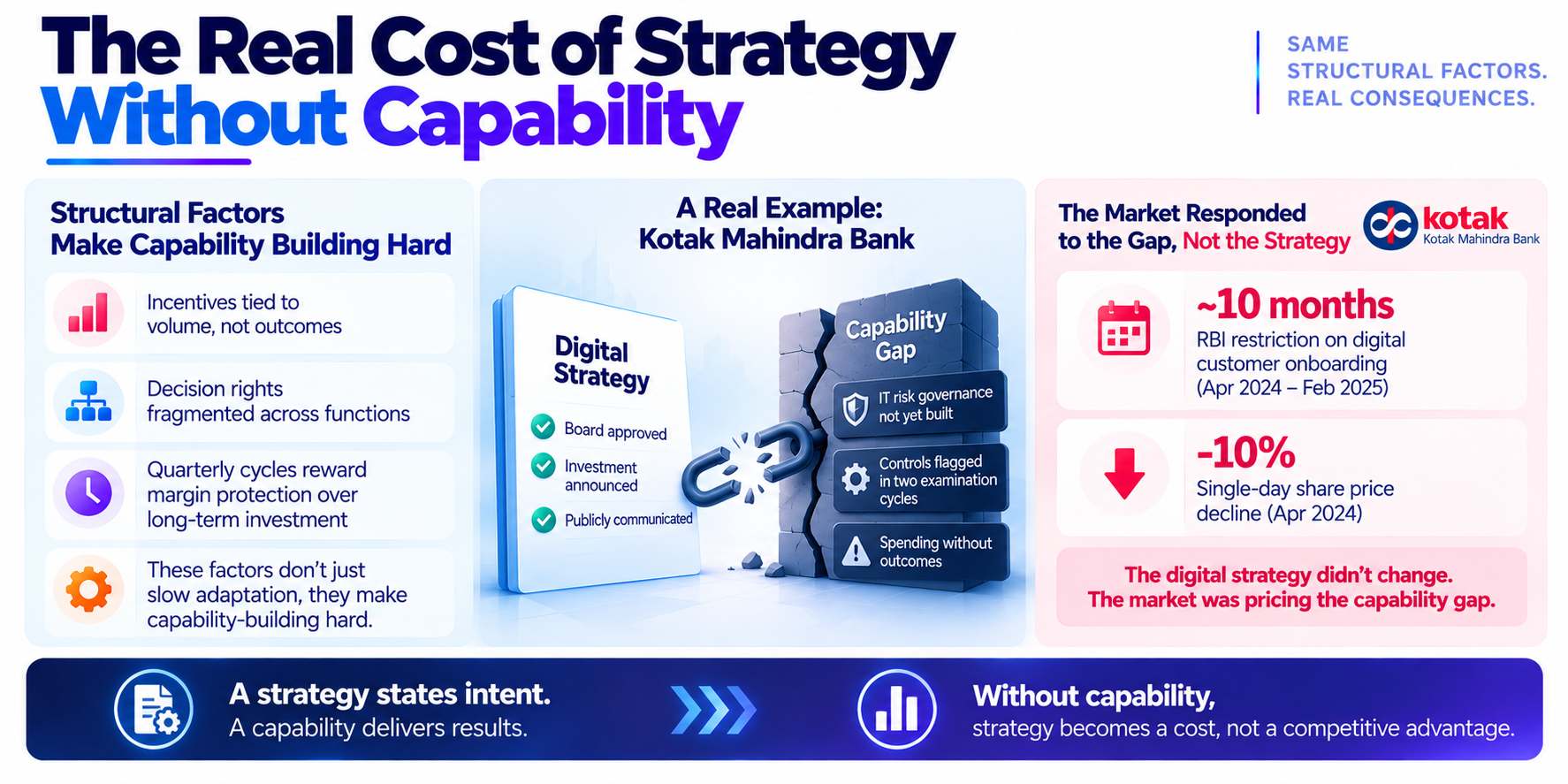
The structural factors that shape retail banking, incentive misalignment tied to volume rather than outcomes, decision rights fragmented across risk, compliance, and technology functions, quarterly reporting cycles that reward margin protection over multi-year investment, are not abstract organizational theory. They are the mechanism by which a real, board-approved digital strategy turns into a result like Kotak Mahindra’s: money spent, ambition stated, governance capability not yet built. A bank does not fail to convert strategy into capability because it lacks a strategy. It fails because the same structural factors that make adaptation hard also make capability-building hard, and a strategy document does nothing to fix any of them.
The market has already priced this distinction. Kotak Mahindra Bank’s shares fell 10% in a single day when RBI’s restriction was announced in April 2024, even though the bank’s digital strategy itself had not changed at all. The market was never pricing the strategy. It was pricing the gap between what the bank said and what its disclosed governance controls could prove.
What Guarantees the Future Is Buildable, Strategy Isn’t
• Measure digital investment by disclosed capability-conversion metrics, margin impact, audit outcomes, regulatory standing, not by the existence of a strategy document or press release.
• Treat a competitor’s published digital roadmap as free information, not a threat; what matters is whether a bank can build the governance capability behind it faster than the competitor can.
• Apply single-threaded governance ownership specifically to regulatory remediation, since diffused accountability is one of the structural factors most directly responsible for a governance gap going unaddressed across multiple examination cycles.
• Track the gap between digital investment and audit-confirmed governance readiness as a standing board-level metric, the same gap that separated HDFC Bank’s result from Kotak Mahindra Bank’s.
• Expect a rival’s strategy announcement and plan around it. Do not expect a rival’s capability and be surprised when it is not there yet; capability takes years, and sometimes a regulator’s intervention, even after a strategy becomes public.
This argument, that capability outlasts and outperforms strategy, is only useful if capability is buildable on purpose rather than assembled by accident, through a systematic, empirical framework for building these capabilities deliberately.
Executive FAQs
If Kotak Mahindra Bank had the same digital ambition as HDFC Bank, why did the outcomes diverge so sharply?
Because the ambition was never the differentiator. Both banks made sustained, multi-year public commitments to digital and AI investment. Only one had built the underlying governance capability to operate that investment safely at scale. RBI’s own examinations found IT governance deficiencies at Kotak Mahindra Bank for two consecutive years before restricting it, the exact signature of capability lagging behind stated ambition.
Doesn’t a strong digital strategy at least give a bank a head start?
A head start on what a competitor can read within a quarter is barely a head start at all. Every major Indian retail bank now discloses comparable digital and AI investment. The advantage that persisted through Kotak Mahindra Bank’s ten-month restriction was not who announced a digital strategy first. It was which bank’s governance controls a regulator was willing to certify.
Could Kotak Mahindra Bank have fixed this by writing a better strategy?
No. The bank’s problem was never a messaging gap; RBI’s own statement cited specific, technical deficiencies in IT inventory management, patch and change management, and business continuity, a capability-conversion problem no rewritten strategy document addresses. The fix ran through a comprehensive external audit and sustained remediation, not through better investor communication.
Is strategy worthless, then?
No, but it is table stakes, not a differentiator. Every serious competitor in this industry now has a stated digital strategy; the ones separating from the pack are the ones whose governance and delivery capability can actually support it. Strategy earns a bank the right to compete. Capability determines whether it keeps that right.
How long does it actually take for a strategy to become a capability?
Long enough that Kotak Mahindra Bank’s restrictions, first imposed in April 2024, were not lifted until February 2025, nearly ten months later, and only after a comprehensive external audit confirmed the deficiencies had actually been resolved. Capability compounds over years and audit cycles, not quarters, which is exactly why the gap between a stated strategy and a proven capability tends to widen before it closes, not the other way around.
References
1. Reserve Bank of India, supervisory action notice on Kotak Mahindra Bank Limited, April 24, 2024.
2. Reserve Bank of India, notice lifting restrictions on Kotak Mahindra Bank Limited, February 13, 2025.
3. Reserve Bank of India, Annual Report, FY2025–26.
4. Reserve Bank of India, Annual Report on the Reserve Bank – Integrated Ombudsman Scheme, FY2023–24.
5. HDFC Bank Ltd, Form 6-K, fiscal year 2026, U.S. Securities and Exchange Commission filing.
6. HDFC Bank Ltd, Q1 FY2027 earnings results and investor presentation, July–August 2026.
7. Kotak Mahindra Bank, Q1 FY2027 earnings results, August 2026.
8. Reporting on Kotak Mahindra Bank share price reaction, Indian financial media, April 2024.
9. National Payments Corporation of India (NPCI), UPI market share and transaction data, 2026.
Organization Learning Labs
Research & Insights Division


