Why Capability Beats Strategy in IT Services & Consulting

A $2.6B AI revenue run rate versus flat profit growth in the same quarter shows why capability, not strategy, determines who actually wins in IT services.
Why Capability Beats Strategy in IT Services & Consulting
The same quarter separated two Indian IT majors: one converted its AI investment into a $2.6 billion revenue run rate, the other watched comparable spending flatten its profit growth to near zero. The difference was never the strategy. Both companies had one.
EVIDENCE AT A GLANCE
$2.6B / 13.9% TCS’s Q1 FY27 annualised AI revenue run rate and reported revenue growth Source: TCS Q1 FY27 results, reported August 2026 | 0.6% Wipro’s Q1 FY27 net profit growth, as AI investment costs outpaced returns in the same quarter Source: Wipro Q1 FY27 results, reported August 2026 | 46%+ Decline in the combined market capitalization of India’s top five listed IT companies from their August 2024 peak to July 2026 Source: Indian financial media reporting on IT sector market capitalization, July 2026 |
$300–400B Infosys’s own estimate of the global AI services market opportunity by 2030 Source: Infosys press release, February 2026 | 80,000+ Employees Infosys has deployed on AI coding tools as part of its AI-augmented engineering practice Source: Infosys Form 6-K, Q1 FY2027 | 12,000 / ~2% Roles TCS reduced in 2026, citing a structural skills mismatch rather than falling client demand Source: Reuters, TCS workforce restructuring coverage, July 2026 |
$960M Honda’s estimated FY2026 operating profit impact from semiconductor shortages tied to the Nexperia export dispute Source: Honda FY2026 financial guidance | ~32% Decline in the Nifty IT index across 2026, even as the broader market rose Source: NSE Nifty IT index performance data, 2026 | 20–38% Salary premium Indian technology employers are paying for AI-literate hires Source: 1Finance data, reported via Business Standard, July 2026 |
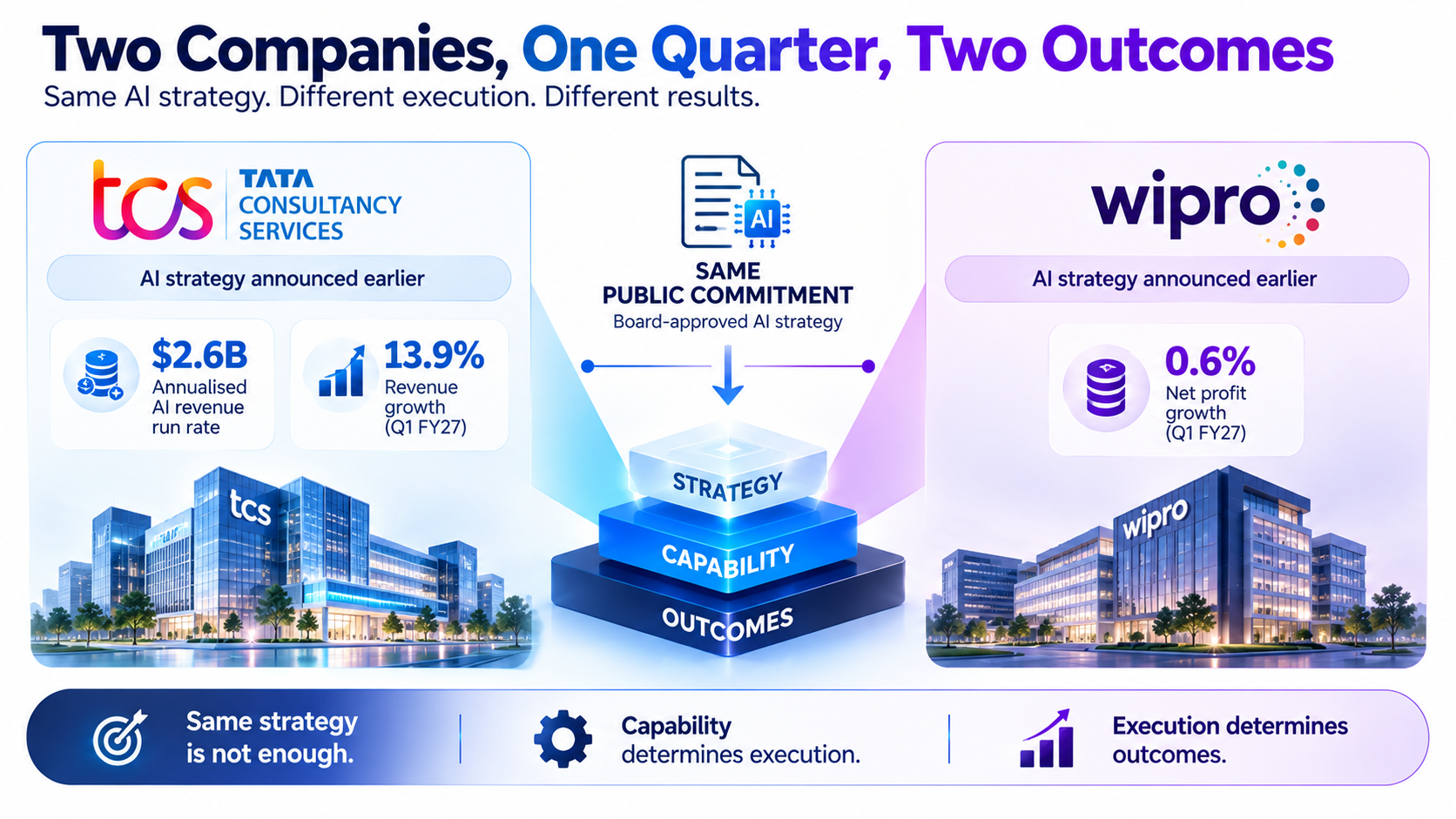
Two Companies, One Quarter, Two Outcomes
In the quarter ending June 2026, Tata Consultancy Services and Wipro both reported results built on the same public commitment: a stated, board-approved AI strategy, communicated to investors well over a year earlier. TCS closed the quarter with a $2.6 billion annualised AI revenue run rate and 13.9% revenue growth. Wipro closed the same quarter with net profit up just 0.6%, its own results showing AI investment costs outpacing the returns those investments were generating. Both companies had a strategy. Only one had built the capability to convert it into revenue.
This is not a story about one company outspending another. It is evidence for the argument this article makes directly: capability, not strategy, is what determines whether an organization’s stated direction ever becomes its actual result. The distinction is not academic. It is the difference between $2.6 billion in disclosed, monetized AI revenue and a profit line that comparable AI investment could not move.
What Strategy Actually Is, and Isn’t
Every major IT services organization now has an AI strategy in the sense that matters to investors: a stated direction, board approval, and public communication. Infosys has its AI First Value Framework, targeting a share of an estimated $300 billion to $400 billion global AI services market by 2030. TCS, Infosys, Wipro, and HCL Technologies all disclosed AI-related investment and positioning in their FY27 first-quarter results within weeks of each other. Strategy, in this sense, is no longer scarce. Every serious competitor in the industry has one, and a strategy document is not something a rival can be prevented from copying; a competitor can read a published framework, adopt the same language, and announce a comparable ambition within a single earnings cycle.
Capability is different. It is not a statement of intent; it is the demonstrated, repeatable ability to convert that intent into a result, evidenced by data a company cannot simply publish without first building it. TCS’s $2.6 billion AI revenue run rate is not a claim, it is a disclosed financial result. Wipro’s flat profit growth despite comparable investment is also a disclosed financial result, and it shows precisely what happens when the investment exists without the capability to convert it.
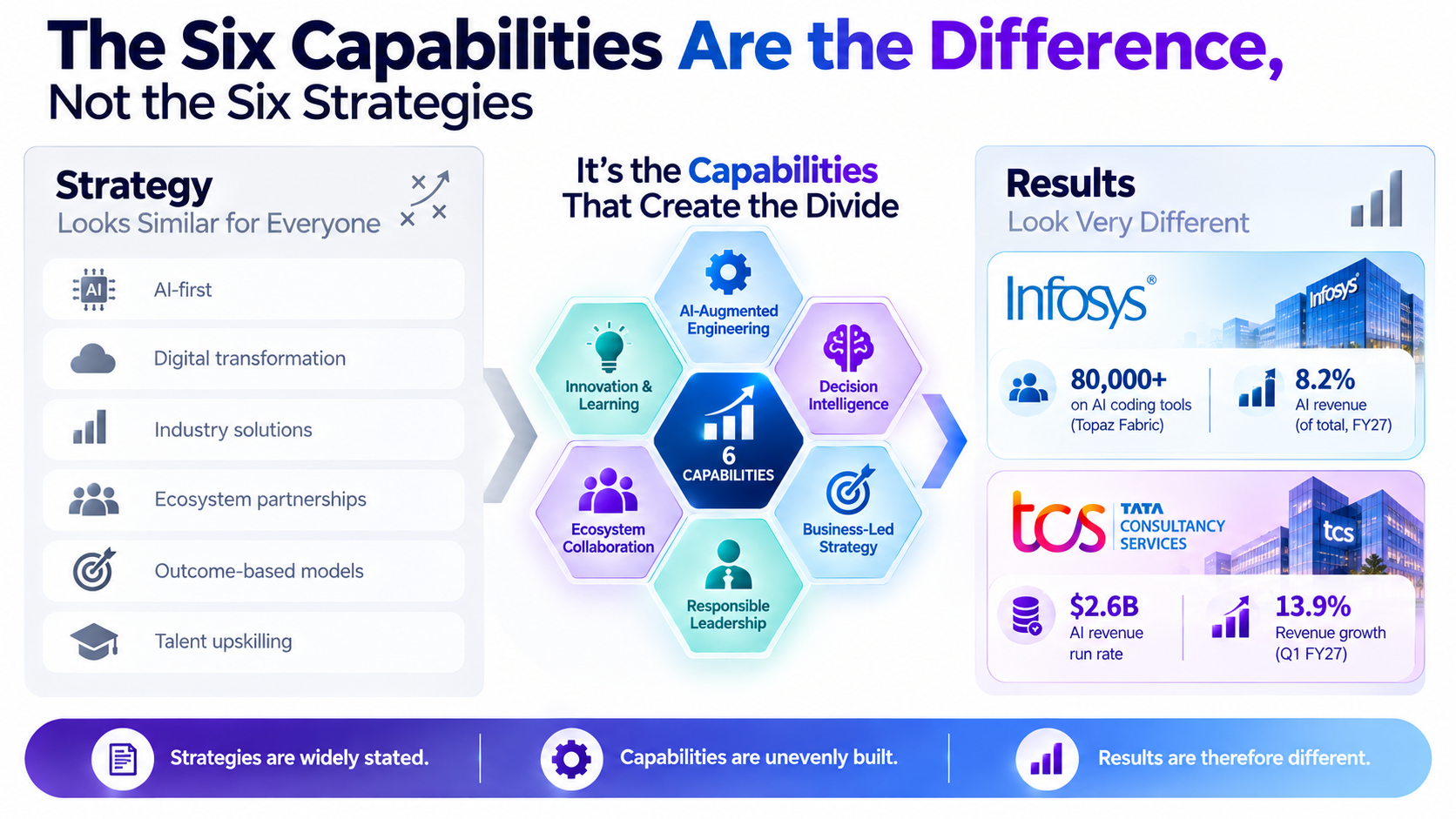
The Six Capabilities Are the Difference, Not the Six Strategies
IT services and consulting organizations that will separate from the rest need six organizational capabilities, spanning engineering, decision-making, innovation, collaboration, strategy, and leadership. Every one of the industry’s major players can, and does, write a strategy that references most or all six. Far fewer have built the underlying capability. Infosys’s Topaz Fabric platform and its 80,000-plus employees on AI coding tools are not strategic statements; they are the AI-augmented engineering capability, actually built, generating the delivery data its commercial pitch depends on. TCS’s $2.6 billion run rate is not a strategy either; it is business-led, outcome-oriented strategy, actually converting.
Strategy vs. Capability, Compared Directly
Five dimensions understate the difference. A holistic comparison has to cover not just how each is produced, but who inside the organization has to change, how the market outside it actually responds, and what a regulator will and won’t accept as proof.
Dimension | Strategy | Capability |
Time to establish | Can be written, approved, and announced within a single quarter | Takes years to build and compounds across multiple capabilities, not one, as the pattern across Honda, TCS, and Infosys shows |
Where it lives in the organization | Owned by a small leadership or strategy team, often independent of whether the rest of the organization has changed at all | Requires the delivery workforce itself to change; Infosys deployed AI tooling to more than 80,000 employees, and Nasscom reports more than two million professionals upskilled industry-wide, evidence that capability is built at workforce scale, not announced from the top |
Copyability | A competitor can read and adopt the same public framework within an earnings cycle | Amazon’s single-threaded leadership model has been publicly documented in a bestselling book since 2021; few competitors have actually replicated the practice, because the description is copyable and the practice is not |
What it produces | A press release, an investor presentation, a stated ambition | A disclosed financial result, such as TCS’s $2.6 billion AI revenue run rate |
How clients actually respond | Wins the initial pitch and the RFP shortlist; a stated ambition is often enough to get an organization into the room | Wins the renewal and the expansion; Infosys reports collaborating with 90% of its top 200 clients on AI journeys and running more than 4,600 live projects, engagement built on delivered work, not a first pitch |
Regulatory and compliance exposure | A compliance roadmap or a stated intent to meet requirements by a given date | An actual, audit-ready system; the EU AI Act’s August 2026 high-risk obligations require completed conformity assessments and a real AI system inventory, not a plan to build one |
What survives margin pressure | Often walked back under pressure; Wipro itself guided for roughly -1% to 1% sequential constant-currency growth the following quarter, a real pullback from earlier ambitions, as AI investment costs weighed on margins | Tends to compound and reinforce itself once multiple capabilities are in place together |
What happens when it stands alone | Investment that does not convert, as Wipro’s flat Q1 FY27 profit growth despite comparable AI spending shows | A durable advantage that is hard for a competitor to close quickly, even after the strategy behind it becomes public |
The Real Cost of Strategy Without Capability
Structural factors like these, incentive misalignment tied to utilization rather than outcomes, decision rights fragmented across business units, quarterly reporting cycles that reward margin protection over multi-year investment, are not abstract organizational theory. They are the mechanism by which a real, board-approved AI strategy turns into a result like Wipro’s: money spent, strategy stated, capability not yet built. An organization does not fail to convert strategy into capability because it lacks a strategy. It fails because the same structural factors that make adaptation hard also make capability-building hard, and a strategy document does nothing to fix any of them.
This is also why the market has stopped rewarding strategy announcements on their own. India’s top five listed IT companies lost more than 46% of their combined market capitalization between August 2024 and July 2026, even as nearly every one of them had a public AI strategy in place for most of that period. The market was never pricing the strategies. It was pricing the gap between what each company said and what each company’s disclosed results could prove.
What Guarantees the Future Is Buildable, Strategy Isn’t
• Measure AI investment by disclosed capability-conversion metrics, revenue run rate, delivery data, margin impact, not by the existence of a strategy document or press release.
• Treat a competitor’s published strategy as free information, not a threat; what matters is whether an organization can build the capability behind it faster than the competitor can.
• Apply single-threaded governance and outcome-based commercial architecture specifically to strategy execution, since these are two of the structural factors most directly responsible for investment that does not convert.
• Track the gap between AI investment and AI revenue run rate as a standing board-level metric, the same gap that separated TCS’s result from Wipro’s in a single quarter.
• Expect a rival’s strategy announcement and plan around it. Do not expect a rival’s capability and be surprised when it is not there yet; capability takes years even after a strategy becomes public.
This argument, that capability outlasts and outperforms strategy, is only useful if capability is buildable on purpose rather than assembled by accident, through a systematic, empirical framework for building these capabilities deliberately.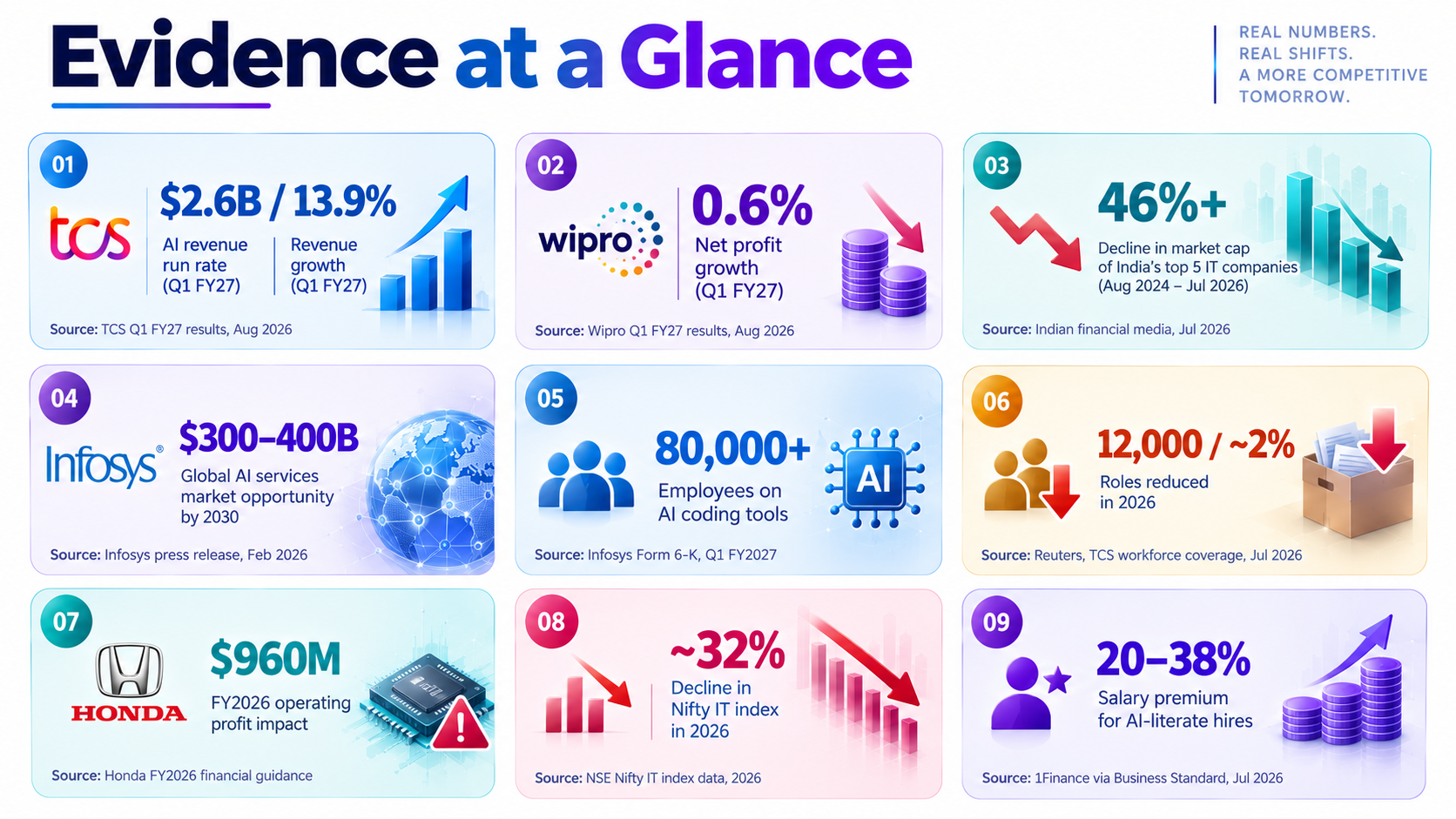
Executive FAQs
If Wipro announced an AI strategy similar to TCS’s, why did the results diverge so sharply in one quarter?
Because the strategy was never the differentiator. Both companies made a public, board-approved commitment well over a year before this quarter’s results. Only one had built, or built fast enough, the underlying delivery capability to convert AI investment into monetized revenue. Wipro’s own results show the investment cost outpacing the return, the exact signature of capability lagging behind strategy.
Doesn’t a strong strategy at least give an organization a head start?
A head start on what a competitor can read within a quarter is barely a head start at all. Infosys’s AI First Value Framework became public in February 2026; within months, TCS, Wipro, and HCL Technologies had all disclosed comparable strategic positioning. The advantage that persisted through the year was not who announced first. It was who converted the announcement into a disclosed result.
Could Wipro fix this by writing a better strategy?
No. Wipro’s Q1 FY27 result was not a messaging problem; it was AI investment cost outpacing returns, a capability-conversion problem no rewritten strategy document addresses. The fix runs through structural factors like incentive design, decision rights, and commercial architecture, not through better positioning language.
Is strategy worthless, then?
No, but it is table stakes, not a differentiator. Every serious competitor in this industry now has a stated AI strategy; the ones separating from the pack are the ones whose capability can actually cash it. Strategy earns an organization the right to compete. Capability determines whether it wins.
How long does it actually take for a strategy to become a capability?
Long enough that Wipro’s Q1 FY27 result, reported the same month as TCS’s, still showed a gap despite both companies pursuing AI strategies for well over a year. Capabilities like these compound over years, not quarters, which is exactly why the gap between a stated strategy and a converted capability tends to widen before it closes, not the other way around.
References
1. Reporting on Tata Consultancy Services, Infosys, Wipro, and HCL Technologies Q1 FY27 results, Indian financial media, August 2026.
2. Reporting on Indian IT sector market capitalization decline, Indian financial media, July 2026.
3. Infosys, "Infosys Unveils AI First Value Framework," press release, February 2026.
4. Infosys Ltd, Form 6-K, fiscal year 2026, U.S. Securities and Exchange Commission filing.
5. Colin Bryar and Bill Carr, Working Backwards: Insights, Stories, and Secrets from Inside Amazon, St. Martin’s Press, 2021.
6. Nasscom, "Technology Sector in India: Strategic Review 2026," February 2026.
7. Reuters, reporting on Tata Consultancy Services workforce restructuring, July 2026.
8. Honda Motor Co., FY2026 financial guidance on semiconductor-related operating profit impact, cited in 2026 supply chain analysis.
9. National Stock Exchange of India, Nifty IT index performance data, 2026.
10. 1Finance salary premium data for AI-literate technology roles, reported via Business Standard, July 2026.
Organization Learning Labs
Research & Insights Division


