Warehouse and Fulfilment Capability Building Guide

A leadership guide to building warehouse and fulfilment capability through lean practice, WMS-led execution, and frontline upskilling for the decade ahead.
Turning Sheds into Engines: Building Warehouse and Fulfilment Capability Through Lean Discipline, Digital Tools, and Frontline Skill
Why Warehousing Has Become a Capability Question, Not a Real Estate Question
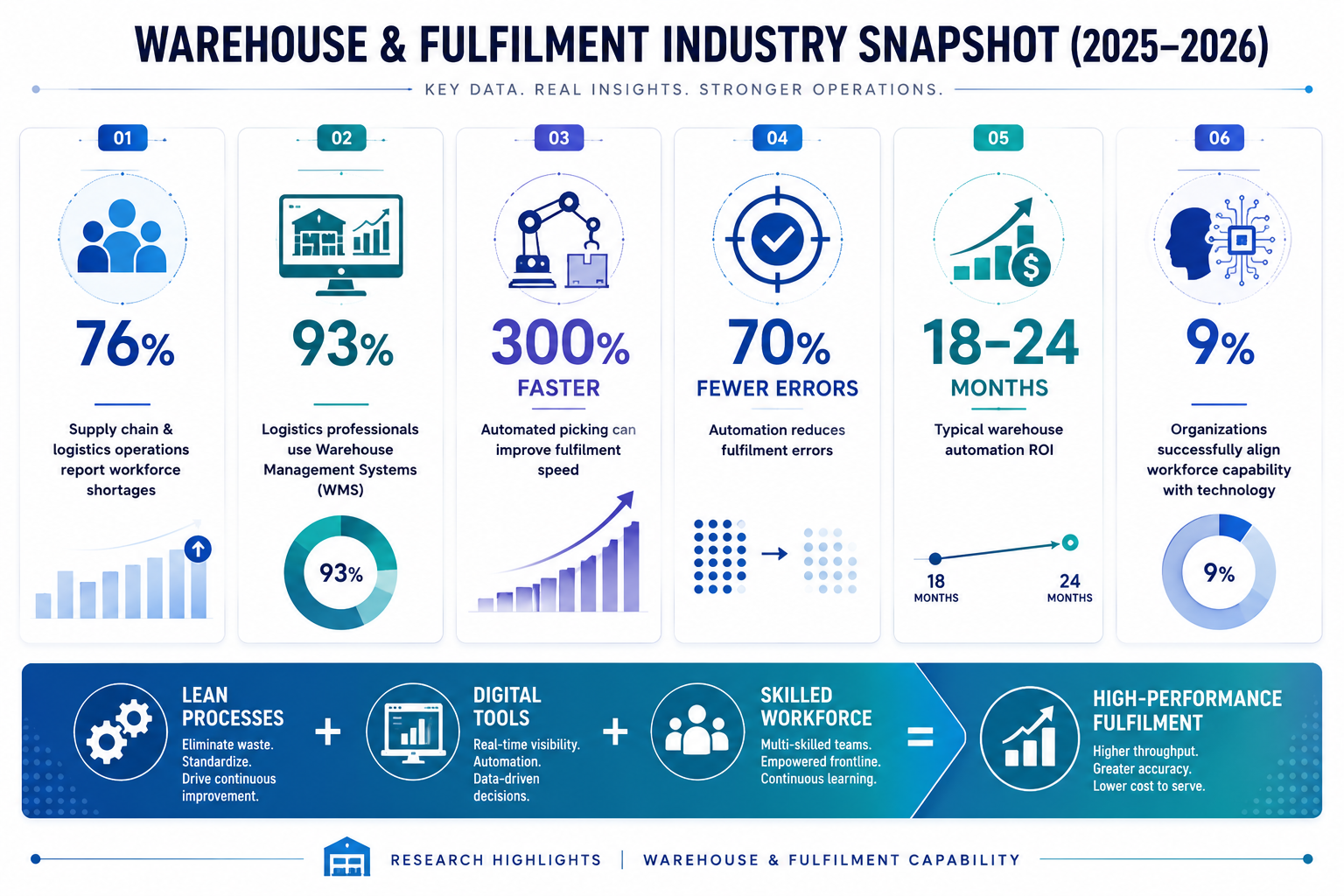
Warehousing used to be judged on square footage and location. It is now judged on throughput, accuracy, and the speed with which a facility can absorb a 500 percent seasonal volume spike without its cost structure collapsing. The global warehouse automation market is projected to grow from roughly 30 billion dollars in 2025 toward figures ranging from 60 billion to more than 100 billion dollars by the early 2030s depending on the forecasting house, and by 2026 nearly 4.7 million commercial warehouse robots are expected to be installed across more than 50,000 facilities worldwide. Yet the capital flowing into automation only pays off where the underlying operating system, layout, standard work, inventory discipline, and people, is already sound. Capital without capability is simply an expensive way to automate a badly designed process.
76% of supply chain and logistics operations report notable workforce shortages, with warehouse operations among the hardest hit. Descartes Systems Group, 2024, cited in MHI Annual Industry Report, 2025 |
Core Capability Elements of a Modern Fulfilment Operation
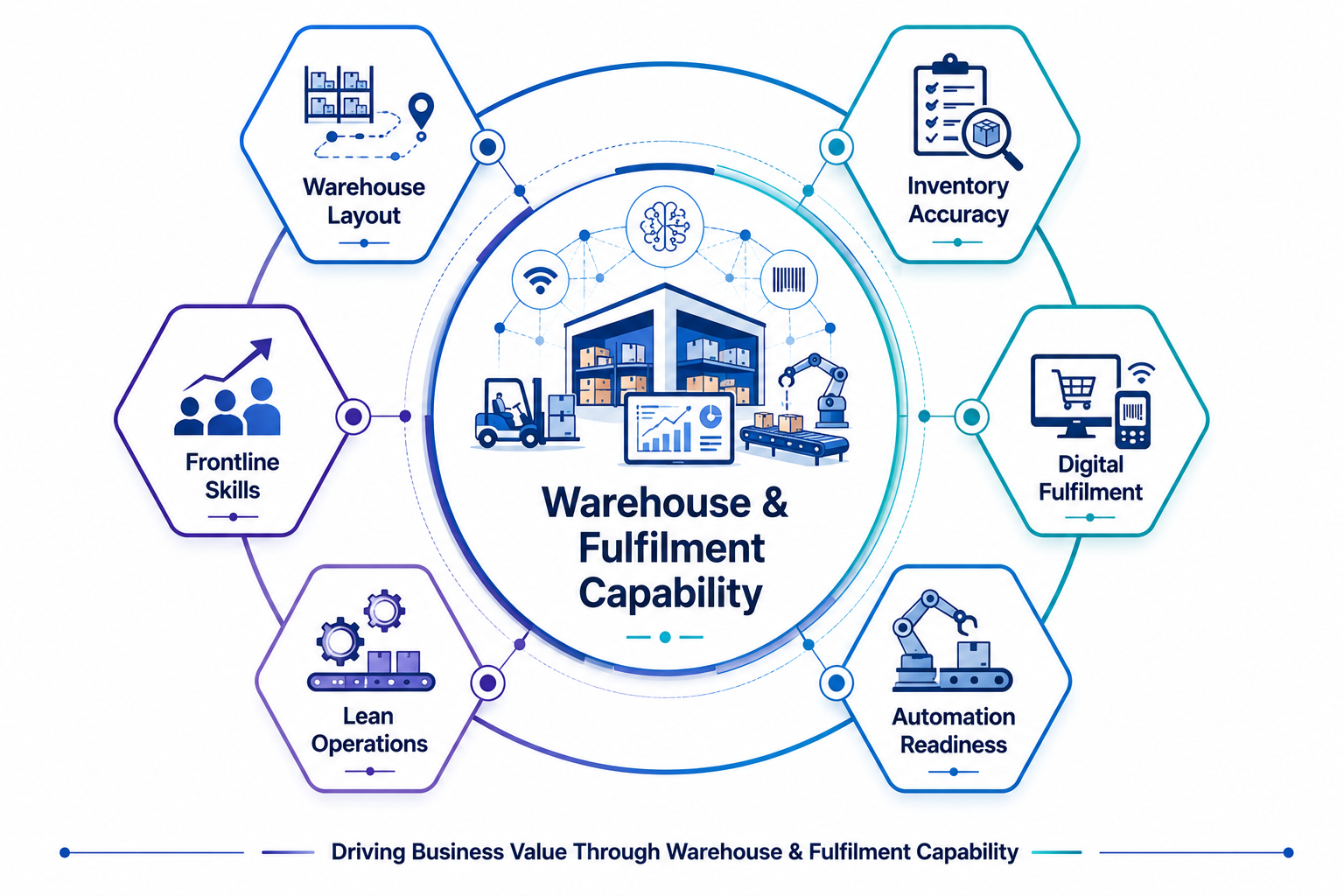
Slotting, Layout Design, and Standard Work
Slotting and layout decisions compound daily; a poor pick path costs the same avoidable minutes on every single order for the life of the layout. Facilities that treat slotting as a one-time design exercise rather than a living discipline consistently underperform those that revisit it against actual velocity data on a fixed cycle. Standard work for receiving, put-away, picking, packing, and dispatch is the connective tissue that makes a facility’s performance repeatable across shifts rather than dependent on which supervisor is on the floor. Goods-to-person systems that eliminate unproductive employee travel have delivered pick-path reductions of up to 60 percent in some operations, but only where the underlying process design, not just the hardware, was reworked alongside the technology.
Inventory Accuracy and Cycle Counting
Inventory accuracy is the quiet capability that determines whether every other investment in the warehouse pays off. Reliance on paper-based picking has dropped to 44 percent industry-wide after remaining in the mid-50 percent range for years, and 93 percent of logistics professionals now use a warehouse management system, reflecting a genuine shift toward software-led, data-driven execution as the operational baseline rather than the exception.
Digital Tools: WMS, Scanners, RFID, and Automation
Automated picking systems can improve order fulfilment speeds by up to 300 percent and reduce fulfilment errors by as much as 70 percent, and most organizations report achieving return on automation investment within 18 to 24 months with efficiency gains often exceeding 20 percent. But 48 percent of warehouses still cite high implementation cost and integration complexity as their primary barrier to automation, which is exactly why a phased rollout, starting with the highest-impact process such as picking or inventory management, consistently outperforms a full-facility overhaul attempted in a single step.
Practical Lean and Kaizen Practices That Build Daily Capability
Technology delivers its promised return only inside a facility that already runs on visible, disciplined process management. The lean practices that consistently distinguish high-performing fulfilment operations are neither exotic nor expensive to introduce:
- 5S discipline on the floor, paired with visual management boards that make flow and bottlenecks visible to every shift, not just to the facility manager.
- Daily stand-ups organized around safety, quality, and productivity, held at the same time and same location so they become routine rather than an occasional check-in.
- Small, continuously tested changes, such as pick-path redesign or label standardization, tracked for measurable impact rather than adopted on assumption.
- A visible link between floor-level Kaizen suggestions and actual process changes, so frontline staff see their input change how the facility runs.
Frontline Skills and Learning as a Capacity Strategy
With 41 percent of warehouse managers reporting an inability to attract and retain workers, and talent shortages rated extremely challenging by roughly half of surveyed operators, multi-skilling has moved from a resilience nice-to-have to a core capacity strategy. A worker trained across picking, packing, and inventory functions gives a facility manager the flexibility to absorb demand spikes and absenteeism without immediately reaching for costly flex labor. Short, on-the-job learning modules paired with buddy systems consistently outperform classroom-only onboarding for warehouse roles, both on time-to-productivity and on retention. A simple capability ladder, mapping the skills required to progress from entry-level picker through multi-skilled operator to shift lead, gives frontline staff a visible growth path and gives operations leaders a structured basis for promotion decisions rather than tenure-based defaults.
Unlock the Full Research
Create a free account or sign in to access the complete methodology, deep-dive analysis, and key implementation frameworks.
Don't have an account? It's free to join.
Organization Learning Labs
Research & Insights Division


Comments