Urban Logistics Network Design Capability

A leadership guide to building urban logistics capability for congestion, low-emission zones, curb access, and hyper-local city delivery through 2035.
Cities as Systems: Building Urban Logistics Capability for Congestion, Regulation, and Hyper-Local Service
Why the City Itself Has Become the Design Problem
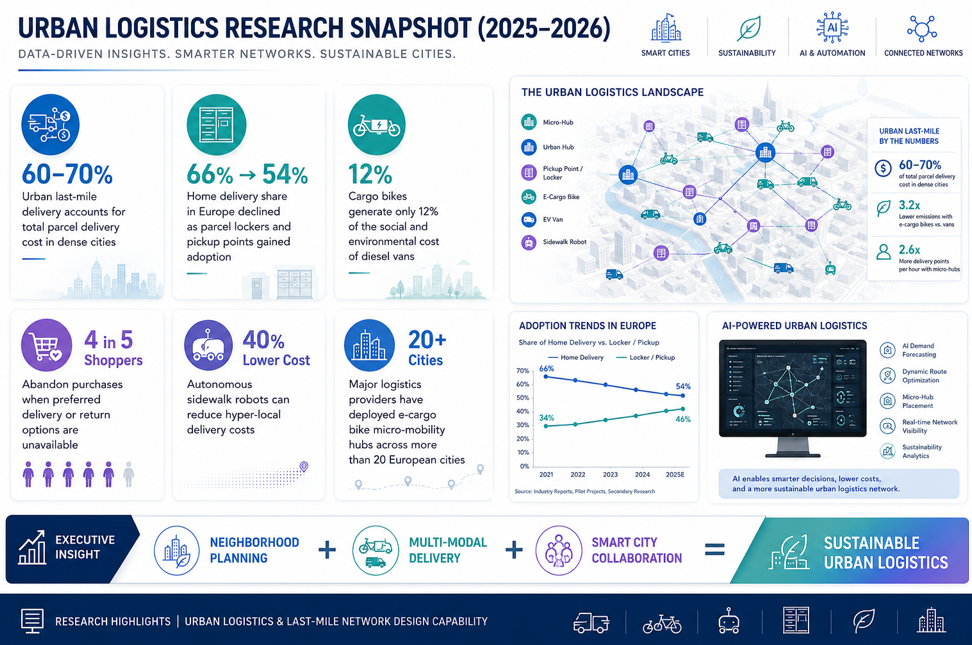
Urban delivery has quietly become the most expensive, most regulated, and least forgiving segment of the entire logistics network. The final few kilometers now account for roughly 60 to 70 percent of total parcel delivery cost in dense urban markets, and the pressure is intensifying from two directions simultaneously: customer behavior is fragmenting away from home delivery, with home’s share of European deliveries falling from 66 to 54 percent in a single year as lockers and pickup points gain share, while regulators are simultaneously tightening low- and zero-emission zone rules, curb-space management, and CO2 standards for heavy-duty vehicles. Organizations still running a single, undifferentiated urban delivery model, one truck type, one routing logic, one delivery window structure, are trying to solve a increasingly complex, city-specific design problem with a single-city-fits-all answer.
The last few kilometers of urban delivery account for roughly 60-70% of total parcel delivery cost in dense cities. nShift, "Last-Mile Innovation in Urban Logistics," 2026 |
Capability Elements for Operating Inside the Urban System
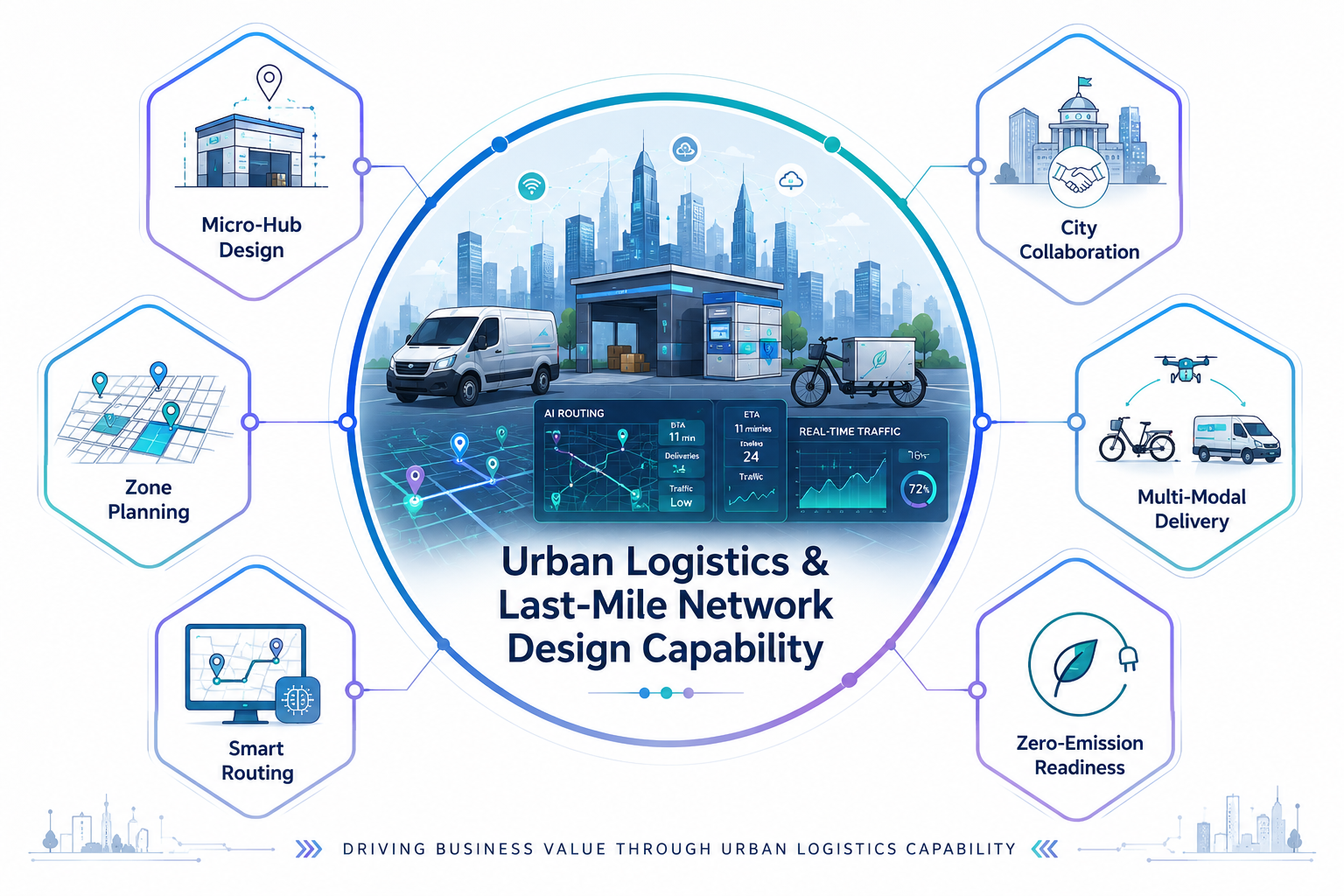
Micro-Hub and Zone Design, Time-Window Management, Consolidation
Micro-logistics hubs, small consolidation points positioned at the edge of or within dense urban cores, are becoming the structural answer to the collision between rising delivery volume and shrinking vehicle access. Cities are increasingly partnering directly with logistics operators to establish these hubs specifically to reduce freight emissions and congestion, routing freight through suburban or edge-of-city consolidation points and then completing the final leg with smaller electric vehicles or cargo bikes. Designing this network correctly requires zone-level demand mapping, not city-wide averages, since delivery density, access restrictions, and curb availability vary block by block within the same city.
Understanding City Regulations, Permits, and Low-Emission Zones
Regulatory fragmentation is one of urban logistics’ defining operational challenges. Idling rules, emissions standards, noise ordinances, and delivery-time restrictions can vary block by block and city by city, meaning fleets moving through multiple jurisdictions on a single route face a constantly shifting compliance target. Zero-emission delivery zones, areas permitting unrestricted access only to zero-emission vehicles, are expanding across US and European cities, and research into their implementation has found a specific equity gap worth planning for directly: zero-emission zone rollout has so far lagged in the neighborhoods most heavily affected by freight activity, meaning organizations that engage proactively with under-served districts, rather than waiting for regulation to catch up, will be better positioned as enforcement expands.
Working With Alternative Modes: Cargo Bikes, EV Vans, and Lockers
Alternative delivery modes have moved from pilot curiosity to measurable operational tool. Cargo bikes carry an estimated total social and environmental cost of only about 12 percent that of a diesel van, and can access bike lanes, pedestrianized streets, and closed roads unavailable to standard vehicles, though their smaller payload and coverage area mean they complement rather than replace vehicle fleets for most delivery profiles. Out-of-home options are scaling in parallel: parcel lockers and pickup points are seeing rapid growth in usage for both deliveries and returns, and nearly four in five shoppers report abandoning a purchase when their preferred delivery or return option is missing, which means locker and pickup-point network design has become a genuine conversion and retention lever, not just a cost-reduction tactic.
Practical Tools and Routines for Urban Operations
Urban logistics capability is built through granular, neighborhood-level operating discipline rather than city-wide policy alone:
- Regular mapping of delivery performance by neighborhood, not just by city, since density, access rules, and failure rates can vary as sharply within a city as they do between cities.
- Structured collaboration with city authorities and landlords for improved loading-zone access, curb management, and building-level delivery infrastructure, rather than treating each access negotiation as a one-off.
- Active experimentation with new urban delivery models, lockers, cargo bikes, micro-hubs, with performance tracked rigorously enough to know which model actually reduces cost and which merely shifts it elsewhere.
- Digital curb-space and time-slot coordination with city platforms, positioning the organization ahead of the accurate ETA and geofenced-event data standards cities are increasingly requiring.
Talent and Learning: Building Urban Logistics Judgment
Unlock the Full Research
Create a free account or sign in to access the complete methodology, deep-dive analysis, and key implementation frameworks.
Don't have an account? It's free to join.
Organization Learning Labs
Research & Insights Division


Comments