The Structural Drivers Reshaping Retail Banking Organizations

Fraud, regulation, and technology are reshaping retail banking faster than most planning cycles. What structurally separates the banks moving with them.
The Structural Drivers Reshaping Retail Banking Organizations
Technology, fraud, and regulatory forces are moving faster than most banks’ planning cycles. What separates the ones moving with these drivers from the ones falling behind is not information; it is structure.
EVIDENCE AT A GLANCE
65–70% vs ~1% First-year commission a bank earns selling an insurance policy across the counter, against roughly 1% on a mutual fund, the real gap RBI’s 2026 rules target Source: RBI Responsible Business Conduct (Second Amendment) Directions, June 2026 | ₹48,021 Cr RBI-reported bank fraud losses in FY26, up 46% even as the number of fraud cases fell Source: RBI Annual Report, FY26 | 85% Share of FY26 fraud value concentrated in loan and advances fraud that cleared origination review Source: RBI Annual Report, FY26 |
80%+ Combined UPI transaction volume share held by PhonePe and Google Pay Source: NPCI data, 2026 | Dec 31, 2026 NPCI’s repeatedly delayed deadline for its 30% market-share cap on individual UPI apps Source: NPCI, 2026 | 48.5% Kotak Mahindra Bank’s Q1 FY27 cost-income ratio, up as it accelerated digital-infrastructure investment not yet converted to margin Source: Kotak Mahindra Bank Q1 FY27 results, August 2026 |
6 quarters Consecutive quarters of margin pressure before HDFC Bank's NIM turned positive Source: HDFC Bank Q1 FY27 results, August 2026 | –15% vs +22% Year-on-year change in overall banking-sector hiring versus AI/ML-specific hiring in India, May 2026 Source: Choice Institutional Equities, India Hiring Pulse, May 2026 | ₹674 Cr Interest misstatement IndusInd Bank's audit found in its microfinance book Source: IndusInd Bank stock exchange disclosure and reporting, May 2025 |
Reading the Same Signals
India’s retail banking industry closed the same reporting week in which HDFC Bank’s net interest margin turned positive after six consecutive quarters of pressure with a very different signal from the regulator: RBI’s FY26 annual report shows bank fraud cases fell to 10,114, down from 23,722 the year before, yet total losses surged 46% to ₹48,021 crore. None of this happened because banks failed to notice AI, fraud, or fintech competition; the underlying forces are well documented. It happened because recognizing a driver and moving at its speed are two different things, and both the regulator’s own data and the market have already priced the difference.
Eight drivers and the six organizational capabilities that respond to them define the terrain reshaping retail banking. What determines how fast a given bank moves across that terrain is not whether its leadership has read the RBI’s reports. It is a set of structural factors inside the organization itself, and in a few cases, outside it.
Three Forces Moving Faster Than Planning Cycles
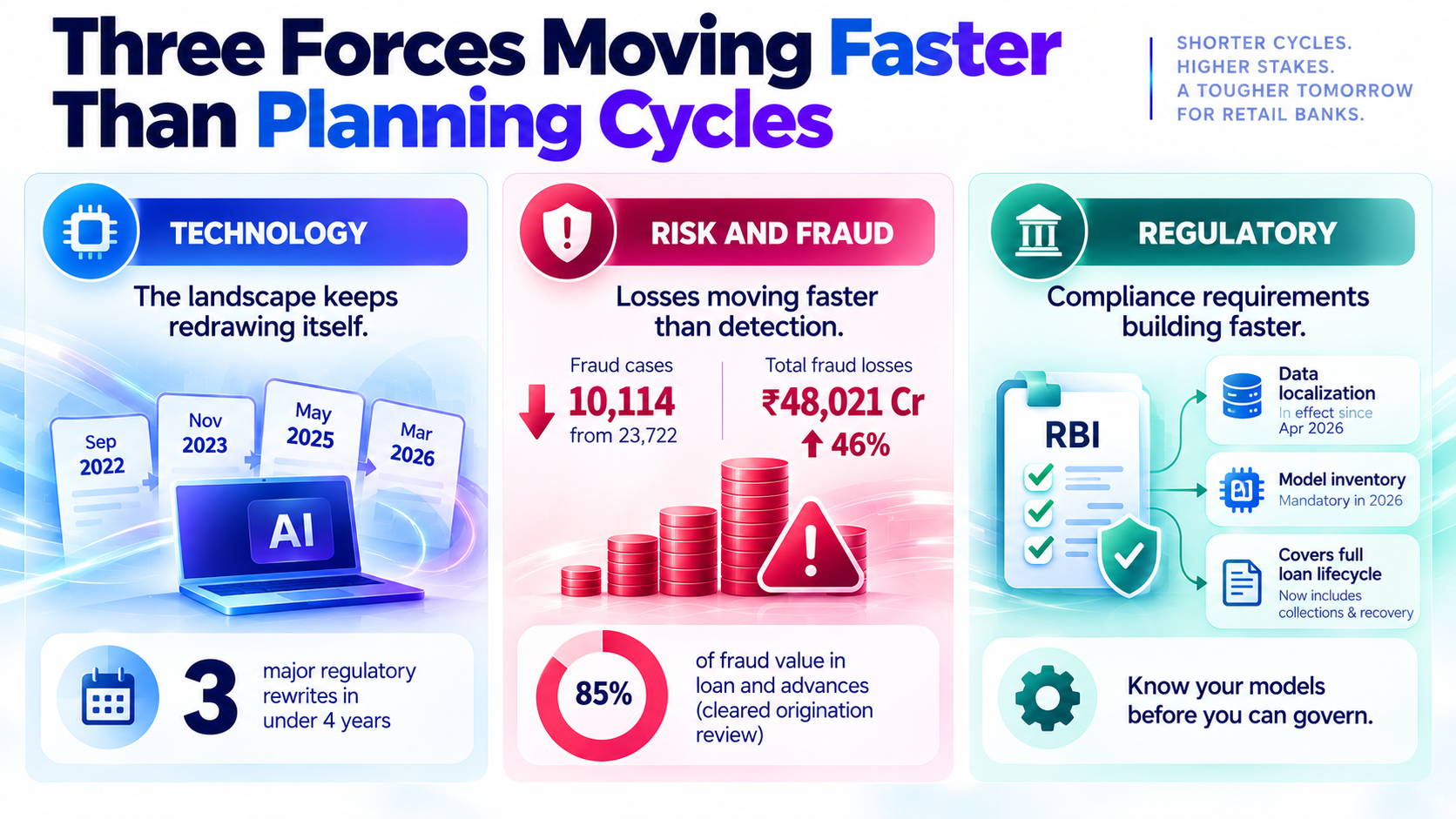
Technology, risk, and regulatory change are not simply difficult. Each is moving on a cycle materially shorter than the planning and budgeting cycles most retail banks still run on, which means a plan built to today’s conditions is frequently outdated before it finishes being implemented.
Technology: The Landscape Keeps Redrawing Itself
RBI’s Digital Lending Directions, issued in May 2025, replaced both the original September 2022 guidelines and the November 2023 DLG Directions in a single consolidation, then were followed by a further Master Direction supplement in March 2026. That is three major regulatory rewrites in under four years, each one extending AI governance obligations further across the loan lifecycle, most recently into collections and recovery. A bank that built its 2024 compliance plan around the original 2022 guidelines has already been through two full rewrites of the ground it was standing on.
Risk and Fraud: Losses Moving Faster Than Detection
RBI’s FY26 annual report describes a pattern that should worry every risk officer more than a rising headline total would: fraud cases fell sharply, but the value lost per incident rose so much that total losses still climbed 46%. Eighty-five percent of that value sits in loan and advances fraud, cases that cleared origination review, meaning a document was checked and approved before the loss was ever recorded. Threshold-based fraud detection, built to flag unusual transaction amounts, was designed for the digital-payment fraud pattern that is actually shrinking, not the shell-company and synthetic-borrower pattern that is now driving the losses.
Regulatory: Compliance Requirements Building Faster Than Implementation Cycles
RBI’s data localization mandate, in full effect since April 2026, requires every regulated lender to store borrower data on servers within India and prohibits transfer abroad without explicit approval. The same regulatory wave introduced a baseline expectation for 2026: a complete model inventory covering every AI system and scoring model that touches a lending or recovery decision, with documented approval history and validation evidence for each one. The compliance burden illustrates the mismatch directly: a bank must first know precisely which models it runs before it can validate, document, or govern any of them, and most banks were not built with that kind of live inventory as a standing discipline.
What Determines the Pace of Building Each Capability
The three drivers above are the ones with the clearest external, dated evidence trail, which is why they anchor this article. They are not, however, the whole picture. Organizational strategy and governance capability, not the drivers themselves, is what a bank actually builds, and the pace of building it varies sharply across each of the six capabilities.
Organizational Capability | What Determines the Pace |
Digital, AI-Enabled & Customer-Centric Banking | Adoption has outpaced engineering and governance discipline; most banks remain between pilot and enterprise-wide practice rather than having scaled AI-led personalization into a tracked, margin-grade discipline |
Enterprise Risk Intelligence & Responsible Decision-Making | Regulatory pressure is forcing documented, evidence-based decisions faster than most banks have built the review structures or model inventories to produce them |
Continuous Innovation & Adaptive Banking | Treated as a discretionary cost rather than a protected pipeline, so it is usually the first line item cut under quarterly margin pressure |
Integrated, Ecosystem-Enabled & Customer-Responsive Collaboration | Responding to fintech and NPCI-governed payment dominance means collaborating with, not just competing against, entities most banks still treat purely as threats |
Business-Led Banking Strategy & Outcome-Oriented Service | Covered in depth below: the gap between stated digital-first strategy and disclosed, converted margin is the clearest evidence this capability is unevenly built |
Responsible, Adaptive & Trust-Centred Banking Leadership | Covered in depth below through the decision-rights fragmentation and talent-supply rows in the structural factors table |
From Recognition to Execution
None of the ten forces above is secret. Every bank’s leadership team can, in principle, read the same RBI and NPCI data this article draws on. The clearest evidence that recognition and structural change are not the same thing sits inside the hiring data itself: overall banking-sector hiring fell 15% year on year in May 2026 even as AI and machine-learning hiring grew 22% in the same period, proof banks know which skills matter while their broader workforce structure has not caught up. A bank can be correctly pricing the skills it needs and still not be structurally set up to build enough of them fast enough.
Eight factors, spanning internal structure, external commercial dynamics, and one hard supply constraint, do most of the explaining for why that gap persists.
Structural Factor | Why It Persists | What Actually Closes It |
Incentive misalignment | A bank can earn 65% to 70% of first-year premium commission on a traditional insurance policy sold across the counter, against roughly 1% on a mutual fund, a real, RBI-documented gap that rewards branch staff for pushing the wrong product regardless of stated risk-adjusted goals; RBI Governor Shaktikanta Das told bank boards directly in November 2024 that staff incentives must be restructured to stop encouraging mis-selling | Tie incentives explicitly to risk-adjusted revenue mix and measurable capability indicators, not commission-heavy product mix, ahead of RBI’s Responsible Business Conduct directions taking effect July 1, 2026 |
Decision-rights fragmentation | Accountability for capability investment typically sits split across risk, compliance, technology, and business-unit heads in large banks; when an initiative crosses more than one of these boundaries, it frequently has no single leader with authority to fund it end to end | Assign single-threaded ownership for each of the six organizational capabilities, with real authority to move budget and headcount across business units |
Quarterly pressure vs. multi-year horizon | Capability-building takes years to compound while quarterly reporting rewards margin protection instead; Kotak Mahindra’s cost-income ratio climbing to 48.5% on digital investment not yet converted to margin is a live example of the market penalizing exactly the spending that builds long-term capability | Ring-fence capability investment as a protected budget line insulated from quarterly cost-cutting |
Legacy technical debt | Kotak Mahindra Bank’s own Core Banking System suffered frequent, significant outages over two years, including a disruptive one on April 15, 2024, real evidence that aging core infrastructure is not a theoretical risk but one RBI cited by name in a formal supervisory action | Treat core modernization as a capability investment with its own budget line, not deferred maintenance |
Leadership mindset lock-in | Planning still assumes the branch-first, relationship-banking model will continue largely unchanged, even as PhonePe and Google Pay together handle more than 80% of UPI volume | Replace assumption-based planning with scenario planning that treats channel disintermediation as the base case, not a tail risk |
Inventory and governance gaps | Banks cannot close a gap they have not mapped; most lack a current inventory of every AI and scoring model touching a lending or recovery decision | Build the model inventory first; validation, compliance, and workforce mapping all depend on it existing |
Customer-side channel inertia | A bank can build digital capability, but it cannot force customer channel migration on its own timeline; even the regulator has repeatedly delayed NPCI’s 30% market-share cap on dominant UPI apps, now pushed to December 31, 2026 | Design for coexistence with fintech-dominated channels rather than betting on regulatory intervention to restore the relationship |
Talent supply constraint | Overall banking-sector hiring fell 15% year on year in May 2026 even as AI and machine-learning hiring grew 22% in the same period, evidence that demand for capability-relevant talent is outpacing the broader hiring pool | Treat competency-building as a supply-side capacity investment, not a hiring exercise, cascading into named roles and processes rather than open-market recruitment alone |
The first six factors are choices a bank’s own leadership can reverse unilaterally. The last two move on someone else’s clock: closing the customer-side gap requires customers and the payments ecosystem to move too, and closing the talent gap requires building capacity against a market-wide constraint that persists regardless of any single bank’s intent.
Why Moving Early Compounds
These eight factors do not stay static; they compound on the same timeline as the industry’s broader shift. Banks that re-architect incentive structures early capture risk-adjusted growth before competitors catch up. Those that treat core modernization as a funded capability investment, rather than deferred maintenance, keep the cost of re-architecture from growing faster than their budget for it. And those that build scenario planning into their fraud and channel posture early are not caught flat-footed when the scenario they planned for becomes the base case, as RBI’s own FY26 data already shows happening with advances fraud. Moving with these drivers early is worth more than moving late costs, and that gap widens every quarter it goes unaddressed.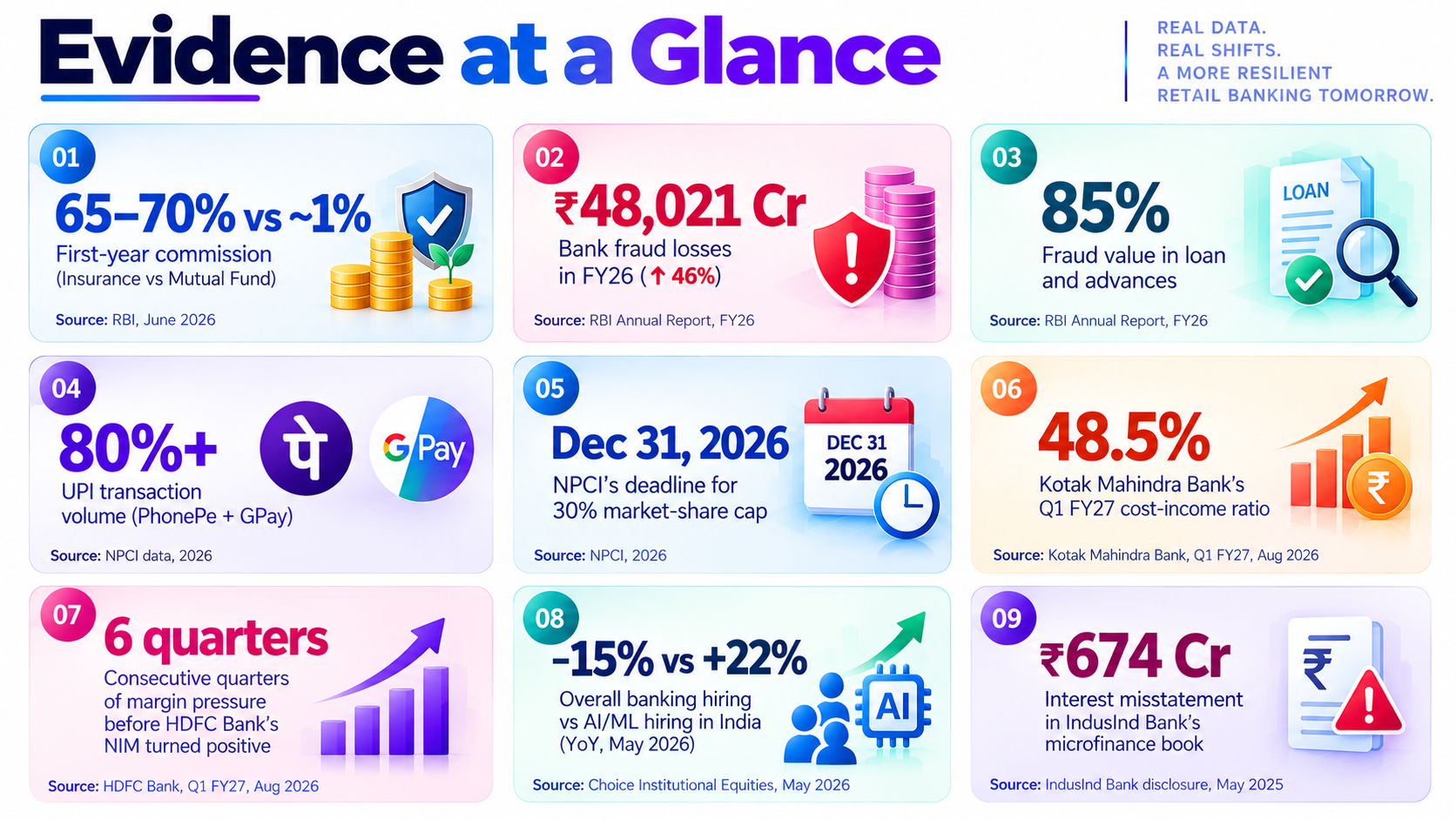
What Converts Recognition into Capability
• Separate the diagnosis from the plan explicitly: naming the eight drivers and six capabilities is a research exercise, not a transformation plan, and treating it as one is how initiatives stall at the strategy-document stage.
• Build the AI and model inventory before attempting classification, compliance, or capability gap analysis of any kind; every downstream exercise depends on knowing what is actually running today.
• Re-tie compensation and incentive structures to risk-adjusted outcome and capability metrics before expecting behavior to change, since incentive systems consistently outweigh stated strategy in shaping what branches and teams actually prioritize.
• Assign single-threaded ownership across the six capabilities, with real authority to move budget and headcount, rather than leaving accountability split across risk, compliance, and business units that each hold partial responsibility.
• Fund capability-building as a ring-fenced, multi-year budget line explicitly insulated from quarterly cost pressure, matching the horizon capability actually takes to compound rather than the horizon it gets reported on.
• Replace single-scenario planning with structured scenario planning for fraud patterns, channel disintermediation, and regulatory timelines, since the evidence above shows the single-scenario baseline has already been wrong repeatedly in the last two years.
• Treat legacy core-system modernization as a named, budgeted capability investment rather than a line item that competes with and consistently loses to new feature delivery.
• Build competency internally against a supply constraint that hiring alone cannot solve: invest in developing the specific competencies a gap analysis identifies, rather than competing for a shrinking pool of already-qualified external hires.
None of this requires new information. It requires banks to act on information they already, largely, have, to design for coexistence with a payments ecosystem they do not control, and to build capacity in the one area, talent, that cannot simply be bought on demand.
Executive FAQs
Is retail banking fraud actually getting worse, or just more visible?
The case count is falling, but the value lost is not, which is the opposite of what "more visible" would predict. RBI’s FY26 annual report shows fraud cases dropped to 10,114 from 23,722, while total losses rose 46% to ₹48,021 crore, because the fraud that remains has concentrated in loan origination, a category harder to catch in real time and far more sophisticated than the digital-payment fraud that is actually declining.
Why do banks specifically struggle to keep pace with regulatory change?
Compliance work depends on a current inventory of every AI and scoring model a bank actually runs, and most banks do not have one built as a standing discipline. RBI’s 2026 baseline requires a complete model inventory before validation, documentation, or governance can even begin, and most banks were not designed with that kind of live inventory in place.
Is this fundamentally an execution problem or a leadership problem?
Both, and they are connected. Incentive misalignment, decision-rights fragmentation, quarterly pressure, and technical debt are organizational design choices leadership sets and can reset. Two other factors sit partly outside leadership’s direct control: customer-side channel inertia and the industry-wide talent supply constraint.
What is the single highest-leverage fix for a bank moving too slowly on these drivers?
Building a current, accurate inventory of the AI systems and scoring models the bank actually operates. Every other fix, classification, compliance, capability gap analysis, and workforce mapping, depends on that inventory existing first, and most banks have not built one.
Is there simply not enough banking AI and risk talent to go around?
The supply-demand gap is real and shows up in real-time hiring data, not just projections. Overall banking-sector hiring fell 15% year on year in May 2026, even as AI and machine-learning hiring grew 22% in the same period, evidence that demand for capability-relevant talent is outpacing the broader hiring pool. A bank can fix every incentive and inventory gap it has and still be unable to hire its way to the competencies it needs on the timeline it needs them.
References
1. Reserve Bank of India, Annual Report, FY2025–26.
2. Reserve Bank of India, Digital Lending Directions, May 2025, and Master Direction supplement, March 2026.
3. Reserve Bank of India, Commercial Banks (Responsible Business Conduct) Second Amendment Directions, June 2026.
4. Reserve Bank of India, supervisory action notice on Kotak Mahindra Bank Limited, April 24, 2024.
5. Remarks by RBI Governor Shaktikanta Das, Conference of Directors of Private Sector Banks, November 2024.
6. National Payments Corporation of India (NPCI), UPI market share and transaction data, 2026.
7. HDFC Bank Ltd, Q1 FY2027 earnings results and investor presentation, July–August 2026.
8. Kotak Mahindra Bank, Q1 FY2027 earnings results, August 2026.
9. Reporting on ICICI Bank and Axis Bank Q1 FY27 results, Indian financial media, August 2026.
10. CRIF High Mark, "How India Lends" report, May 2026.
11. Choice Institutional Equities, "India Hiring Pulse," May 2026.
12. IndusInd Bank Ltd, stock exchange disclosure on microfinance business interest misstatement, May 15, 2025.
Organization Learning Labs
Research & Insights Division


