The Structural Drivers Reshaping IT Services Organizations

Technology, supply chain, and regulatory forces are reshaping IT services faster than most planning cycles. What separates organizations moving with them.
The Structural Drivers Reshaping IT Services Organizations
Technology, supply chain, and regulatory forces are moving faster than most IT organizations’ planning cycles. What separates the ones moving with these drivers from the ones falling behind is not information; it is structure.
EVIDENCE AT A GLANCE
$10–12B Estimated FY26 AI revenue for India’s tech industry, reflecting a shift from pilots to scaled, ROI-driven deployment Source: Nasscom Annual Strategic Review 2026 | 2M+ / 200–300K Professionals upskilled in AI-related skills over the past year, including those reaching advanced proficiency Source: Nasscom Annual Strategic Review 2026 | 12,000 / ~2% Roles TCS reduced in 2026, citing a structural skills mismatch rather than falling client demand Source: Reuters, TCS workforce restructuring coverage, July 2026 |
~32% Decline in the Nifty IT index across 2026, even as the broader market rose Source: NSE Nifty IT index performance data, 2026 | 180+ New entities added to the U.S. Bureau of Industry and Security Entity List since January 2025, targeting AI chip and semiconductor equipment makers Source: U.S. BIS Entity List, tracked in 2026 supply chain analysis | 3x in 24 months Number of times compute-performance and transistor-density licensing thresholds have been revised downward Source: 2026 semiconductor export control tracking |
$960M Honda’s estimated FY2026 operating profit impact from semiconductor shortages tied to the Nexperia export dispute Source: Honda FY2026 financial guidance | 40+ Countries now covered by the Foreign Direct Product Rule’s extended reach for controlled technology Source: 2026 semiconductor export control tracking | 20–38% Salary premium Indian technology employers are paying for AI-literate hires Source: 1Finance data, reported via Business Standard, July 2026 |
Reading the Same Signals
India’s technology industry closed FY26 with revenue up 6.1% against headcount growth of just 2.3%, and TCS cut roughly 12,000 roles in the same year, citing a structural skills mismatch rather than falling demand. The Nifty IT index fell roughly 32% across 2026 even as the broader market rose. None of this happened because the industry failed to notice what was coming; the forces behind it are well documented. It happened because recognizing a driver and moving at its speed are two different things, and the market has already priced the difference.
Eight drivers, technology, supply chain, regulatory, and market shifts, and the six organizational capabilities that respond to them, define the terrain reshaping IT services and consulting. What determines how fast a given organization moves across that terrain is not whether its leadership has read the research. It is a set of structural factors inside the organization itself, and in a few cases, outside it.
Three Forces Moving Faster Than Planning Cycles
Technology, supply chain, and regulatory change are not simply difficult. Each is moving on a cycle materially shorter than the planning and budgeting cycles most IT organizations still run on, which means a plan built to today’s conditions is frequently outdated before it finishes being implemented.
Technology: The Landscape Keeps Redrawing Itself
Nasscom’s own account of CY25 describes an industry that moved decisively from AI experimentation to industrialisation within a single year. Strategic M&A consolidated AI-native assets, and providers re-engineered revenue models away from FTE delivery toward outcome-based, risk-sharing constructs as AI-driven productivity gains became measurable rather than theoretical. An organization that built its 2025 plan around experimentation-stage assumptions was already behind an industry that had moved to industrialisation by the time that plan reached execution. Nasscom projects FY26 AI-specific revenue at $10 billion to $12 billion, real evidence that this shift is now generating measurable revenue rather than remaining a pilot-stage cost center, alongside more than two million professionals upskilled in AI-related capability over the same period.
Supply Chain: Thresholds Moving Faster Than Planning Cycles
Semiconductor export control policy has changed faster than any organization’s hardware strategy reasonably can. More than 180 entities have been added to the U.S. Bureau of Industry and Security Entity List since January 2025, primarily targeting AI chip developers and semiconductor equipment makers. The compute-performance and transistor-density thresholds that trigger licensing requirements have been revised downward three times in the past 24 months, and the Foreign Direct Product Rule now extends to items destined for entities in more than 40 countries when those items incorporate controlled technology, a scope expansion procurement teams increasingly describe as difficult to track in real time.
The Nexperia dispute made this concrete rather than abstract. When the Dutch government seized control of the chipmaker in late 2025 and split it into separate Dutch and Chinese entities, China responded with export controls on Nexperia-originated components. The automotive sector, heavily dependent on Nexperia’s discrete semiconductors, absorbed the most volatility; Honda alone estimated the resulting shortages would reduce its FY2026 operating profit by roughly $960 million. An organization that built its semiconductor access strategy around the rules in place at the start of 2025 was planning against a target that had already moved by the time the strategy reached execution.
Regulatory: Compliance Requirements Building Faster Than Implementation Cycles
The EU AI Act is the clearest live example of regulatory requirements outpacing typical implementation cycles. Its high-risk obligations become binding on August 2, 2026: providers must complete conformity assessments, register systems in the EU AI database, implement quality management systems, and activate post-market monitoring, while deployers must implement human oversight mechanisms, retain automated logs for at least six months, and conduct Fundamental Rights Impact Assessments where required. A European Commission proposal to delay parts of this timeline to late 2027 has not been enacted into law, so August 2026 remains the operative deadline organizations are planning against. The compliance burden itself illustrates the mismatch: an organization must first build a complete, current inventory of every AI system it operates, then classify each one against the Act’s risk taxonomy, before any of the substantive obligations above can even begin, and most IT estates were not built with that kind of inventory as a standing discipline.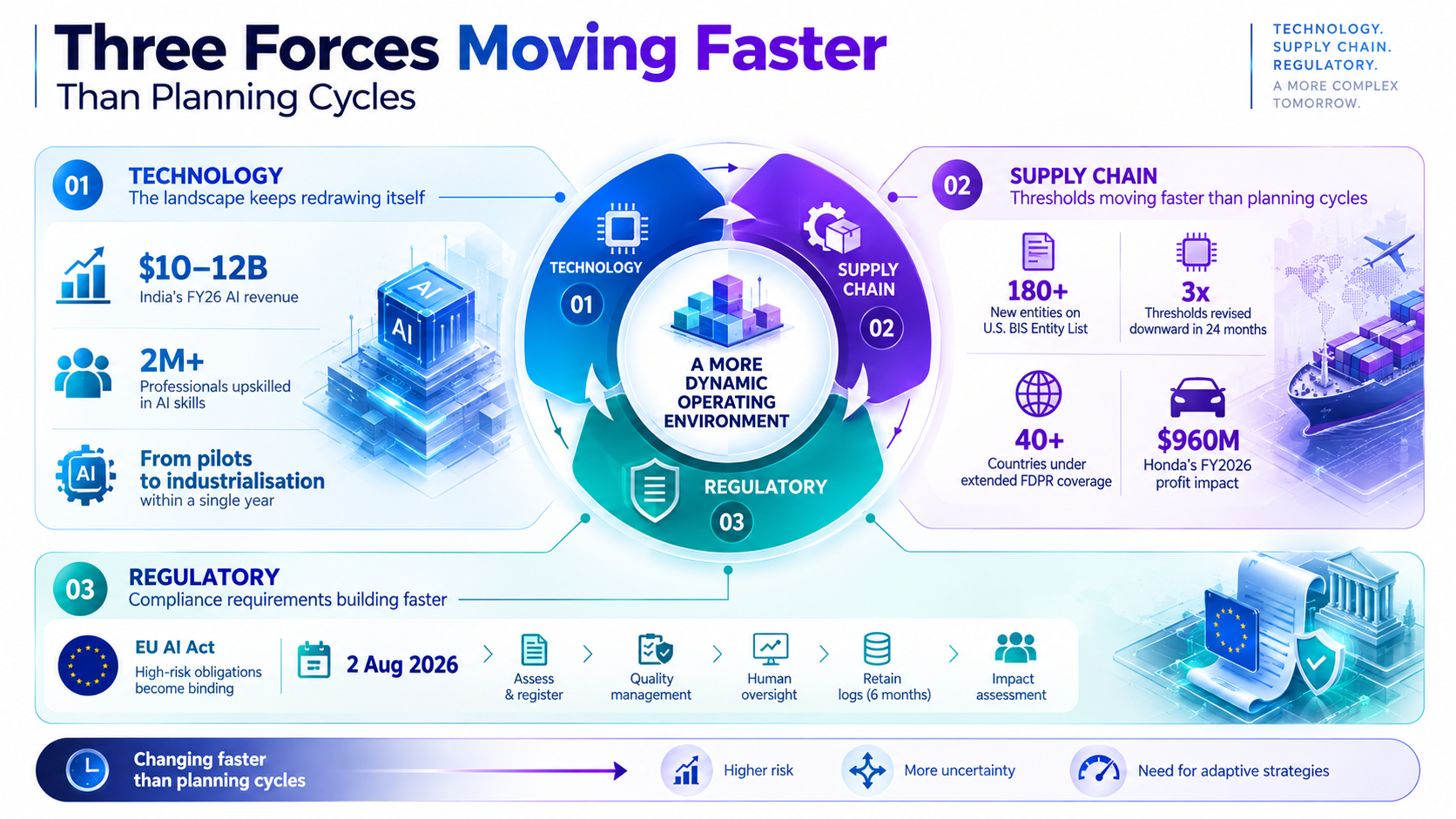
What Determines the Pace of Building Each Capability
The three drivers above, technology, supply chain, and regulatory, are the ones with the clearest external, dated evidence trail, which is why they anchor this article. They are not, however, the whole picture. Organizational strategy and governance capability, not the drivers themselves, is what an organization actually builds, and the pace of building it varies sharply across each of the six capabilities.
Organizational Capability | What Determines the Pace |
AI-Augmented, Industry-Contextualized Technology & Engineering | Adoption has outpaced engineering discipline; most organizations remain between pilot and enterprise-wide practice rather than having scaled AI-assisted delivery into a tracked, revenue-grade discipline |
Enterprise Problem-Solving & Decision Intelligence | Regulatory pressure (the EU AI Act) is forcing documented, evidence-based decisions faster than most organizations have built the review structures to produce them |
Continuous Innovation & Adaptive Enterprise Learning | Treated as a discretionary cost rather than a protected pipeline, so it is usually the first line item cut under quarterly margin pressure |
Integrated, Ecosystem-Enabled & Client-Centric Collaboration | Responding to GCC expansion and hyperscaler encroachment means collaborating with, not just competing against, entities most organizations still treat purely as threats |
Business-Led Technology Strategy & Outcome-Oriented Consulting | Covered in depth below: the gap between stated AI-first strategy and disclosed, converted results is the clearest evidence this capability is unevenly built |
Responsible, Adaptive & Transformation-Oriented Leadership | Covered in depth below through the decision-rights fragmentation and talent-supply rows in the structural factors table |
From Recognition to Execution
None of the eight drivers or six capabilities above is secret. Every organization’s leadership team can, in principle, read the same Nasscom data cited throughout this article. The clearest evidence that recognition and structural change are not the same thing sits inside the hiring data itself: India’s largest IT services firms are paying a real, measurable premium, 20 to 38%, for AI-literate hires, proof they know which skills matter, while the bulk of campus hiring continues at generalist intake levels largely unchanged in structure from prior years. An organization can be correctly pricing the skills it needs and still not be structurally set up to build enough of them fast enough.
Eight factors, spanning internal structure, external commercial dynamics, and one hard supply constraint, do most of the explaining for why that gap persists.
Structural Factor | Why It Persists | What Actually Closes It |
Incentive misalignment | Executive compensation and delivery-team incentives remain tied to utilization and billable hours, not capability metrics or outcome delivery | Tie compensation explicitly to outcome-based revenue mix and measurable capability indicators, not headcount deployed |
Decision-rights fragmentation | Accountability for capability investment typically sits split across business unit heads, geography leaders, and a central technology function in large, diversified IT services organizations; when an initiative crosses more than one of these boundaries, it frequently has no single leader with authority to fund it end to end | Assign single-threaded ownership for each of the six organizational capabilities, with real authority to move budget and headcount across business units, not a rotating governance committee |
Quarterly pressure vs. multi-year horizon | Capability-building takes years to compound while public reporting cycles reward quarterly margin protection instead; the Nifty IT index fell roughly 32% across 2026 even as the broader market rose, a live market signal that makes boards more cautious about near-term margin compression, not less | Ring-fence capability investment as a protected budget line insulated from quarterly cost-cutting |
Legacy technical debt | Delivery models built for a labour-arbitrage era are expensive and slow to re-architect around AI-native workflows | Treat technical debt reduction as a capability investment with its own budget line, not deferred maintenance |
Leadership mindset lock-in | Planning still assumes the traditional client relationship and delivery model will continue largely unchanged | Replace assumption-based planning with scenario planning that treats disruption as the base case, not a tail risk |
Inventory and governance gaps | Organizations cannot close a gap they have not mapped; most lack a current inventory of the systems they actually run | Build the inventory first; classification, gap analysis, and workforce mapping all depend on it existing |
Client-side commercial timing | Renegotiating a multi-year, time-and-materials contract into an outcome-based structure requires the client’s active consent, and clients are not always in a hurry to give it; TCS’s own leadership cited client decision delays as a factor in its 2026 restructuring, a real signal that commercial change on the client side moves on the client’s timeline, not the provider’s | Lead renegotiation with a small set of reference clients willing to co-design outcome-based terms, then use the proof points to make the case industry-wide |
Talent supply constraint | Nasscom reports more than two million professionals upskilled in AI over the past year, with 200,000 to 300,000 reaching advanced proficiency, yet Indian technology employers are still paying a 20 to 38% salary premium for AI-literate hires, real-time evidence that even substantial, industry-wide upskilling has not yet caught up with demand | Treat competency-building as a supply-side capacity investment cascading into named competency categories, such as technical and domain mastery or innovation and adaptive learning, not a generic hiring exercise |
The first six factors are choices an organization’s own leadership can reverse unilaterally. The last two move on someone else’s clock: closing the client-side gap requires the client’s consent as much as the provider’s will, and closing the talent gap requires building capacity against a market-wide shortage that persists regardless of any single organization’s intent.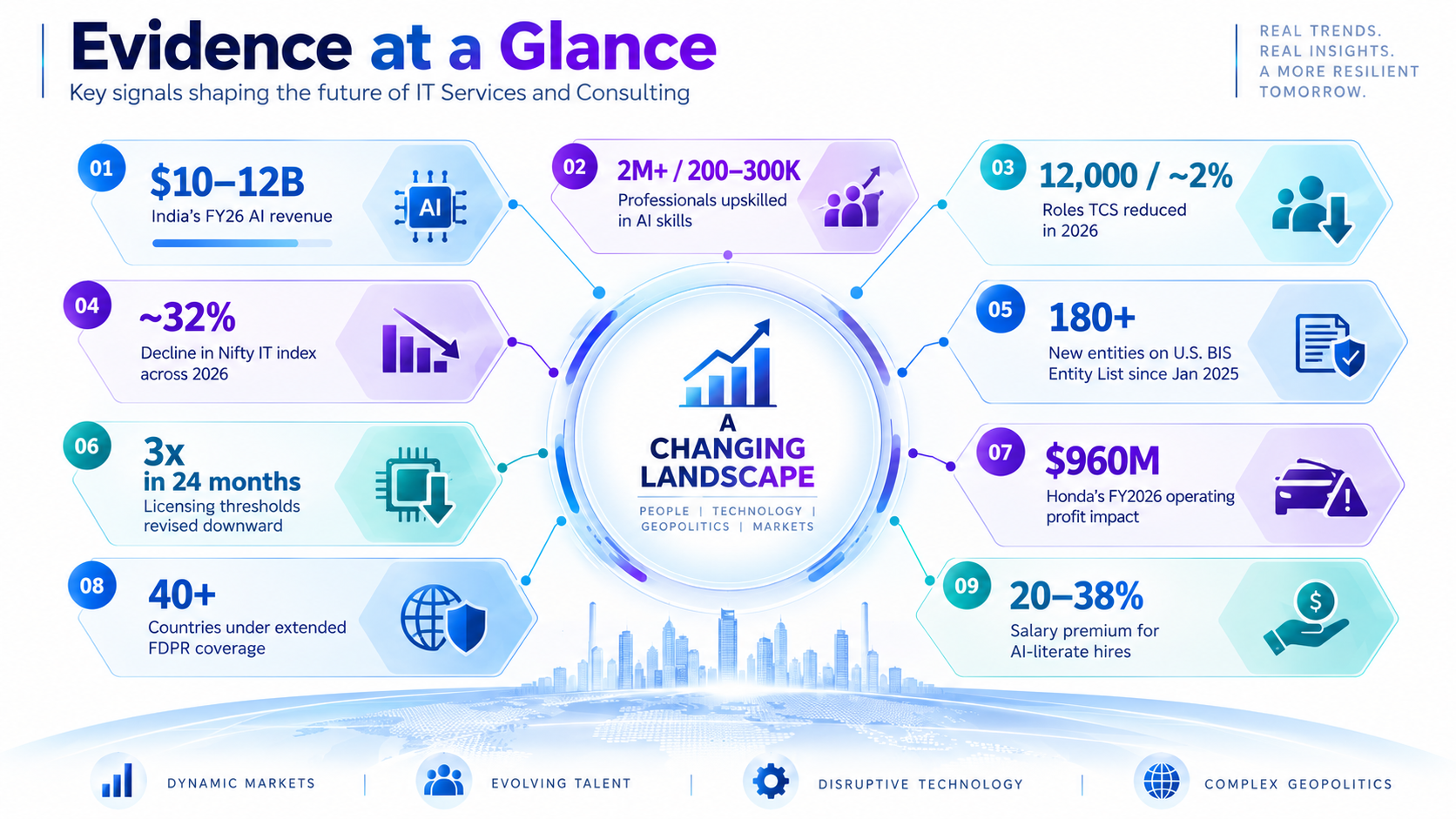
Why Moving Early Compounds
These eight factors do not stay static; they compound on the same timeline as the industry’s broader shift. Organizations that re-architect their commercial model early capture outcome-based deals before competitors catch up. Those that treat technical debt reduction as a funded capability investment, rather than deferred maintenance, keep the cost of re-architecture from growing faster than their budget for it. And those that build scenario planning into their supply chain and regulatory posture early are not caught flat-footed when the scenario they planned for becomes the base case, as it already has three times in the last 24 months for semiconductor thresholds alone. Moving with these drivers early is worth more than moving late costs, and that gap widens every quarter it goes unaddressed.
What Converts Recognition into Capability
• Separate the diagnosis from the plan explicitly: naming the six fronts and four forces is a research exercise, not a transformation plan, and treating it as one is how initiatives stall at the strategy-document stage.
• Build the systems and AI inventory before attempting classification, compliance, or capability gap analysis of any kind; every downstream exercise depends on knowing what actually exists today.
• Re-tie compensation and incentive structures to outcome and capability metrics before expecting behavior to change, since incentive systems consistently outweigh stated strategy in shaping what teams actually prioritize.
• Assign single-threaded ownership across the six organizational capabilities, with real authority to move budget and headcount, rather than leaving accountability split across business units that each hold partial responsibility and no one holds the whole.
• Fund capability-building as a ring-fenced, multi-year budget line explicitly insulated from quarterly cost pressure, matching the horizon capability actually takes to compound rather than the horizon it gets reported on.
• Replace single-scenario planning with structured scenario planning for semiconductor access, regulatory timelines, and client demand, since the evidence above shows the single-scenario baseline has already been wrong repeatedly in the last 24 months.
• Treat legacy technical debt reduction as a named, budgeted capability investment rather than a line item that competes with and consistently loses to new feature delivery.
• Lead commercial renegotiation with a small set of willing reference clients rather than waiting for the whole client base to ask for outcome-based terms on its own.
• Build competency internally against a supply constraint that hiring alone cannot solve: invest in developing the specific competency categories a gap analysis identifies, rather than competing for a shrinking pool of already-qualified external hires.
None of this requires new information. It requires organizations to act on information they already, largely, have, to negotiate rather than assume client cooperation, and to build capacity in the one area, talent, that cannot simply be bought on demand.
Executive FAQs
Why do IT organizations specifically struggle to keep pace with regulatory change?
Compliance work depends on a current inventory of the systems an organization actually runs, and most organizations do not have one built as a standing discipline. The EU AI Act requires a complete AI system inventory before classification, documentation, or monitoring can even begin, and most IT estates were not designed with that kind of live inventory in place.
How does the semiconductor supply chain affect IT services firms that don’t make hardware?
IT services and consulting firms depend on compute access for AI-intensive delivery work, and their clients across manufacturing, automotive, and other hardware-dependent sectors are directly exposed to chip supply disruption, as Honda’s roughly $960 million FY2026 profit impact from the Nexperia dispute shows. Export control thresholds that shift without warning make long-term capacity and delivery planning materially harder for any organization whose roadmap assumes stable access to specific hardware.
Is this fundamentally an execution problem or a leadership problem?
Both, and they are connected. The structural factors in this article, incentive misalignment, decision-rights fragmentation, quarterly pressure, and technical debt, are organizational design choices that leadership sets and can reset. Two other factors sit partly outside leadership’s direct control: client-side commercial timing and the industry-wide talent supply constraint.
What is the single highest-leverage fix for an organization moving too slowly on these drivers?
Building a current, accurate inventory of the systems and AI capabilities the organization actually operates. Every other fix, classification, compliance, capability gap analysis, and workforce competency mapping, depends on that inventory existing first, and most organizations have not built one.
Is there simply not enough AI talent to go around?
The supply-demand gap is real and shows up in real-time pricing rather than just projections. Nasscom reports more than two million professionals upskilled in AI over the past year, yet Indian technology employers are still paying a 20 to 38% salary premium for AI-literate hires, evidence that even substantial, industry-wide upskilling has not caught up with demand. An organization can fix every incentive and inventory gap it has and still be unable to hire its way to the competencies it needs on the timeline it needs them.
Why do capability investments stall even when the CEO visibly supports them?
Because support at the top does not automatically translate into authority in the middle. Accountability for capability investment is typically split across business unit heads, geography leaders, and a central technology function, none of whom individually can reallocate capital across the whole organization. When an initiative crosses more than one of these boundaries, it frequently has no single leader accountable for funding it end to end.
References
1. Nasscom, "Technology Sector in India: Strategic Review 2026," February 2026.
2. Reuters, reporting on Tata Consultancy Services workforce restructuring and CEO commentary, July 2026.
3. Honda Motor Co., FY2026 financial guidance on semiconductor-related operating profit impact, cited in 2026 supply chain analysis.
4. Sourceability, "2026 Semiconductor Industry Market Outlook" and Nexperia export dispute coverage, 2026.
5. U.S. Bureau of Industry and Security, Entity List additions, tracked in 2026 semiconductor supply chain analysis.
6. European Union, Artificial Intelligence Act, high-risk obligation provisions and enforcement timeline (Articles 9–17, 26).
7. National Stock Exchange of India, Nifty IT index performance data, 2026.
8. 1Finance salary premium data for AI-literate technology roles, reported via Business Standard, July 2026.
9. Indian technology sector hiring disclosures (TCS, Infosys, Wipro, HCLTech), as reported in Indian financial media, 2026.
Organization Learning Labs
Research & Insights Division


