The Future-Ready Retail Bank: The Top 6 Capabilities That Matter

What separates future-ready retail banks is organizational strategy and governance capability, not the digital technology each bank has already bought.
The Future-Ready Retail Bank: The Top 6 Capabilities That Matter
Technology, fraud patterns, and regulation explain why the ground is moving. What actually separates the banks pulling ahead is organizational strategy and governance capability, six of them, built and operating, not merely announced.
EVIDENCE AT A GLANCE
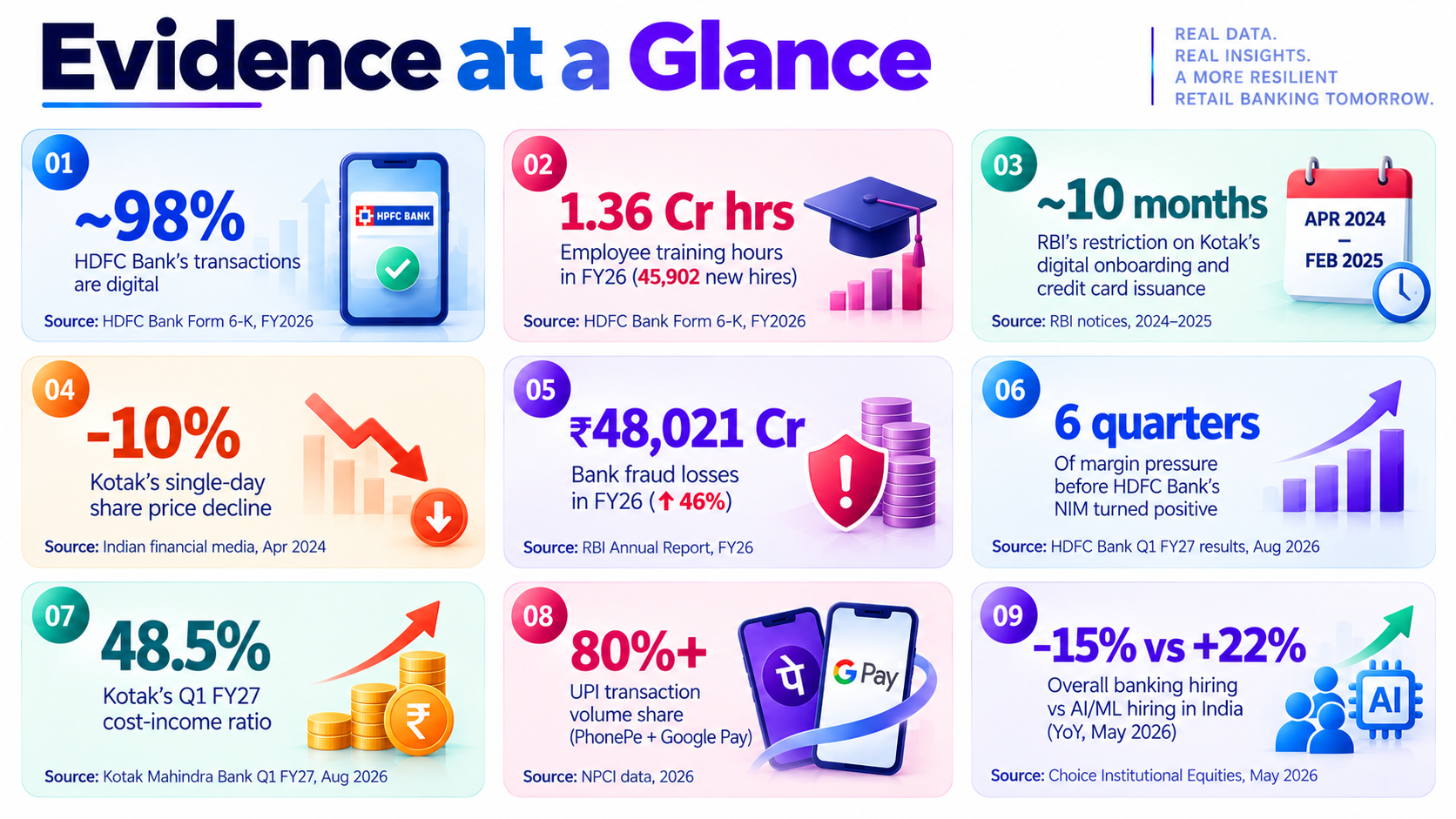
~98% Share of HDFC Bank’s financial transactions conducted digitally in FY26 Source: HDFC Bank Form 6-K, FY2026 | 1.36 Cr hrs Employee training hours HDFC Bank disclosed for FY26, alongside 45,902 new hires Source: HDFC Bank Form 6-K, FY2026 | ~10 months Length of RBI’s restriction on Kotak Mahindra Bank’s digital customer onboarding and credit card issuance, April 2024 to February 2025 Source: RBI supervisory action notices, 2024–2025 |
-10% Kotak Mahindra Bank’s single-day share price decline after RBI’s restriction was announced Source: Indian financial media, April 2024 | ₹48,021 Cr RBI-reported bank fraud losses in FY26, up 46% even as the number of fraud cases fell Source: RBI Annual Report, FY26 | 6 quarters Consecutive quarters of margin pressure HDFC Bank faced before its net interest margin turned positive in Q1 FY27 Source: HDFC Bank Q1 FY27 results, August 2026 |
48.5% Kotak Mahindra Bank’s Q1 FY27 cost-income ratio, up as it accelerated digital-infrastructure investment Source: Kotak Mahindra Bank Q1 FY27 results, August 2026 | 80%+ Combined UPI transaction volume share held by PhonePe and Google Pay Source: NPCI data, 2026 | –15% vs +22% Year-on-year change in overall banking-sector hiring versus AI/ML-specific hiring in India, May 2026 Source: Choice Institutional Equities, India Hiring Pulse, May 2026 |
From Recognizing the Future to Operating In It
Retail banks in India face eight drivers, AI and digital adoption, a changing fraud pattern, tightening regulation, fintech dominance of the payment interface, and more, reshaping the industry. Recognizing them is a research exercise; building the organizational capability to respond is a different, harder discipline most banks routinely underinvest in. This piece answers the practical question underneath both: what, specifically, does a bank need to be able to do to compete in the industry those drivers are creating.
Six organizational capabilities answer that question, and none of them is a checklist item to be scored on its own. A capability that stands alone does not constitute future readiness; it only matters to the extent it compounds with the others. The evidence for this is not one bank’s claim about itself. RBI barred Kotak Mahindra Bank from onboarding new digital customers and issuing new credit cards for nearly ten months, from April 2024 to February 2025, and the bank’s shares fell 10% in a single day when the restriction was announced, not because the bank lacked scale, brand, or customer relationships, but because two consecutive years of unaddressed IT risk and governance deficiencies undercut capability the rest of the bank genuinely had. RBI’s own FY26 annual report shows the same pattern at industry scale: fraud cases fell, yet total losses still surged 46% to ₹48,021 crore, because detection capability has not kept pace with how fraud itself has changed. HDFC Bank, by contrast, shows what it looks like when capabilities reinforce each other rather than each standing alone: 1.36 crore employee training hours and 45,902 new hires in FY26 grew alongside a digital transaction share near 98%, and its net interest margin turned positive in Q1 FY27 after six consecutive quarters of pressure, workforce investment, digital capability, and commercial conversion arriving together, not in sequence. One bank, one regulator’s industry-wide data, one bank again, three different outcomes, one pattern: capability compounds or it does not exist at all.
Six Organizational Capabilities
Each of these is a capability in its own right, and none functions in isolation. The test throughout is practical: what does a bank that has actually built the capability do differently from one that has only adopted the underlying technology or announced the intention.
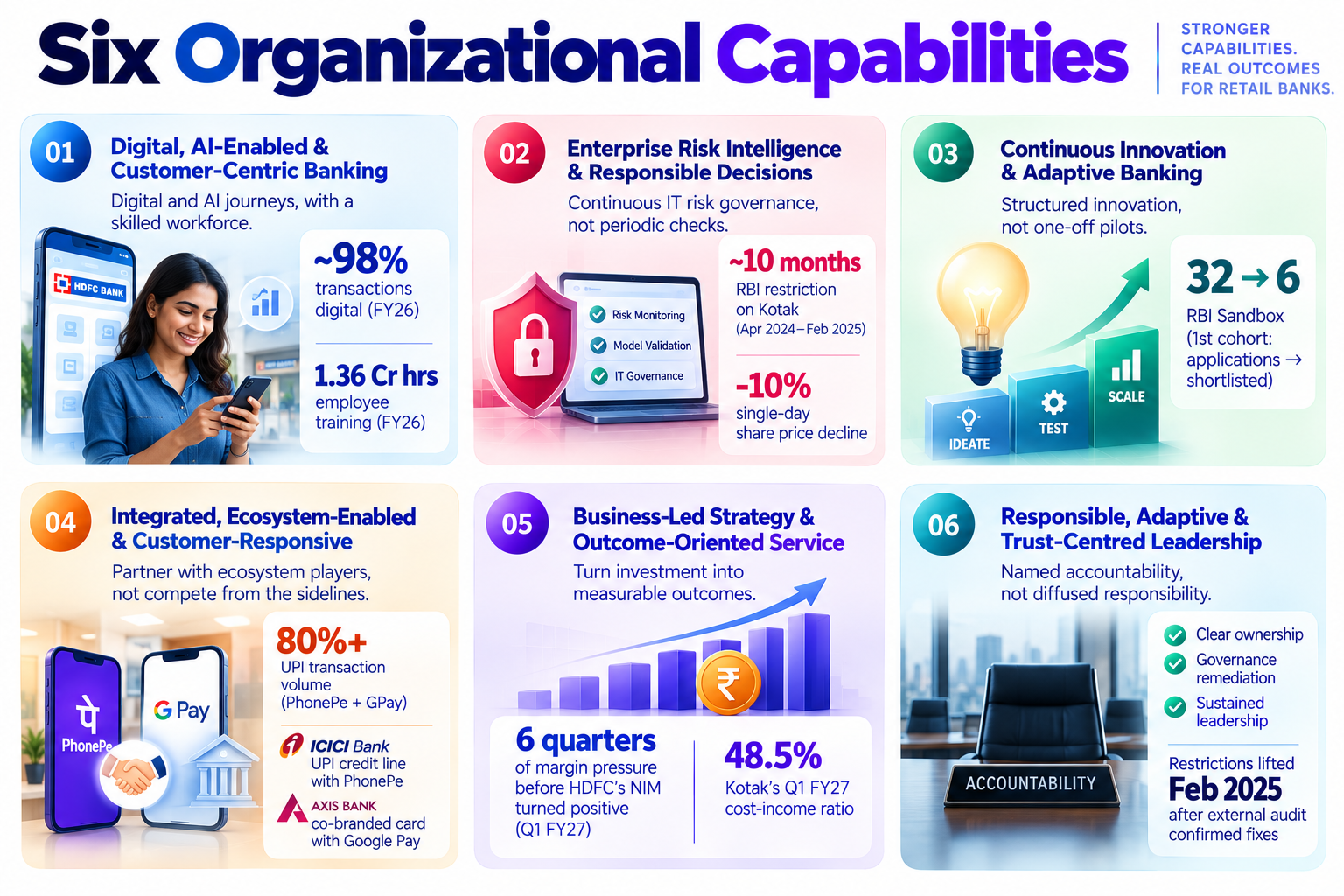
1. Digital, AI-Enabled & Customer-Centric Banking Capability
A bank has this capability when digital and AI-led journeys are owned by named roles working alongside branch teams, not run as a separate digital-only initiative, and when workforce training keeps pace with the technology rollout. HDFC Bank’s disclosed 1.36 crore employee training hours in FY26, alongside 45,902 new hires, shows what building this capability at organizational scale actually requires: a workforce commitment, not just a digital product launch.
2. Enterprise Risk Intelligence & Responsible Decision-Making Capability
A bank has this capability when IT risk and information security governance is continuously audited and remediated, not treated as a periodic checkbox. RBI’s April 2024 action against Kotak Mahindra Bank, barring new digital customer onboarding and credit card issuance for nearly ten months after two consecutive years of unaddressed IT governance deficiencies, is the industry’s clearest cautionary case: a real, well-capitalized bank absorbed a real business restriction and a 10% single-day share decline because its risk-governance processes did not keep pace with its own digital growth.
3. Continuous Innovation & Adaptive Banking Capability
A bank has this capability when it engages structured innovation pathways as a standing discipline, not one-off pilots. RBI’s own Regulatory Sandbox, running since 2019 across five thematic cohorts, is genuinely selective: its first cohort, on retail payments, drew 32 applications but shortlisted only 6 for live testing. A bank that cannot get a product through that kind of structured, governed testing process is unlikely to be experimenting seriously at all; one that treats sandbox participation as a standing capability, not a one-time PR exercise, is building exactly the innovation discipline this capability requires.
4. Integrated, Ecosystem-Enabled & Customer-Responsive Collaboration Capability
A bank has this capability when it can operate alongside dominant payment-ecosystem and data-sharing partners rather than being purely disintermediated by them. PhonePe and Google Pay together handle more than 80% of UPI transaction volume, and NPCI’s proposed cap on individual app dominance has been delayed repeatedly, so a bank without a genuine ecosystem-orchestration capability has no answer beyond competing on price for whatever the fintech layer does not yet own. ICICI Bank's 2026 Credit Line on UPI partnership with PhonePe, its first-ever such arrangement with any lender, and Axis Bank's co-branded Google Pay Flex credit card are the clearest live test: banks that build direct lending and card partnerships with the platforms holding the customer relationship are building collaboration as a capability, not simply ceding that relationship to the platform that originates it.
5. Business-Led Banking Strategy & Outcome-Oriented Service Capability
A bank has this capability when margin conversion from digital and product investment is governed and tracked at the account-leadership level, not assumed. HDFC Bank’s net interest margin turning positive in Q1 FY27, after six consecutive quarters of pressure, is a disclosed, governed commercial outcome, not a claimed one; Kotak Mahindra Bank’s cost-income ratio climbing to 48.5% in the same quarter, on comparable digital investment, shows what the absence of that governance looks like in real numbers.
6. Responsible, Adaptive & Trust-Centred Banking Leadership Capability
A bank has this capability when a single leader holds real, named accountability for governance remediation, not a rotating committee with diffused responsibility. Kotak Mahindra Bank’s restrictions were lifted only in February 2025, after a comprehensive external audit confirmed the underlying deficiencies had actually been fixed, real evidence that governance accountability, once broken, takes sustained leadership ownership to rebuild, not a press statement promising improvement.
The Six Capabilities at a Glance
Capability | Signal You Have It | Signal You Don’t Yet |
Digital, AI-Enabled & Customer-Centric Banking | Digital and branch journeys designed jointly, with workforce training tracked alongside technology rollout | Digital treated as a separate initiative from branch and workforce planning |
Enterprise Risk Intelligence & Responsible Decision-Making | IT and model governance continuously audited and remediated ahead of regulatory review | Governance gaps go unaddressed across multiple examination cycles |
Continuous Innovation & Adaptive Banking | Structured engagement with real testing pathways like RBI’s Regulatory Sandbox, not one-off pilots | Innovation confined to press-release pilots with no path through a governed testing process |
Integrated, Ecosystem-Enabled & Customer-Responsive Collaboration | Direct lending and card partnerships with dominant fintech platforms, like ICICI Bank's Credit Line on UPI with PhonePe or Axis Bank's co-branded Google Pay Flex card, integrated into core lending and advisory workflows | Fintech and data-sharing partners treated purely as competitive threats, no coordination model |
Business-Led Banking Strategy & Outcome-Oriented Service | Margin conversion from digital investment tracked and governed as a standing discipline | Digital spend rising without a governed link to margin or customer outcomes |
Responsible, Adaptive & Trust-Centred Banking Leadership | One named leader accountable for governance remediation, validated by external audit | Accountability diffused across committees with no single owner for remediation |
How the Six Compound
These six are not independent checkboxes to be scored one at a time; a bank weak in one typically struggles to build the others, and the pattern holds at both the institutional and the industry level. HDFC Bank’s own disclosures show what compounding looks like when it works: workforce investment, digital scale, and commercial conversion arrived together in the same reporting year, not in sequence, evidence of organizational discipline compounding across capabilities rather than one technology rollout doing the work alone. Kotak Mahindra Bank shows what it looks like when one link is missing: real scale, brand strength, and customer relationships were not enough to prevent a ten-month business restriction once regulators found IT risk governance had gone unaddressed for two straight examination cycles, one capability gap undercutting value the bank otherwise had. RBI’s own FY26 data shows the same failure mode at industry scale: fraud detection capability has not kept pace with how fraud itself has shifted, and the eighty-five percent of losses concentrated in loan origination shows exactly where that gap sits. A bank that tries to build ecosystem collaboration without risk-governance discipline underneath it, or outcome-based strategy without leadership accountable for delivering it, is making a promise its own data cannot back up, and regulators, and the market, notice the gap quickly.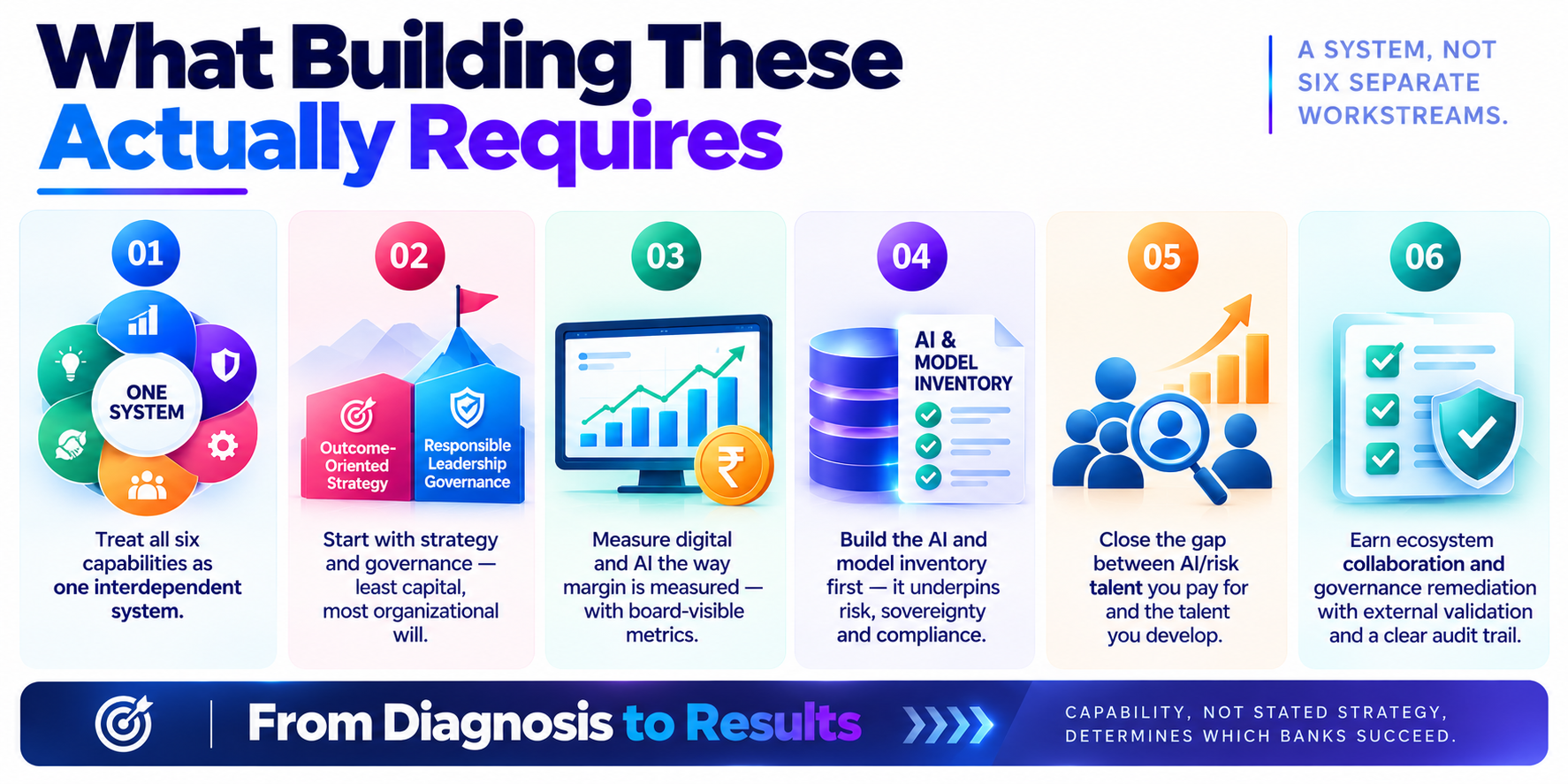
What Building These Actually Requires
• Treat all six capabilities as one interdependent system, not six separate workstreams; a digital investment without the risk-governance capability to sustain it stalls at the next IT examination cycle.
• Start with the two capabilities that require the least capital and the most organizational will: outcome-oriented strategy and responsible leadership governance are structural decisions, not technology purchases, and can begin immediately.
• Measure digital and AI-led banking the way margin is measured, with tracked, board-visible metrics, not a count of app downloads or transaction share.
• Build the AI and model inventory before attempting risk-governance, sovereignty, or compliance work of any kind; every one of those depends on knowing what is actually running today.
• Close the gap between what the bank pays for AI and risk talent and how many people it has actually developed to that level; a widening gap between overall hiring and AI-specific hiring is a visible, trackable warning sign.
• Treat ecosystem collaboration and governance remediation as something earned and externally validated, not claimed through a press statement; the argument only holds if the audit trail backs it up.
Naming these six capabilities is still a diagnostic exercise, not a transformation plan. Converting the diagnosis into results means making the case for why capability, not stated strategy, is what actually determines which banks succeed, and building a systematic, deliberate way to develop them, rather than hoping they accumulate as a byproduct of survival.
Executive FAQs
If a board can only fund two capabilities this year, which two?
Business-led, outcome-oriented strategy and responsible leadership governance, because both are structural decisions rather than technology purchases and can start without waiting on a capital cycle. Enterprise risk intelligence follows close behind on urgency, given how quickly an unaddressed governance gap became a ten-month business restriction for Kotak Mahindra Bank.
Why frame these as organizational capabilities rather than technology capabilities?
Because technology access is no longer the differentiator. Every serious retail bank in India has comparable AI and digital tooling available to it. HDFC Bank and Kotak Mahindra both invested heavily in digital infrastructure and produced sharply different outcomes in the same reporting period. What diverged was organizational governance and risk discipline, not which vendor platform each bank licensed.
Could a bank simply spend its way into these capabilities?
Spending buys technology, not governance. Kotak Mahindra Bank’s restrictions were not lifted until a comprehensive external audit confirmed the underlying IT risk deficiencies had actually been fixed, roughly ten months after they were first imposed. Governance capability, once broken, is rebuilt through sustained leadership ownership and validated remediation, not a larger technology budget.
How would a leadership team know if governance accountability is actually missing, rather than just moving slowly?
The clearest signal is a regulatory or audit finding that recurs across more than one examination cycle with no single leader accountable for closing it. RBI flagged Kotak Mahindra Bank’s IT governance gaps for two consecutive years, 2022 and 2023, before imposing restrictions in 2024, a recurring finding is the warning sign, not the final action.
Could a bank build all six capabilities and still lose ground?
Yes. Capability is necessary, not sufficient. A bank that builds all six faster than its competitors still loses ground if fintech dominance of the payment interface or NBFC share gains restructure the market faster than any single institution can compound its own capability, which is exactly why those drivers stay relevant even after the six capabilities are built.
References
1. Reserve Bank of India, supervisory action notice on Kotak Mahindra Bank Limited, April 24, 2024.
2. Reserve Bank of India, notice lifting restrictions on Kotak Mahindra Bank Limited, February 13, 2025.
3. Reserve Bank of India, Annual Report, FY2025–26.
4. Reserve Bank of India, Regulatory Sandbox cohort results and Enabling Framework, 2019–2025.
5. ICICI Bank, Credit Line on UPI partnership announcement with PhonePe, 2026; Axis Bank and Google Pay, Flex co-branded credit card partnership announcement, December 2025.
6. HDFC Bank Ltd, Form 6-K, fiscal year 2026, U.S. Securities and Exchange Commission filing.
7. HDFC Bank Ltd, Q1 FY2027 earnings results and investor presentation, July–August 2026.
8. Kotak Mahindra Bank, Q1 FY2027 earnings results, August 2026.
9. Reporting on Kotak Mahindra Bank share price reaction, Indian financial media, April 2024.
10. National Payments Corporation of India (NPCI), UPI market share and transaction data, 2026.
11. Choice Institutional Equities, "India Hiring Pulse," May 2026.
Organization Learning Labs
Research & Insights Division


