The Future-Ready IT Services & Consulting Org: Top 6 Capabilities

What separates future-ready IT services and consulting organizations is organizational strategy and governance capability, not the technology beneath it.
The Future-Ready IT Services & Consulting Org: Top 6 Capabilities
Technology, geopolitics, and market shifts explain why the ground is moving. What actually separates the organizations pulling ahead is organizational strategy and governance capability, six of them, built and operating, not merely announced.
EVIDENCE AT A GLANCE
$300–400B Infosys’s own estimate of the global AI services market opportunity by 2030, the scale of value it is building capability to capture Source: Infosys press release, February 2026 | 90% / 4,600+ Share of Infosys’s top 200 clients now collaborating on AI journeys, and the number of live AI projects underway Source: Infosys newsroom, 2026 | $2.6B / 13.9% TCS’s Q1 FY27 annualised AI revenue run rate and reported revenue growth Source: TCS Q1 FY27 results, reported August 2026 |
6,000 Frontier engineers Infosys plans to build over the next few years, a disclosed workforce-structuring commitment, not a technology purchase Source: Infosys Form 6-K, Q1 FY2027 | $10–12B Nasscom’s FY26 estimate of AI-specific revenue for India’s tech industry Source: Nasscom Annual Strategic Review 2026 | 12,000 / ~2% Roles TCS reduced in 2026, citing a structural skills mismatch rather than falling client demand Source: Reuters, TCS workforce restructuring coverage, July 2026 |
1,750+ Global Capability Centers operating in India, increasingly performing work that once defaulted to external providers Source: Nasscom Strategic Review data | 20–38% Salary premium Indian technology employers are paying for AI-literate hires Source: 1Finance data, reported via Business Standard, July 2026 | $960M Honda’s estimated FY2026 operating profit impact from semiconductor shortages tied to the Nexperia export dispute Source: Honda FY2026 financial guidance |
From Recognizing the Future to Operating In It
IT services and consulting organizations face eight drivers, technology change, semiconductor supply volatility, regulatory tightening, client insourcing, hyperscaler encroachment, and more, reshaping the industry. Recognizing them is a research exercise; building the organizational capability to respond is a different, harder discipline most organizations routinely underinvest in. This piece answers the practical question underneath both: what, specifically, does an organization need to be able to do to compete in the industry those drivers are creating.
Six organizational capabilities answer that question, and none of them is a checklist item to be scored on its own. A capability that stands alone does not constitute future readiness; it only matters to the extent it compounds with the others. The evidence for this is not a single company’s claim about itself. Honda absorbed a roughly $960 million FY2026 profit hit not because it lacked engineering talent or client relationships, but because its decision-intelligence processes had no structured way to price a concentrated semiconductor dependency before the crisis, and that single gap was enough to undercut capability the rest of the organization genuinely had. TCS cut roughly 12,000 roles in 2026 despite deep client relationships and real delivery scale, because its leadership pointed to a structural skills mismatch, a gap in workforce and leadership capability that no amount of strength elsewhere could offset. Infosys, by contrast, shows what it looks like when capabilities reinforce each other rather than each standing alone: its decision to fund an outcome-based commercial pitch only once its own delivery data could back it up is an organizational discipline, not a technology purchase, and its workforce planning, client relationships, and commercial repositioning grew together, not in sequence. Three real organizations, three different outcomes, one pattern: capability compounds or it does not exist at all.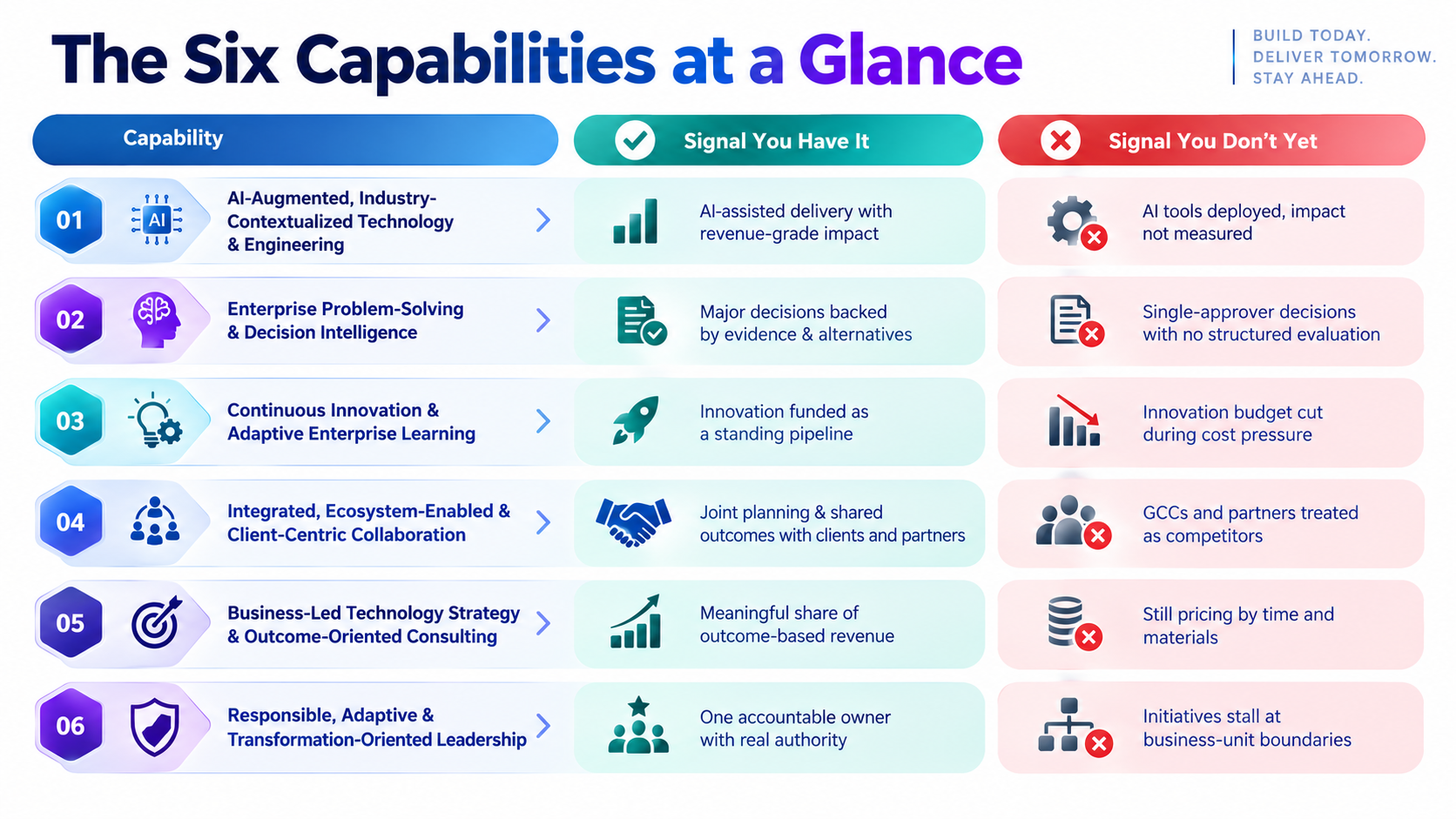
Six Organizational Capabilities
Each of these is a capability in its own right, and none functions in isolation. The test throughout is practical: what does an organization that has actually built the capability do differently from one that has only adopted the underlying technology or announced the intention.
1. AI-Augmented, Industry-Contextualized Technology & Engineering Capability
An organization has this capability when engineering roles are structured around permanent industry-context ownership, not just tool access, industry-vertical solution architects sitting alongside engineers as a standing part of the delivery team, and when AI-assisted delivery is tracked with board-visible, revenue-grade metrics rather than a count of licenses issued. Infosys’s own disclosed plan to build a team of 6,000 frontier engineers over the coming years is a workforce-structuring commitment, not a software purchase, evidence the organization is organizing itself around this capability rather than simply licensing tools any competitor can also buy.
2. Enterprise Problem-Solving & Decision Intelligence Capability
An organization has this capability when major commitments are backed by documented alternative-evaluation, not a single approver’s instinct. Honda’s roughly $960 million FY2026 hit from the Nexperia dispute is the industry’s clearest cautionary case: a real, well-run engineering organization absorbed a disruption because its decision processes had no structured way to price the risk of concentrated semiconductor sourcing before the crisis, not after.
3. Continuous Innovation & Adaptive Enterprise Learning Capability
An organization has this capability when innovation investment is a protected, governed budget line with a named accountable owner, reviewed on its own terms rather than folded into the general technology budget, and when the organization maintains a standing reskilling structure rather than a training calendar revisited once a year. The clearest signal an organization lacks this capability is not a slow technology roadmap; it is an innovation budget that disappears the moment quarterly numbers tighten, precisely the governance failure this piece finds driving Wipro-shaped outcomes elsewhere.
4. Integrated, Ecosystem-Enabled & Client-Centric Collaboration Capability
An organization has this capability when it can operate alongside a client’s own Global Capability Center rather than being purely disintermediated by it. More than 1,750 GCCs now operate in India, and organizations without a genuine ecosystem-orchestration capability have no answer beyond competing on price for whatever work the GCC does not yet perform internally.
5. Business-Led Technology Strategy & Outcome-Oriented Consulting Capability
An organization has this capability when outcome-based pricing is a standing commercial motion, decided and governed at the account-leadership level, not an exception negotiated deal by deal, and when a meaningful, tracked share of revenue already reflects that shift. TCS closed Q1 FY27 with a $2.6 billion annualised AI revenue run rate and 13.9% revenue growth on the strength of exactly this kind of commercial repositioning, not headcount growth.
6. Responsible, Adaptive & Transformation-Oriented Leadership Capability
An organization has this capability when a single leader holds real authority to move budget and headcount across business units for a given initiative, rather than a rotating governance committee with partial jurisdiction and no one fully accountable. Amazon’s own single-threaded leadership model, documented by former Amazon executives Colin Bryar and Bill Carr in Working Backwards, assigns one accountable owner per initiative specifically to eliminate the cross-team dependencies that slow decisions down. IT services organizations whose capability initiatives stall at a business-unit boundary are missing exactly this.
The Six Capabilities at a Glance
Capability | Signal You Have It | Signal You Don’t Yet |
AI-Augmented, Industry-Contextualized Technology & Engineering | AI-assisted delivery tracked with revenue-grade metrics; engineering fluent in client industry context | AI tooling adopted but productivity impact never measured; delivery generic across industries |
Enterprise Problem-Solving & Decision Intelligence | Major commitments backed by documented alternative-evaluation and post-decision review | Single-approver sign-off with no structured evaluation of alternatives |
Continuous Innovation & Adaptive Enterprise Learning | Innovation funded as a protected, standing pipeline with a named owner | Innovation budget the first line item cut under margin pressure |
Integrated, Ecosystem-Enabled & Client-Centric Collaboration | Joint planning and shared outcome metrics with clients’ own GCCs and partners | GCCs and partners treated purely as competitive threats, no coordination model |
Business-Led Technology Strategy & Outcome-Oriented Consulting | Revenue mix meaningfully shifted toward outcome-based contracts | Still pricing by time and materials while calling it transformation |
Responsible, Adaptive & Transformation-Oriented Leadership | One accountable owner per capability initiative with real budget authority | Initiatives stall at business-unit boundaries with no one able to unblock them |
How the Six Compound
These six are not independent checkboxes to be scored one at a time; an organization weak in one typically struggles to build the others, and the pattern holds across more than one company’s story. Infosys’s own disclosures show what compounding looks like when it works: its workforce-structuring commitment, building toward 6,000 frontier engineers, generates the delivery data its outcome-oriented commercial pitch depends on, and its public argument for the continued necessity of client judgment only holds up because 90% of its top 200 clients and more than 4,600 live projects are counted engagements, not claims, organizational discipline compounding across capabilities, not one technology platform doing the work alone. TCS shows what it looks like when one link is missing: real client scale and delivery relationships were not enough to prevent a 12,000-role reduction once its own leadership identified a structural skills mismatch, a gap specifically inside its workforce and leadership capability, one capability undercutting value the organization otherwise had. Honda, outside IT services entirely, shows the same failure mode from the client side: engineering and manufacturing strength did not protect roughly $960 million in FY2026 operating profit once its decision-intelligence processes failed to price a concentrated semiconductor dependency before the crisis. An organization that tries to build client-centric collaboration without engineering discipline underneath it, or an outcome-based strategy without leadership accountable for delivering it, is making a promise its own data cannot back up, and clients, and the market, notice the gap quickly.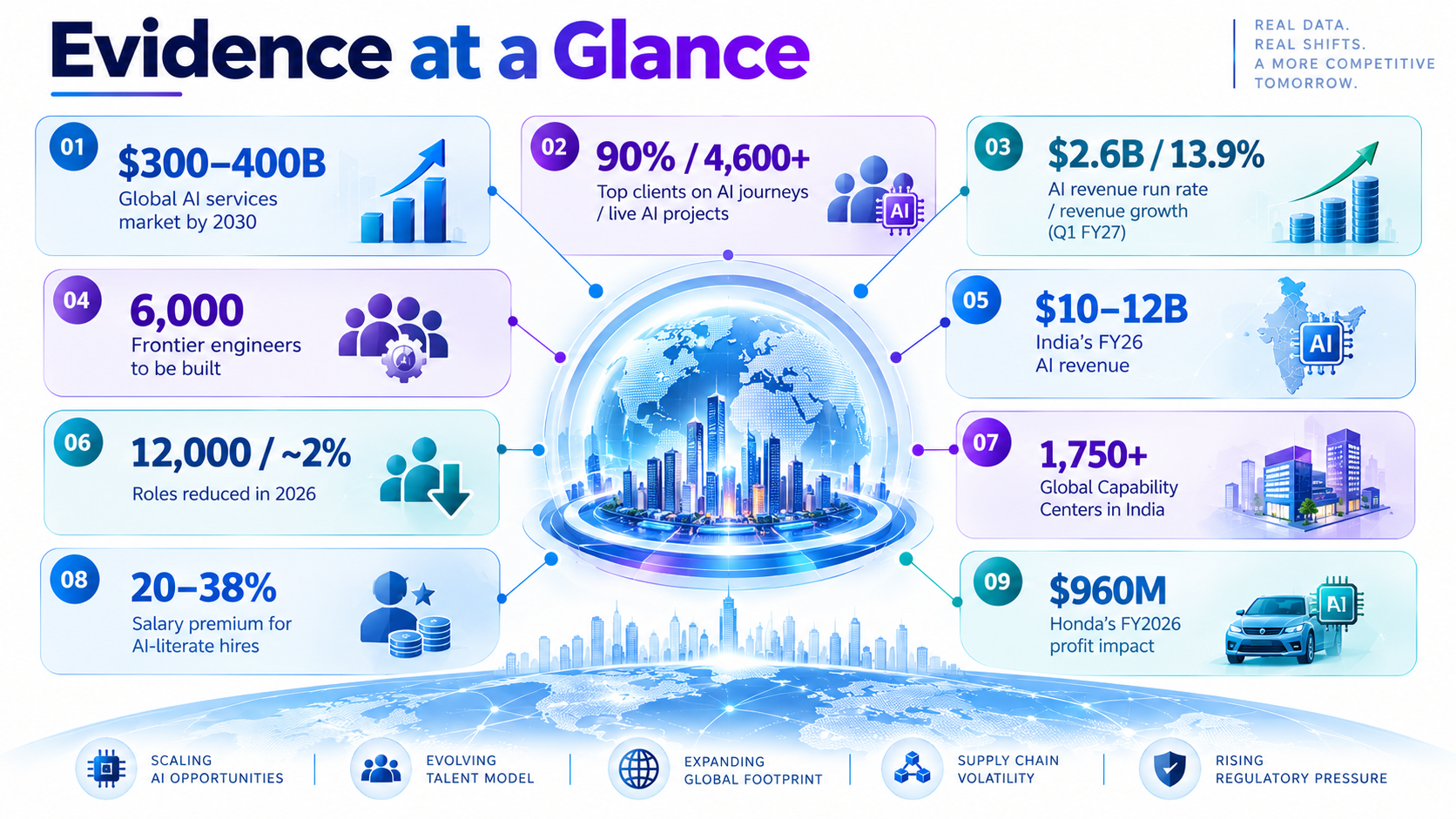
What Building These Actually Requires
• Treat all six capabilities as one interdependent system, not six separate workstreams; a technology investment without the leadership and governance capability to monetize it stalls at the pilot stage.
• Start with the two capabilities that require the least capital and the most organizational will: outcome-oriented strategy and responsible leadership governance are structural decisions, not technology purchases, and can begin immediately.
• Measure AI-augmented engineering the way revenue is measured, with tracked, board-visible metrics, not a count of licenses purchased.
• Build the AI system inventory before attempting decision-intelligence, sovereignty, or compliance work of any kind; every one of those depends on knowing what is actually running today.
• Close the gap between what the organization pays for AI talent and how many people it has actually developed to that level; a rising salary premium next to flat advanced-proficiency numbers is a visible, trackable warning sign.
• Treat ecosystem collaboration and outcome-based judgment as something earned through delivery data, not claimed through positioning; the argument only holds if the engineering and platform capability underneath it is real.
Naming these six capabilities is still a diagnostic exercise, not a transformation plan. Converting the diagnosis into results means making the case for why capability, not stated strategy, is what actually determines which organizations succeed, and building a systematic, deliberate way to develop them, rather than hoping they accumulate as a byproduct of survival.
Executive FAQs
If a board can only fund two capabilities this year, which two?
Business-led, outcome-oriented strategy and responsible leadership governance, because both are structural decisions rather than technology purchases and can start without waiting on a capital cycle. AI-augmented engineering and decision intelligence follow close behind on urgency, forced by real client and regulatory pressure, but they require capability-building work the first two do not.
Why frame these as organizational capabilities rather than technology capabilities?
Because every serious competitor in this industry already has comparable technology access. TCS, Infosys, and Wipro each stated an AI-first strategy in the same period and produced three different results in the same quarter. What diverged was organizational strategy, decision discipline, and leadership accountability, not which AI platform each company licensed. Technology, geopolitical change, and market shifts are the drivers explaining why this matters; these six capabilities are what an organization actually builds in response.
Could a large enough acquisition just buy these capabilities at once?
It can buy pieces of the technology and engineering capability, a platform, a patent portfolio, a team with specialist expertise. It cannot buy decision intelligence, ecosystem collaboration, or leadership accountability. Those are properties of how an organization actually operates, and Amazon’s own single-threaded leadership model took years of internal practice to become real, not a transaction to close.
How would a leadership team know if single-threaded governance is actually missing, rather than just moving slowly?
The clearest signal is a capability initiative that has stalled at a business-unit boundary with no one able to say who has the authority to unblock it. Slow-but-owned initiatives eventually ship. Initiatives with no single accountable owner do not, regardless of how much executive support they have on paper, because there is no one whose job it is to force the trade-off.
Could an organization build all six capabilities and still lose?
Yes. Capability is necessary, not sufficient. An organization that builds all six faster than its competitors still loses ground if client insourcing through GCC expansion or hyperscaler encroachment restructures the market faster than any single organization can compound its own capability, which is exactly why those drivers stay relevant even after the six capabilities are built.
References
1. Infosys Ltd, Form 20-F, fiscal year 2026, U.S. Securities and Exchange Commission filing.
2. Infosys Ltd, Form 6-K, Q1 fiscal year 2027 results, U.S. Securities and Exchange Commission filing.
3. Infosys, "Infosys Unveils AI First Value Framework," press release, February 2026.
4. Colin Bryar and Bill Carr, Working Backwards: Insights, Stories, and Secrets from Inside Amazon, St. Martin’s Press, 2021.
5. Nasscom, "Technology Sector in India: Strategic Review 2026," February 2026.
6. Reuters, reporting on Tata Consultancy Services workforce restructuring, July 2026.
7. Reporting on Tata Consultancy Services Q1 FY27 results, Indian financial media, August 2026.
8. Honda Motor Co., FY2026 financial guidance on semiconductor-related operating profit impact, cited in 2026 supply chain analysis.
9. 1Finance salary premium data for AI-literate technology roles, reported via Business Standard, July 2026.
Organization Learning Labs
Research & Insights Division


