The Commerce Capability Cloud: E-Commerce Talent and Learning

Why static, role-based training cannot keep pace with digital commerce. WEF-backed evidence on reskilling, talent pathways, and capability design to 2035.
The Commerce Capability Cloud
Designing Talent, Learning, and Behaviour for Future-Proof E-Commerce Organizations
Introduction: Skill Churn Is Outpacing the Org Chart
The World Economic Forum's Future of Jobs Report 2025 estimates that nearly 40 percent of core workforce skills will change by 2030, and that if the global workforce were represented by 100 people, 59 would require some form of reskilling or upskilling within that window, with 11 of them unlikely to receive it. For commerce organizations specifically, where technology stacks, channels, and consumer behaviour are evolving on a faster cycle than almost any other function of the enterprise, this is not a distant workforce planning concern. It is already the binding constraint on how quickly a commerce organization can execute its strategy, regardless of how well designed that strategy is on paper.
Static, role-based training was built for a world where a job's skill requirements stayed roughly stable for years at a time. That world no longer exists inside commerce functions. A performance marketer hired two years ago for paid search expertise now needs working fluency in generative AI content tools and agentic campaign management. A merchandiser hired for category planning now needs enough data literacy to interpret a demand-sensing model. Eighty-seven percent of executives report their organization has a skills gap now or will within five years, and 63 percent of employers cite the skills gap as the primary barrier to business transformation, ahead of budget, technology, or even organizational resistance.
Mapping the E-Commerce Capability Domains
Rather than mapping talent to a fixed org chart, future-proof commerce organizations map talent to seven capability domains that persist even as the specific roles and tools inside them change: strategy and product, technology and platform, operations, marketing and growth, customer experience, data and analytics, and governance. Every commerce role sits primarily inside one domain but increasingly requires working fluency in at least one adjacent domain, which is precisely the shift that traditional, single-track career ladders were never designed to support.
This domain mapping matters because it reframes the unit of workforce planning. Instead of asking how many performance marketers the organization needs, leaders should ask how much marketing and growth capability, at what level of data and technology fluency, the organization needs, and then decide how many of those people should sit formally inside marketing versus rotate through it from adjacent domains. Organizations that continue to plan headcount purely by job title will consistently under-invest in the cross-domain fluency that determines execution speed.
Generalist Leaders, Deep Specialists, and the T-Shaped Middle
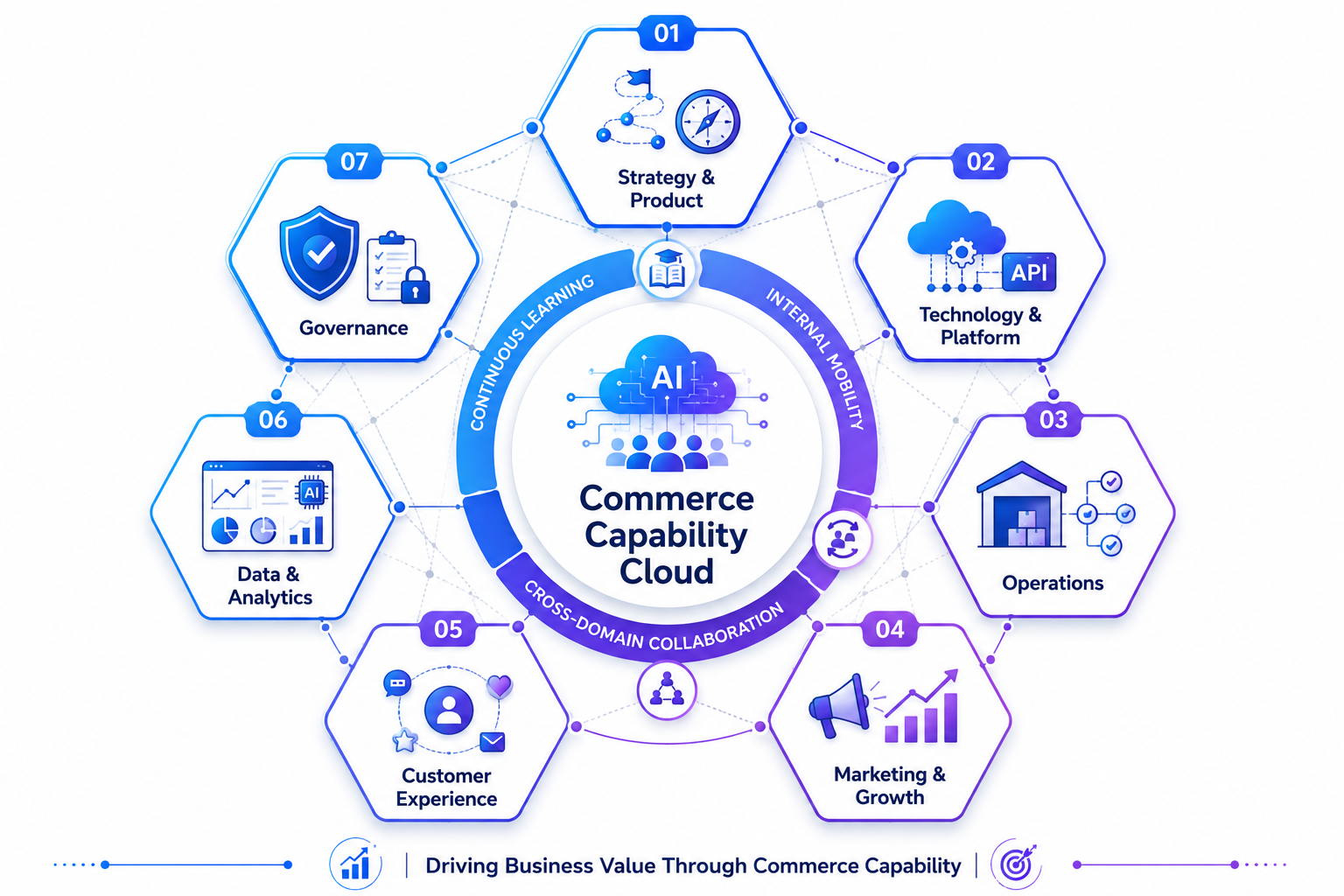
Two talent archetypes anchor a healthy commerce capability cloud, and a third connects them. Generalist leaders hold broad fluency across most of the seven domains and are best positioned for roles that require constant trade-off judgment across functions, such as the commerce architect or operations director roles described elsewhere in this series. Deep specialists, a senior data scientist, a returns automation engineer, a privacy and consent counsel, carry depth that the organization cannot substitute with generalist judgment alone, and their career paths need to be genuinely attractive without requiring a move into people management to progress. Between them sit T-shaped profiles: professionals with real depth in one domain and working fluency in one or two adjacent domains, who make cross-functional collaboration fast because they do not need a translator to understand what the adjacent team is actually asking for.
Talent Pathways That Actually Move People
The organizations building genuine capability mobility design explicit pathways between domains, not just theoretical permission to move. An operations analyst with strong data instincts should have a visible, supported path into a data and analytics role without starting over at entry level. A performance marketer with customer-facing empathy and strong problem-solving should have a credible path into customer experience leadership. A merchandiser fluent in demand data should be able to move toward data and analytics roles rather than being permanently boxed into a single category-management track for an entire career.
- Internal mobility is measurably cheaper and more effective than most organizations assume: Internal hires save organizations meaningfully on cost per role relative to external hiring and, according to Harvard Business Review research, outperform external hires by roughly 18 percent in their first two years, a gap large enough that under-investing in internal mobility carries a direct performance cost, not just a retention cost.
- Skills-based hiring and internal mobility are two sides of the same capability strategy: Skills-based hiring, evaluating what a candidate can actually do rather than filtering primarily on degree or prior job title, is now a 2026 priority for roughly three-quarters of employers, and it is the practical mechanism that makes cross-domain pathways real rather than aspirational.
- Entry-level pathways need deliberate redesign, not just protection: With entry-level roles under structural pressure, one in three companies reportedly expects to eliminate some entry-level positions by the end of 2026, commerce organizations need a deliberate strategy for how early-career talent enters and builds toward T-shaped fluency, since the traditional entry-level pipeline many capability pathways assumed is itself changing.
Learning Architecture Design
Unlock the Full Research
Create a free account or sign in to access the complete methodology, deep-dive analysis, and key implementation frameworks.
Don't have an account? It's free to join.
Organization Learning Labs
Research & Insights Division


Comments