Tech-Augmented F&B Operations: Building Workforce Capability

Robotics and AI are reshaping kitchens and plants, but capability, not technology, decides who wins. A leadership guide to building the human OS for automated F&B.
From Recipe to Algorithm: Building Human Capability for Tech-Augmented F&B Operations
Why the real constraint on kitchen and plant automation is not the machinery, but the workforce and leadership behaviour built to run it
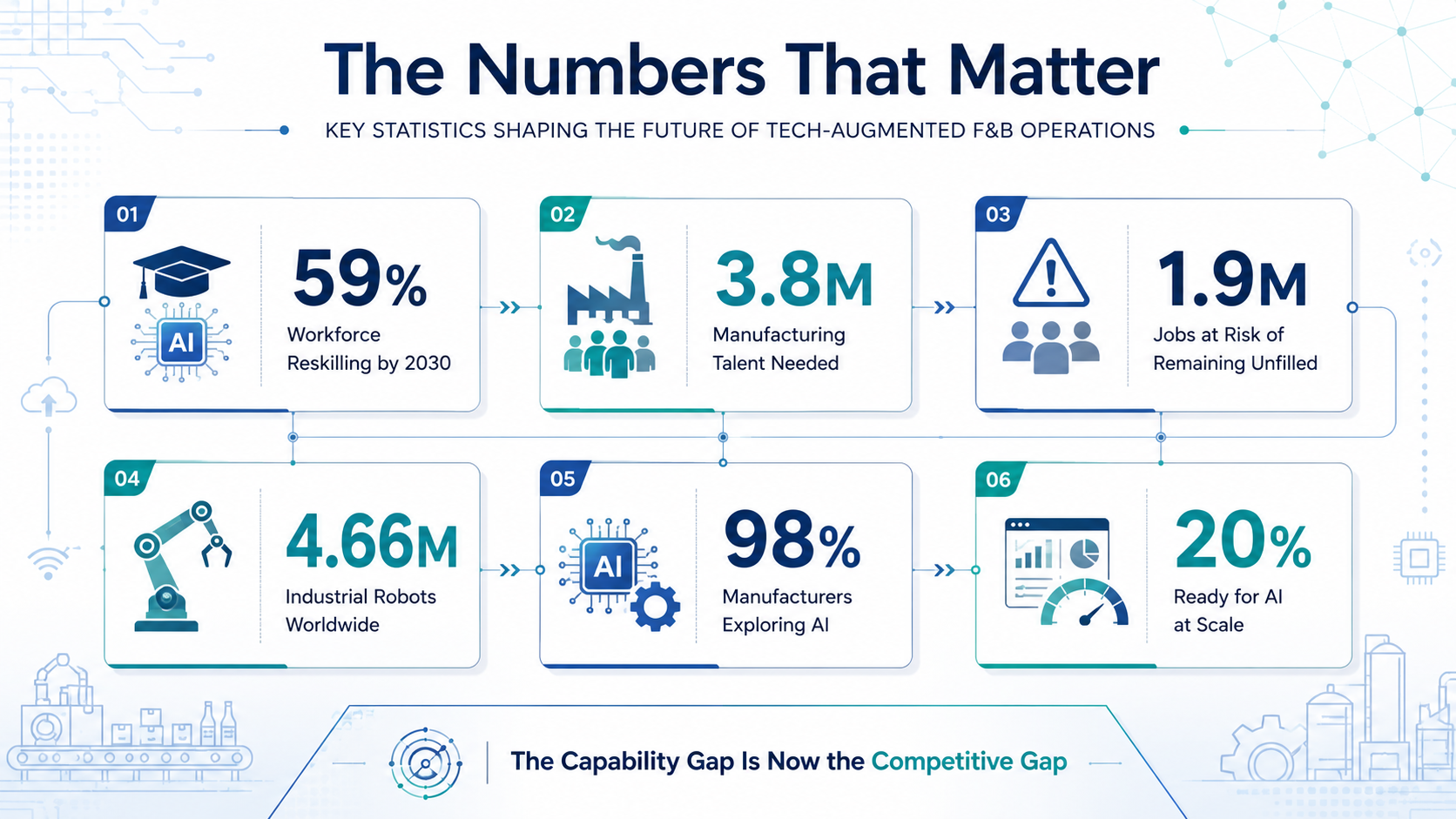
When the Kitchen Becomes a Data System
Tech-augmented F&B operations have moved from pilot curiosity to operating necessity faster than most leadership teams have adjusted their talent strategy. Robotic arms handle prep work in cloud kitchens, computer vision monitors line quality in real time, IoT sensors track cold chain integrity across thousands of shipment legs, and AI-driven demand forecasting resets production schedules by the hour rather than the week. The technology layer is no longer the differentiator it was five years ago. Every credible operator can now buy comparable sensors, comparable robotics, and comparable software. What separates the plants and kitchens that convert this investment into margin from the ones that stall in pilot purgatory is something far less purchasable: the capability of the people who run the equipment, interpret its data, and change their behaviour because of what it tells them.
This is the uncomfortable truth sitting underneath most automation business cases. A cobot priced at roughly thirty thousand dollars can now handle picking and sorting tasks that food plants have struggled for years to staff, not because workers are unqualified but because almost nobody is applying for those roles. Automation in food and beverage today is less a story of machines replacing people and more a story of machines covering the shifts nobody could fill, while the humans who remain are asked to do fundamentally different work: interpreting dashboards, validating exceptions, and making judgment calls that no sensor can make alone. The question every CXO in this sector must now answer is blunt. Can your workforce and your leadership bench actually use this technology to create value, or will it sit as expensive infrastructure layered on top of an operating model that has not changed?
The New Capability Stack for Tech-Augmented Operations
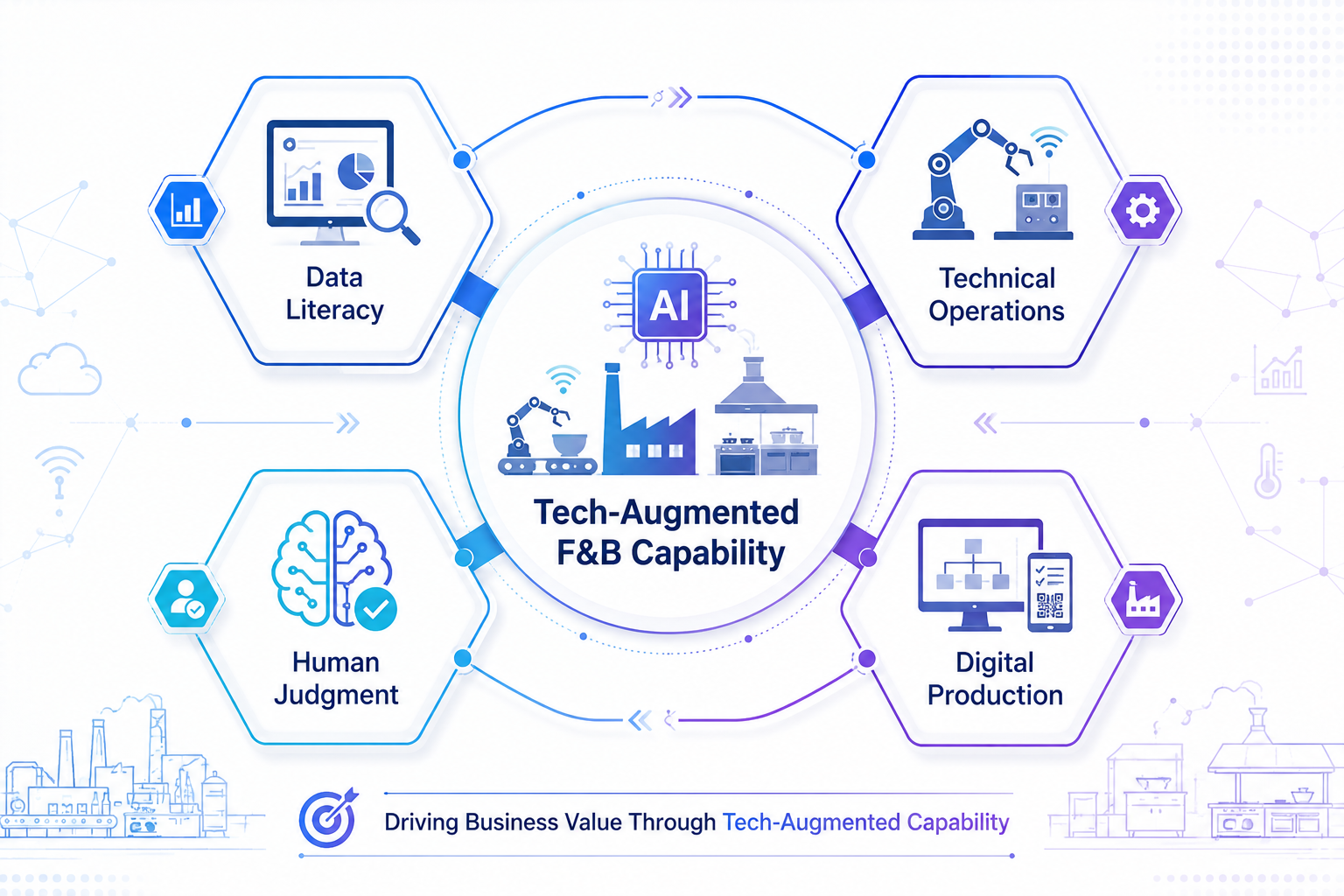
The capability requirements of a tech-augmented F&B operation cut across four distinct layers, and most organizations are only investing in one or two of them. The first layer is data literacy on the floor: the ability of line supervisors, quality technicians, and shift leads to read a dashboard, understand what a deviation means, and know when to escalate versus when to adjust. The second layer is technical operation, meaning the practical skill of running robotics, calibrating sensors, and troubleshooting the inevitable friction between decades-old machinery and newly installed AI systems, a friction that is more common than most vendors admit given that most food manufacturing facilities still run on infrastructure installed long before anyone contemplated a smart plant.
The third layer is digital menu and production management, relevant across QSR chains, ghost kitchens, and CPG lines alike, where staff must move fluidly between physical execution and digital systems that dictate portioning, sequencing, and substitution in real time. The fourth and most frequently neglected layer is judgment: the capacity to know when the algorithm is wrong. Sensor drift, mislabeled SKUs, and edge cases that training data never anticipated all still require a human who trusts their own experience enough to override a system, and organizations that train people only to comply with the technology, never to question it, are quietly building fragility into their most automated lines.
STRATEGIC INSIGHT Segment your capability build. A QSR chain, a fine-dining group, a CPG manufacturer, and a ghost kitchen operator need overlapping but distinct capability stacks. Treating automation training as one generic program is the single most common reason capability investments underperform. |
From Intuition to Instrumentation: The Behavioural Shift on the Line
Technology adoption in food operations fails less often because of poor equipment and more often because of unchanged habits. A plant can install every sensor on the market and still run on tribal knowledge if supervisors keep making scheduling and quality calls by feel rather than by referencing the dashboard sitting in front of them. The behavioural shift required is specific and uncomfortable: moving from an environment where experience alone earned authority to one where experience must be paired with a habit of checking data before acting on it. This is not a small ask for a workforce, particularly in kitchens and plants where seniority has historically been synonymous with instinct.
The habits that separate high-performing tech-augmented operations from stalled ones are unglamorous but decisive: logging data consistently rather than retroactively, following an alert protocol instead of overriding it out of habit, and consulting analytics before changing a recipe, a schedule, or a supplier rather than after the fact when the deviation has already cost margin. Executive teams often underestimate how much cultural work sits behind these habits. A frontline worker who has been reprimanded in the past for a machine error may instinctively avoid triggering an alert rather than investigate it, and that avoidance behaviour, multiplied across a shift, quietly erodes the entire value case for the sensor network the company just financed.
Designing Learning Architectures for the Algorithmic Kitchen
Unlock the Full Research
Create a free account or sign in to access the complete methodology, deep-dive analysis, and key implementation frameworks.
Don't have an account? It's free to join.
Organization Learning Labs
Research & Insights Division


Comments