Talent OS for IT Services: From Utilisation to Human Potential

How IT services CXOs can replace the utilisation model with a Talent OS built on skills intelligence, internal marketplaces, and dynamic learning to compete through 2035.
From Utilisation to Human Potential: A New Talent Operating System for IT Services in the Age of Skills-Based Organisations
Why the utilisation-driven operating model is structurally incompatible with the skills-based era — and what the Talent OS replacement architecture looks like for CFOs, CHROs, CIOs, and business unit leaders
Abstract
The IT services industry has long organised itself around a deceptively simple metric: utilisation. Yet a model designed to maximise billable hours has produced brittleness in delivery, chronic burnout in the workforce, and a structural inability to invest in the capabilities that actually create value. As global enterprises accelerate their AI-native transformation agendas, IT services firms face an existential question: can you build the talent of the future while running the operating model of the past?
This article argues that the answer is no — and proposes a replacement architecture. The Talent Operating System (Talent OS) is the integrated set of practices, platforms, and policies through which organisations recognise, develop, allocate, and reward human potential at scale. Built on a skills intelligence layer, animated by internal talent marketplaces, and sustained by dynamic learning ecosystems, the Talent OS represents the organisational infrastructure required to compete in the age of skills-based organisations (SBOs). Strategic implications for CFOs, CHROs, CIOs, and business unit leaders are examined throughout, alongside practical implementation guidance for firms piloting the transition without disrupting live delivery.
1. The End of the Utilisation Era
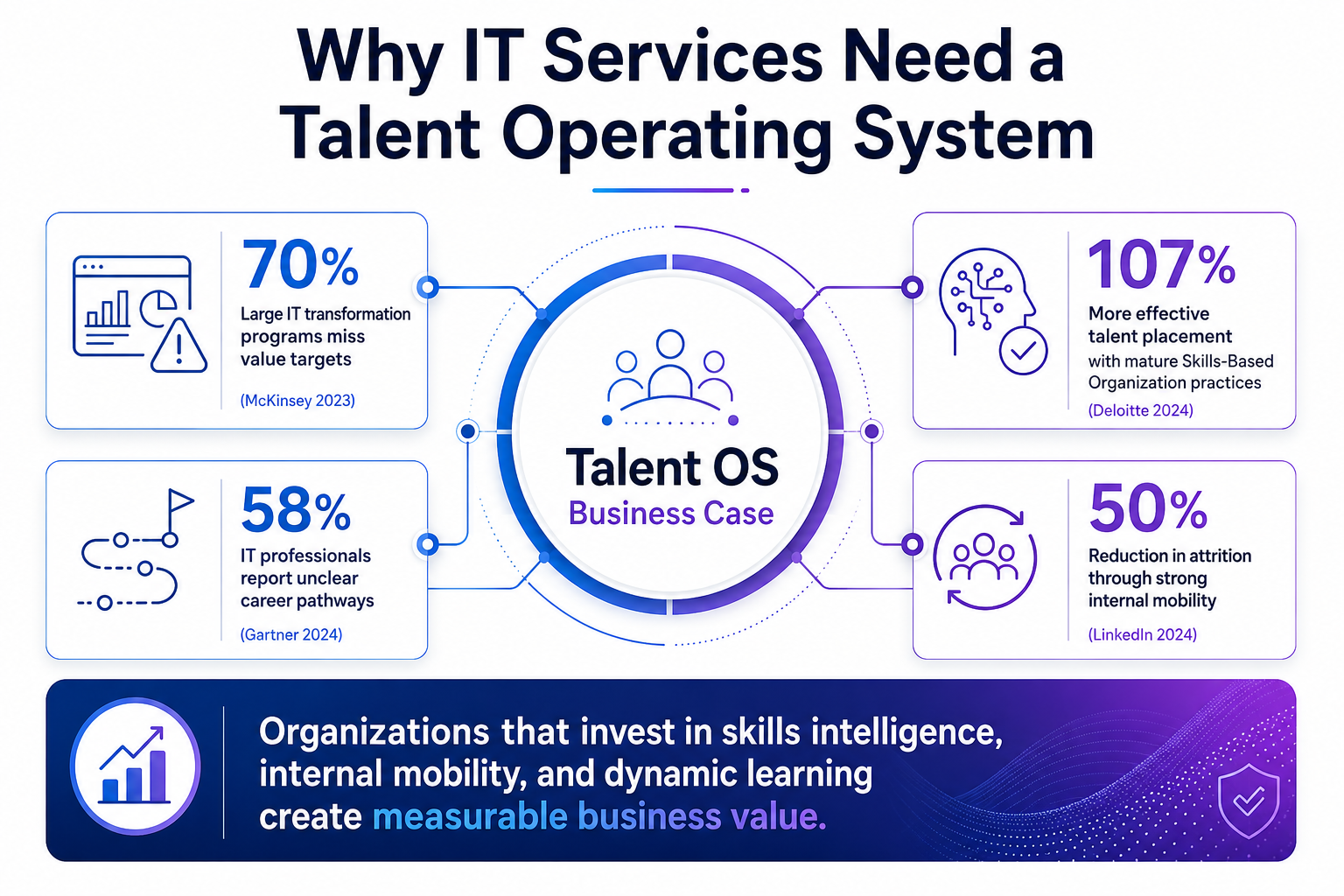
Despite record technology investment, 70 percent of large-scale IT transformation programmes fail to deliver their intended value targets (McKinsey Global Institute, 2023). The reasons are rarely technical. They are human: wrong skills allocated to wrong work, talent exhausted by relentless delivery without replenishment, and organisations too rigidly structured around billable output to redirect capability toward innovation.
Utilisation as a primary management metric made sense in the era of time-and-materials contracting, when the value exchange was explicit: hours billed for hours delivered. But it imports a fundamental distortion into any talent strategy. When the primary metric is whether a person is billable today, the organisational incentive is to keep them on accounts rather than develop them for tomorrow. Career development, internal mobility, and structured learning are not simply deprioritised — they are actively penalised. A consultant pulled from a project to complete a certification is a utilisation loss. A manager who allows lateral moves risks account coverage gaps.
"The utilisation era is not ending because leaders have changed their values. It is ending because the market has changed its demands. Clients no longer simply buy hours; they buy outcomes. And outcomes require differentiated skills, not interchangeable capacity." — Deloitte Human Capital Trends, 2025 |
The consequences compound over years. McKinsey's 2023 research on digital talent confirms that organisations with rigid utilisation frameworks lose their highest-potential employees 40 percent faster than firms with visible internal mobility paths. Gartner's 2024 Future of Work survey found that 58 percent of IT services professionals describe their firm's career pathways as opaque or non-existent. And Deloitte's 2025 Human Capital Trends report identifies capability stagnation — the condition in which workforce skills fall progressively behind market needs — as the single largest strategic risk in professional services.
Skills-based organisations offer an alternative operating logic. Rather than organising work around fixed roles and measuring productivity through occupancy, SBOs organise work around skill requirements and measure productivity through value delivered. The transition touches everything from how projects are staffed to how compensation is structured to how learning investments are approved. But it begins with a single, foundational shift: treating human capability as a dynamic strategic asset rather than a static operational input.
2. What Is a Talent Operating System?
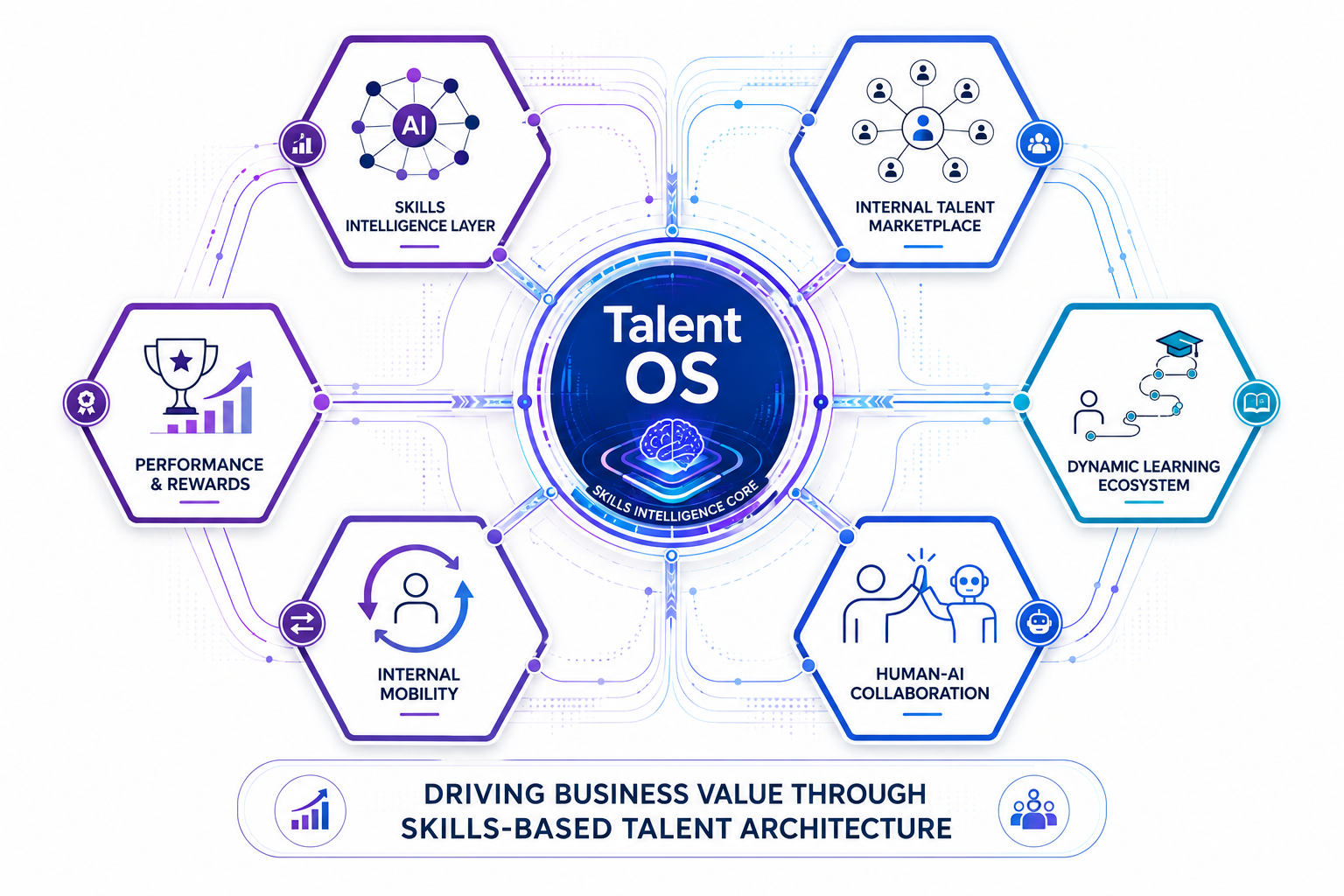
The term "operating system" is deliberate. Just as a technology OS provides the foundational infrastructure through which all applications run, a Talent OS provides the foundational infrastructure through which all talent decisions are made. It is not a single platform or policy. It is an integrated architecture — and its components must work together for any one of them to function well.
Talent OS Component | What It Does |
Skills Intelligence Layer | Dynamic, data-driven map of what capabilities the organisation has, at what proficiency levels, and how those capabilities relate to one another. The foundation without which every other component is guessing. |
Internal Talent Marketplace | Platform and cultural norm allowing skills and opportunities to find each other across organisational boundaries. Breaks the hold of "who you know" on career progression and surfaces opportunities based on skills, not seniority. |
Learning Ecosystem | Interconnected learning experiences, content platforms, cohort programmes, and on-the-job stretch assignments that respond to emerging gaps, connect learning to real work, and track capability development rather than course completion. |
Performance and Reward Frameworks | Metrics, incentives, and recognition mechanisms that define what the organisation values. In a Talent OS, these recognise skill building, knowledge sharing, mentoring, and lateral moves — not only delivery metrics and billability. |
These components are mutually dependent. A talent marketplace without skills intelligence is a job board. Skills intelligence without a learning ecosystem generates a map of gaps with no routes forward. A learning ecosystem without aligned performance frameworks produces development that feels disconnected from real career consequence. The Talent OS is an integrated system — and it requires that integration to function.
87% Executives experiencing skills gaps now or expecting them within 5 years (McKinsey Survey) | 98% More likely to retain high performers with mature SBO practices (Deloitte, 2024) | 40% Faster talent loss with rigid utilisation frameworks (McKinsey, 2023) | 57% More likely to anticipate and respond to change with skills-based practices (Deloitte, 2024) |
3. The Rise of Skills-Based Organisations
Skills-based organisations are not a philosophical aspiration. They are an emerging operational reality, documented across sectors and accelerated by the AI era's relentless demand for capability recombination. Deloitte's 2024 Global Human Capital Trends survey found that organisations with mature skills-based talent practices are 107 percent more likely to place talent effectively, 98 percent more likely to retain high performers, and 57 percent more likely to anticipate and respond to change.
For IT services firms, the shift from role-based to skills-based organising carries specific structural implications:
Workforce Planning
Instead of planning headcount by role category, organisations plan by skills portfolio. This requires knowing not only what skills the organisation has today but what adjacent skills employees could develop — and at what velocity, given the right investment. The firms that build this intelligence now will make faster, more confident workforce decisions than competitors operating on assumptions and org charts.
Unlock the Full Research
Create a free account or sign in to access the complete methodology, deep-dive analysis, and key implementation frameworks.
Don't have an account? It's free to join.
Organization Learning Labs
Research & Insights Division


Comments