Talent Flywheel IT Services | Growing Skills at Scale 2030

How IT services firms can build a self-reinforcing talent flywheel to grow skills internally at scale.
The Talent Flywheel in IT Services: From Buying Skills to Growing Them at Scale
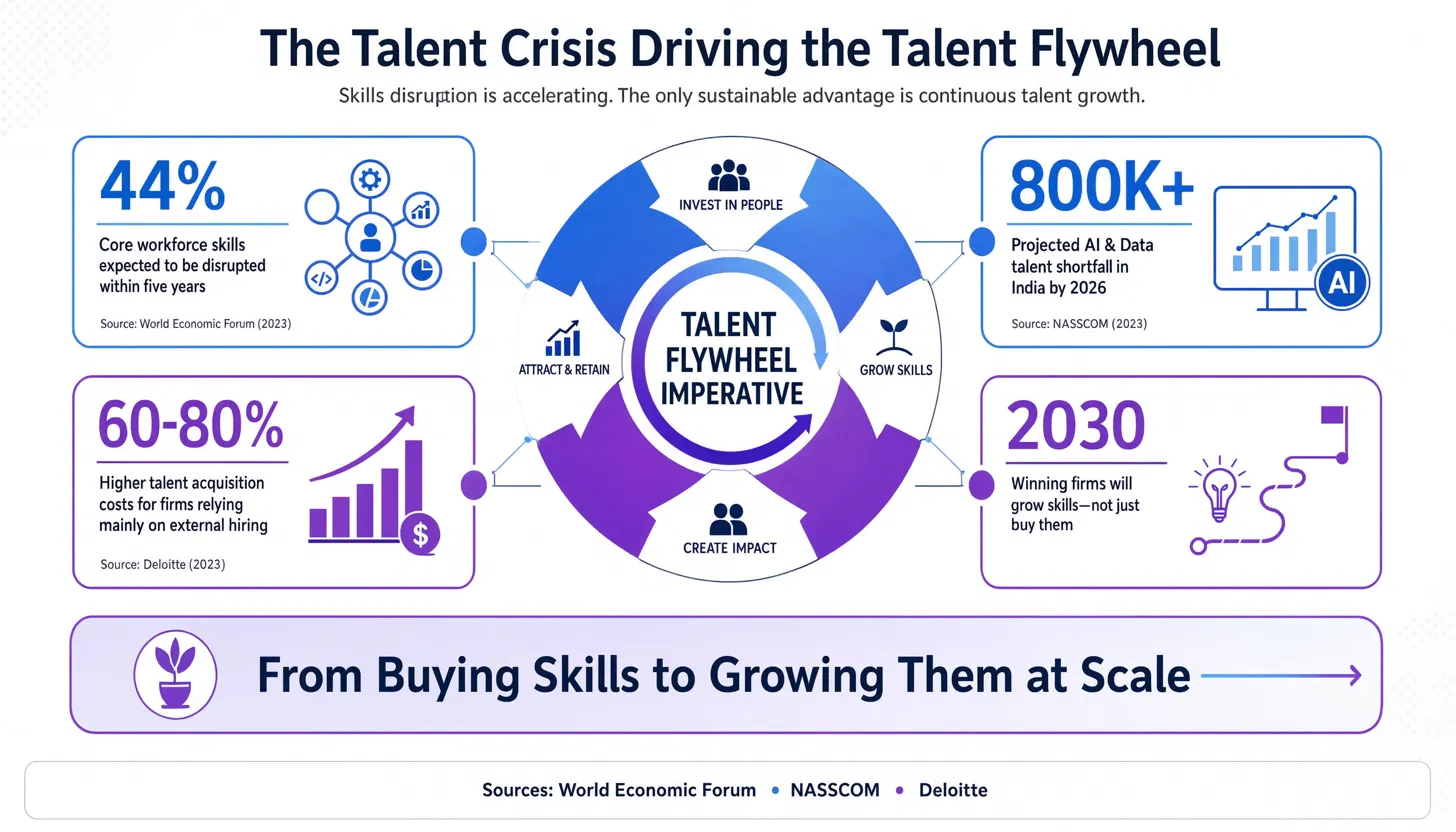
For three decades, the dominant talent strategy in IT services has been lateral hiring. When new technologies emerge, firms compete aggressively in the external market for professionals who already possess the required skills. That strategy is now structurally broken. The Talent Flywheel -- a self-reinforcing internal capability-building system -- is rapidly becoming the defining competitive advantage in IT services.
Why Is the "Buy Skills" Model Breaking Down for IT Services Firms?
The structural limitations of the lateral hiring model are now compounding across multiple dimensions simultaneously.
Supply Cannot Keep Pace With Demand
As every IT services organization, enterprise client, GCC, and technology startup simultaneously competes for AI engineers, cloud architects, data scientists, and cybersecurity specialists, the external talent pool becomes chronically constrained. NASSCOM (2023) projects a shortfall exceeding 800,000 AI and data professionals in India alone by 2026, against current hiring trajectories.
The Cost of Lateral Hiring Is Compounding
Premium skills command significant and growing compensation premiums. Deloitte (2023) finds that organizations relying primarily on external hiring for digital and AI roles report per-FTE talent acquisition costs 60 to 80 percent higher than those investing in systematic internal development pathways.
Attrition Destroys the Economics of Buying
Professionals with niche expertise are among the most mobile in the industry. After being hired at premium cost, they are frequently recruited away within 12 to 18 months. Organizations invest heavily in onboarding and client context, only to absorb those costs again when the professional leaves.
"The organizations that will win the talent war of 2030 will not be those who hire the fastest. They will be those who learn the fastest." — Josh Bersin, Global Workforce Intelligence Report, 2023 |
What Is the Talent Flywheel Model and How Does It Work?
The talent flywheel is a self-reinforcing cycle of anticipation, building, deployment, and reinvestment that progressively strengthens an organization's internal capability base while reducing structural dependency on external hiring.
STAGE 1: ANTICIPATE Analyze technology trends, client pipelines, and strategic roadmaps to identify critical capability gaps 18 to 36 months in advance. Skills intelligence is the strategic precondition for everything that follows. |
STAGE 2: BUILD INTERNALLY Develop capabilities through internal academies, digital learning platforms, mentoring structures, and project-based learning. Learning must be both scalable across populations and measurable in business terms. |
STAGE 3: DEPLOY INTO HIGHER-VALUE WORK Place newly skilled professionals into advanced engagements through internal talent marketplaces and skills-based staffing systems. Higher billing rates and deeper client relationships fund the next cycle. |
STAGE 4: REINVEST IN CAPABILITY Revenue and productivity gains from higher-value deployment are partially reinvested into expanding learning infrastructure, developing new curricula, and scaling the platforms that support the entire system. |
What Organizational Infrastructure Does a Talent Flywheel Require?
Skills-Based Organizational Architecture
Unlock the Full Research
Create a free account or sign in to access the complete methodology, deep-dive analysis, and key implementation frameworks.
Don't have an account? It's free to join.
Organization Learning Labs
Research & Insights Division


Comments