Sustainable Transport Capability for Leaders

A leadership guide to building practical ESG and sustainable transport capability that turns emissions targets into route, fleet, and behavior change.
Greening the Network: Building Practical Sustainability Capability in Transportation and Logistics
Why Sustainability Has to Become an Operating Capability, Not a Reporting Exercise
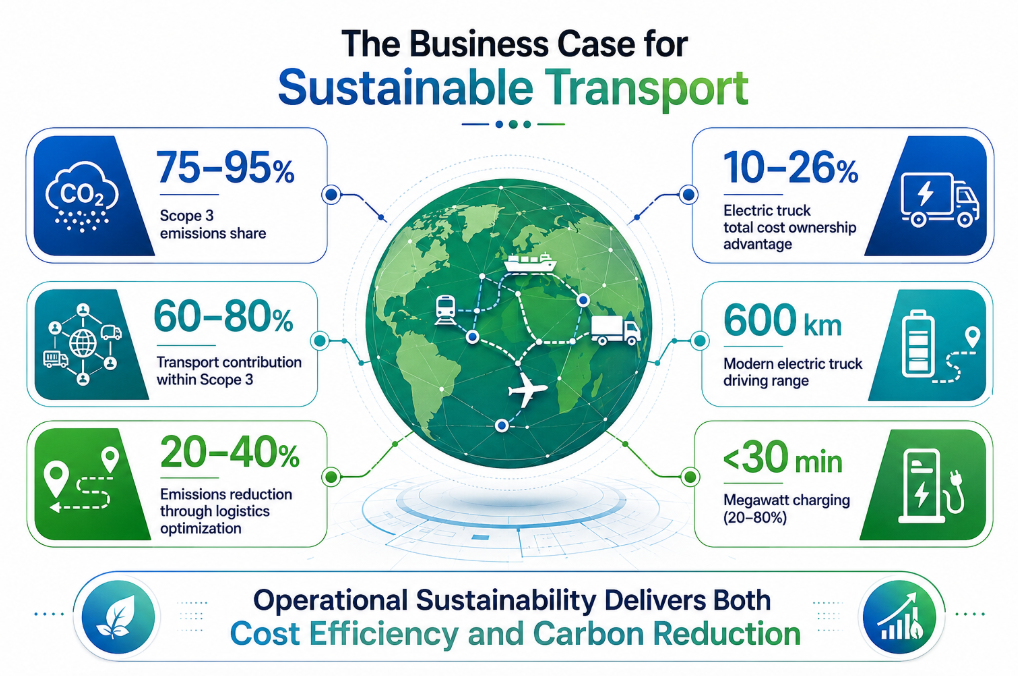
For most logistics organizations, Scope 3 emissions, those generated across the value chain rather than by owned assets, account for 75 to 95 percent of total greenhouse gas emissions, and corporate supply chain emissions run on average 26 times higher than direct operational emissions. Within that Scope 3 total, upstream transportation and distribution typically accounts for 60 to 80 percent on its own, meaning the transportation function sits at the very center of any credible decarbonization strategy, not at its periphery. Despite this, engagement with Scope 3 measurement remains limited across the sector, and internal software systems at most organizations are not yet capable of presenting the data managers need to factor emissions into live transportation decisions, such as which carrier to use for a given load. Treating sustainability as an annual disclosure exercise, produced after the fact by a reporting team, misses where the actual reduction opportunity sits: in daily routing, fleet, and behavior decisions.
Upstream transportation and distribution typically accounts for 60-80% of a logistics company’s total Scope 3 emissions. Nexio Projects, Scope 3 Emissions for Logistics Companies, 2026 |
Capability Components for Operational Decarbonization
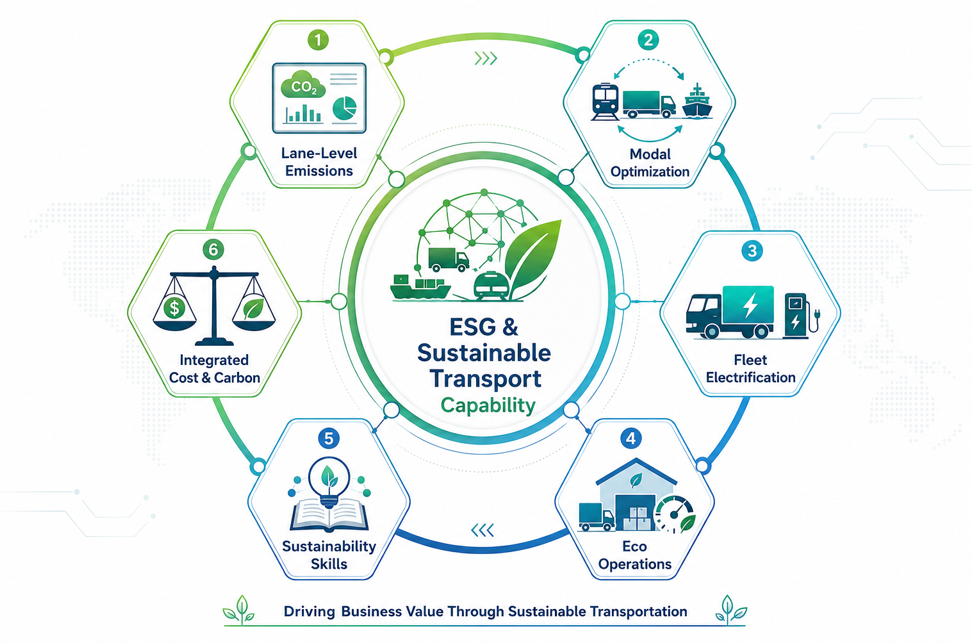
Measuring Emissions Per Lane, Per Shipment, Per Customer
Credible decarbonization starts with emissions data granular enough to inform an actual routing or carrier decision, not just an annual, company-wide total. Misallocating transport emissions between reporting categories is one of the most common errors organizations make, for example recording transportation of purchased goods under the wrong category entirely, which quietly undermines the accuracy of the entire inventory and, with it, leadership’s confidence in using the data operationally. Organizations that build emissions measurement at the lane, shipment, and customer level create the specific, decision-grade data that lets planners weigh a carbon cost alongside a financial cost when choosing a mode or carrier, rather than treating emissions as a number calculated separately after the operational decision has already been made.
Modal Shift and Consolidation Strategies for Lower Carbon
Strategic logistics planning, mode shifting from air and truck toward rail or sea where feasible, improving load factors, reducing empty return trips, and regionalizing sourcing to shorten transport distances, can reduce emissions by 20 to 40 percent without materially increasing cost. This is a critical point for leadership framing: credible decarbonization does not require choosing between cost discipline and emissions reduction in most cases; the two objectives are frequently aligned, since a better-consolidated shipment or a shorter sourcing distance is usually cheaper as well as cleaner. The organizations extracting this value fastest are the ones treating modal shift and consolidation as core network design questions, not as sustainability initiatives run in parallel to the core planning process.
Equipment Choices: EVs, Fuel-Efficient Vehicles, and Maintenance
Electric trucks have moved from pilot experiment to mainstream fleet option in the past year, with global electric medium- and heavy-duty truck sales exceeding 90,000 units, and newer models now offering up to 600 kilometers of range. The economics increasingly favor electrification on the right routes: in predictable, return-to-base operations, electric trucks already show a 10 to 26 percent total-cost-of-ownership advantage over diesel in some markets, without subsidy. The capability question is not whether to electrify, but which routes, depots, and customers are ready first; depot-based, urban, port, and regional freight with predictable daily mileage and controllable charging windows are consistently the strongest early-adoption candidates, while long-haul routes generally require charging infrastructure that is still maturing.
Practical Behaviors and Processes That Make Targets Real
Emissions targets translate into results only through specific, daily behaviors embedded across planning, driving, and warehouse operations:
- Planners using emissions as a genuine factor alongside cost and time in mode and carrier selection, supported by lane-level emissions data rather than an annual company-wide average.
- Drivers trained in eco-driving technique and maintenance habits, both of which measurably affect fuel and energy consumption independent of the vehicle technology itself.
- Warehouses and hubs adopting simple, low-cost energy and waste routines, since decarbonization gains are not confined to the moving fleet and often carry a faster payback in fixed facilities.
- Route and load consolidation reviewed with the same rigor as cost-per-mile, since the two metrics frequently move together rather than in opposition.
Talent and Learning: Building Sustainability Fluency Across Roles
Unlock the Full Research
Create a free account or sign in to access the complete methodology, deep-dive analysis, and key implementation frameworks.
Don't have an account? It's free to join.
Organization Learning Labs
Research & Insights Division


Comments