Sustainable Pharma: Capability Gaps to Competitive Advantage

Pharma's sustainability challenge is a capability gap, not a technology gap. Learn how leaders build the workforce skills that turn ESG ambition into results.
Sustainable Pharma: Turning Capability Gaps into Competitive Advantage
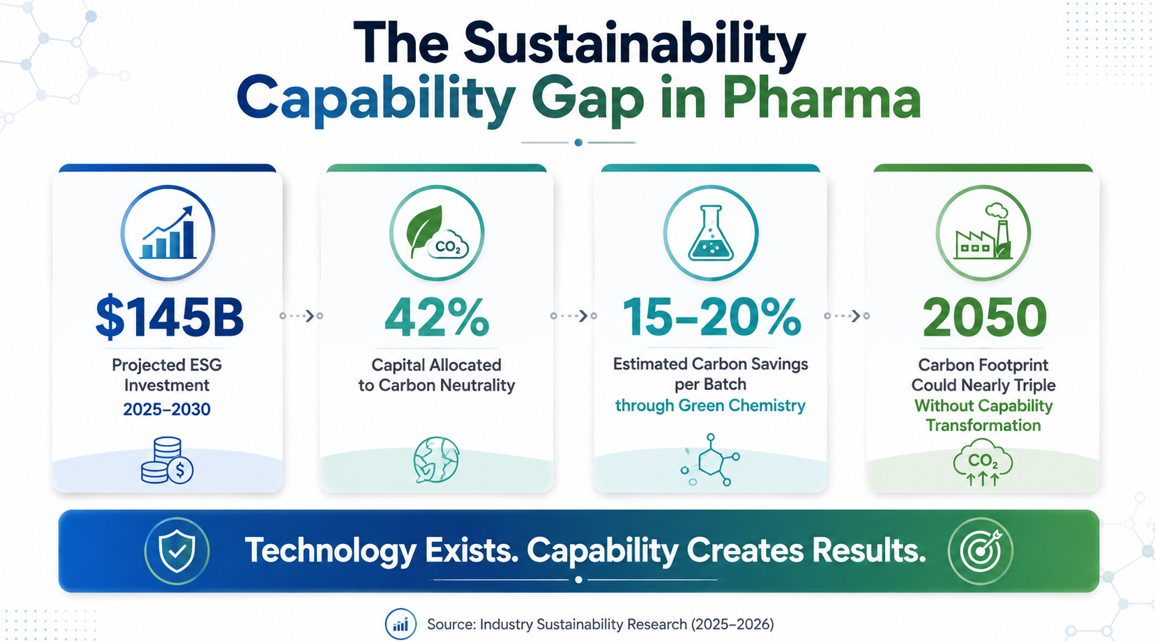
Building sustainable pharma workforce capabilities has become the defining leadership challenge of the next decade, and the industry is approaching it the wrong way. The pharmaceutical sector generates a disproportionate share of global healthcare emissions relative to revenue, and independent lifecycle analysis puts its emission intensity meaningfully higher than the automotive industry's. If current trajectories persist, the sector's carbon footprint could nearly triple by 2050.
What is consistently missed in boardroom discussions is that this is not primarily a technology problem or an ambition problem. It is a capability problem. The companies that lead the next phase of sustainable pharma will not necessarily be those with the boldest net-zero pledges. They will be the ones that systematically build the skills, knowledge, and organizational mindsets required to embed sustainability into everyday decisions, across R&D, manufacturing, supply chain, and commercial functions.
This distinction matters more than it appears to. Climate targets can be announced in a single boardroom meeting. They can only be delivered by a workforce equipped with capabilities that most pharmaceutical professionals were never trained to hold.
The Capability Challenge: Where Ambition Outpaces Knowledge
Over the past five years, pharmaceutical companies have made significant public sustainability commitments. Emissions reduction targets are now standard practice among large-cap pharma. ESG budgets are expanding sharply: industry analysis puts planned sector-wide ESG investment at approximately $145 billion between 2025 and 2030, with roughly 42% of that capital directed toward carbon neutrality initiatives, and the remainder split across social impact and governance programmes.
Yet knowledge has not scaled to match ambition. The sustainability expectations facing pharma now extend well beyond carbon emissions. Water consumption, waste generation, circularity, and supply-chain transparency are all under increasing scrutiny. Pressure arrives from every direction at once: investors screening for climate risk, regulators tightening disclosure requirements, healthcare systems building sustainability into procurement criteria, and increasingly, patients themselves, many of whom now expect companies devoted to health to demonstrate environmental responsibility in how that health is produced.
Meeting these expectations requires professionals who think differently about their core work, not a separate sustainability function bolted onto business as usual:
- R&D scientists who treat sustainability as a design parameter, evaluating environmental impact before a molecule ever reaches the lab bench
- Manufacturing engineers who understand energy systems, continuous processing, and circular-economy principles as fluently as they understand batch operations
- Supply-chain professionals conversant in water management, API discharge standards, and circular logistics
- Commercial teams capable of articulating sustainability-linked value without drifting into greenwashing
Most pharma professionals were never trained with these lenses because, until recently, the industry did not need them to be. The capability gap is real, and it is widening as regulatory and investor expectations accelerate faster than internal learning curves.
Mapping the Sustainability Capability Landscape
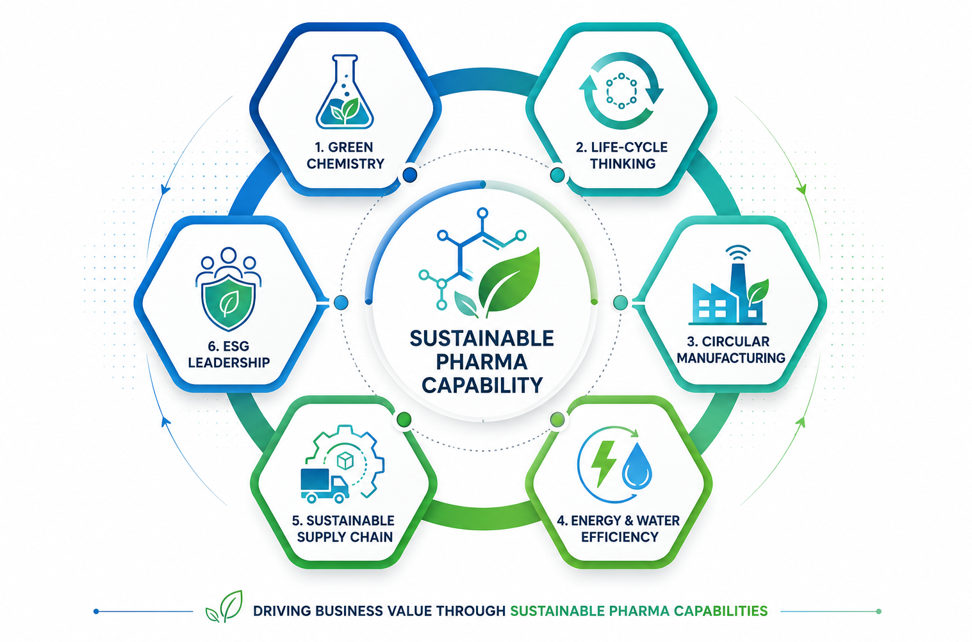
Building sustainable pharma competencies is not a single program or a single function's responsibility. It requires coordinated capability development across the entire value chain, and it looks different in every part of the organization.
Life-Cycle Thinking in R&D: Seeing the Full Picture
Historically, pharmaceutical R&D optimized for three variables: efficacy, safety, and speed to market. Environmental impact, if it was addressed at all, was handled downstream. Sustainability demands a shift toward life-cycle thinking: quantifying environmental impact from raw-material extraction through synthesis, formulation, manufacturing, distribution, use, and disposal.
This shift is more disruptive than it first appears. Solvents account for 80–90% of the total materials used in API synthesis. Without training in solvent alternatives, environmental impact assessment, and green chemistry principles, this single fact rarely changes a bench chemist's day-to-day decisions, regardless of how many times it appears in a sustainability report.
R&D teams building genuine life-cycle capability need structured development in environmental chemistry fundamentals, computational screening of compounds and reaction pathways, green chemistry principles, biodegradability and persistence assessment, and solvent and reagent selection. GSK has achieved sustained reductions in environmental impact through greener synthetic process redesign, and Pfizer has embedded green chemistry into its development protocols as a non-negotiable standard rather than an optional best practice. These outcomes reflect organizational capability built deliberately through training, process redesign, and sustained leadership commitment, not isolated pilot projects.
Green Chemistry: From Framework to Operating Discipline
Green chemistry has evolved from an academic concept into a genuine business imperative. Its twelve founding principles offer a clear conceptual framework, but frameworks alone do not change behavior on a production floor. Practical capability is required: retrosynthesis viewed through a sustainability lens, catalytic efficiency techniques that reduce waste generation, mastery of flow chemistry, and the ability to scale sustainable processes without eroding the environmental gains achieved at bench scale.
CAPABILITY IN PRACTICE
Pfizer's investments in green chemistry and solvent recovery are delivering estimated carbon savings of 15–20% per batch in affected processes, a gain realized only because operators, chemists, and engineers were trained to apply the underlying principles rather than simply informed of them.
Realizing this value consistently, batch after batch, site after site, depends on a workforce trained to apply green chemistry principles as a matter of routine, not a workforce that merely understands the concept in the abstract.
Energy-Efficient and Circular Operations
Pharmaceutical manufacturing is inherently resource-intensive. Facilities operate continuously, consume large volumes of energy and water, and generate complex waste streams within tight regulatory constraints. Sustainable operations require new capabilities at multiple organizational levels simultaneously.
Energy management at scale. Transitioning to renewable energy involves far more than an infrastructure upgrade. It requires expertise in grid dynamics, demand forecasting, storage systems, and energy procurement strategy. AstraZeneca and Pfizer illustrate how energy strategy, operations leadership, and procurement capability must align to move beyond symbolic renewable-energy purchases toward operational transformation.
Continuous manufacturing. Moving from batch to continuous processes reduces waste, energy use, and cycle times, but it demands an entirely different technical and cultural skill set. Operators, engineers, and quality professionals must become fluent in real-time monitoring and control systems that bear little resemblance to traditional batch-record documentation.
Circular economy thinking. Circularity extends well beyond recycling to closed-loop system design. Nearly half of biopharma manufacturers now prioritize recyclable packaging, but effective circularity additionally requires capability in solvent recovery, supplier collaboration, and circular procurement practice, not packaging redesign in isolation.
Zero liquid discharge and API management. Water scarcity and antimicrobial-resistance risk are elevating the importance of zero liquid discharge (ZLD) systems and API discharge controls. Implementing these systems requires expertise in wastewater treatment, environmental risk assessment, and resistance mitigation. Despite rising regulatory and investor attention, only about half of leading pharma companies currently disclose targeted water-management practices in API manufacturing, a transparency gap that itself reflects a capability gap.
Unlock the Full Research
Create a free account or sign in to access the complete methodology, deep-dive analysis, and key implementation frameworks.
Don't have an account? It's free to join.
Organization Learning Labs
Research & Insights Division


Comments