Skills-Based Talent Strategy in Banking

87% of financial firms now use skills-based hiring. See why skills taxonomies and simplified job architecture are the BFSI capability imperative through 2035.
Why Are Banks Abandoning Job Titles as the Organizing Principle for Talent?
For decades, banks organised talent around job titles: Credit Analyst, Relationship Manager, Operations Executive. Each carried fixed expectations, a linear promotion ladder, and little room to move sideways. That model assumed something banking can no longer promise its people: stability. Digital transformation, algorithmic risk modelling, and a regulatory perimeter that widens every year have made capability, not title, the currency that determines whether a bank can execute its strategy.
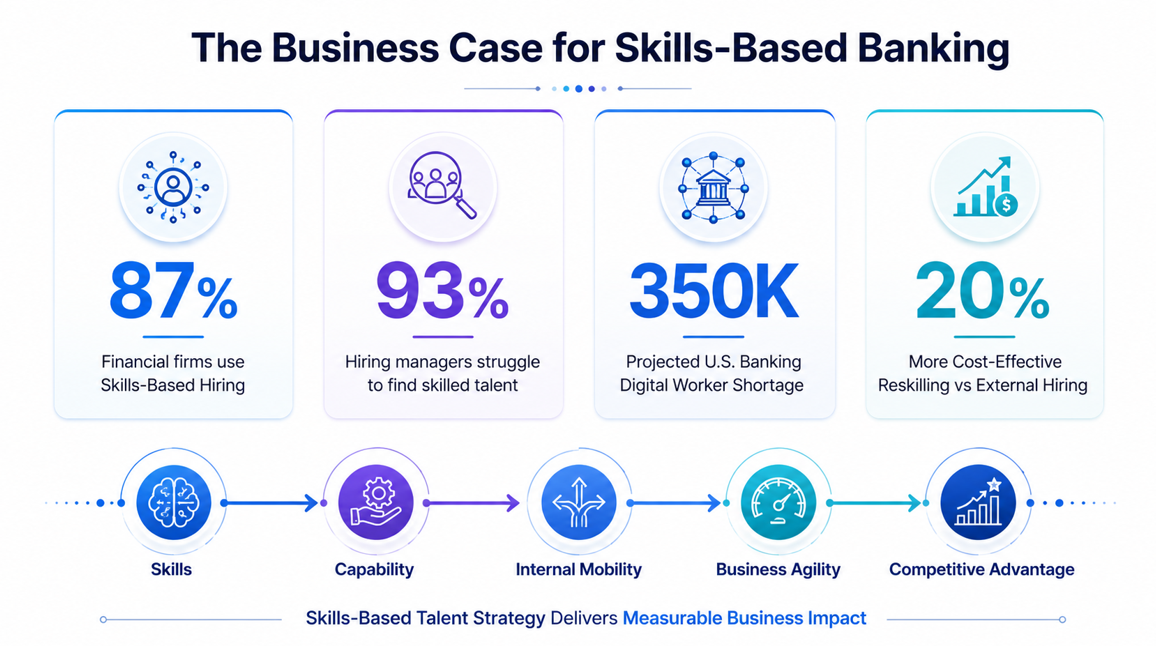
The shift is no longer theoretical. According to a 2025 CFA Institute-cited industry report, 87 percent of financial firms had adopted some form of skills-based hiring as of 2024, moving deliberately away from degrees and institutional pedigree toward what one BCG Managing Director has called simply "will and skill." This is not an HR pilot. It is fast becoming the default operating model for how leading banks source, deploy, and grow talent.
EXECUTIVE SNAPSHOT Skills-based talent strategy is not a recruitment tactic. It is a structural response to a labour market where roles change faster than job descriptions can be rewritten, and where the institutions that can redeploy talent fastest will out-execute those that cannot. |
Why Role-Based Talent Models Are Breaking Down
Traditional role-based systems assume the underlying job stays still long enough to define it. Banking today offers no such stability. Digital banking, data analytics, AI, cybersecurity, and regulatory technology skills evolve faster than job descriptions can be rewritten, while regulatory expectations increasingly demand continuous capability building rather than a static qualification earned once. Talent scarcity compounds the problem: 93 percent of hiring managers in financial services report difficulty finding skilled candidates for open roles, and U.S. banking alone faces a projected shortfall of roughly 350,000 digital workers that external hiring cannot realistically close.
When core skills turn over every three to five years, roles anchored to outdated assumptions become the bottleneck rather than the solution. A skills-based approach reframes the question. Instead of asking who fits a fixed job title, banks ask who has, or can build, the capabilities the business actually needs next. That reframing unlocks faster hiring, deeper internal mobility, and materially better retention, outcomes already visible in Indian and global banks that have adopted structured skills frameworks.
The Foundation: Skills Taxonomy and Simplified Job Architecture
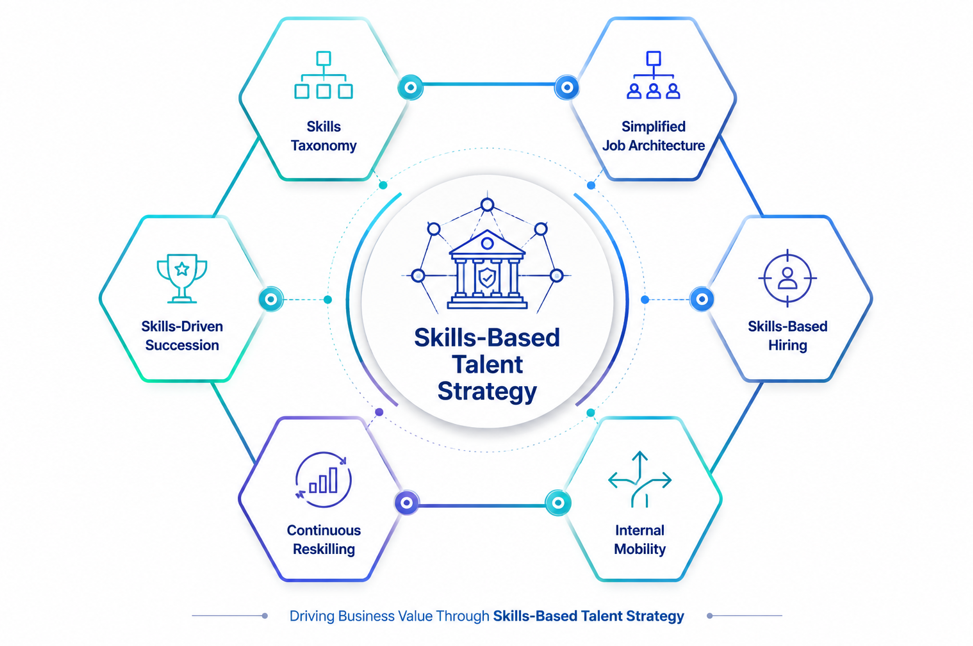
A durable skills-based workforce rests on two structural pillars: a skills taxonomy that defines the capabilities the bank needs, and a simplified job architecture that defines how work is organised around them. Together they create a shared language spanning recruitment, learning, performance management, and career growth.
How Big Should a Bank's Skills Taxonomy Actually Be?
Most effective banking taxonomies contain roughly 100 to 150 skills, grouped into five to seven categories such as leadership, core banking, data and analytics, technology, customer capabilities, operations, and risk and compliance. This range is deliberate. Fewer than 100 skills becomes too generic to guide real development decisions; more than 150 becomes difficult to operationalise inside performance and learning systems. Some of the world's most sophisticated financial institutions push far beyond this working range for specialist purposes: the UK's Financial Services Skills Commission notes that certain member firms maintain taxonomies of up to 3,000 discrete skills, though even the FSSC itself has distilled this down to 13 future-critical skills for practical prioritisation, spanning technical capabilities like data analysis and machine learning alongside human capabilities like adaptability and creative problem-solving.
Banks typically build taxonomies by combining external industry frameworks with internal validation, using cross-functional workshops and interviews with high performers to ensure the taxonomy reflects real work rather than theoretical job descriptions. The result should function as a living capability map, not a static HR document filed away after a single project.
The number one skill is going to be learning agility: the ability to unlearn, relearn, and learn continuously throughout your life. — Sagar Goel, Managing Director & Partner, Boston Consulting Group |
Simplifying Job Architecture to Enable Mobility
Once skills are defined, the next step feels counterintuitive to most banking leaders: reduce the number of job titles. Leading banks now operate with roughly 20 to 30 core roles instead of hundreds of overlapping designations, expressing seniority through skill depth and complexity rather than a proliferation of new titles. Credit Analyst I, II, and Senior Analyst, for example, consolidate into a single Credit Professional role, with growth defined by progression from foundational to advanced skill levels rather than a title change.
Unlock the Full Research
Create a free account or sign in to access the complete methodology, deep-dive analysis, and key implementation frameworks.
Don't have an account? It's free to join.
Organization Learning Labs
Research & Insights Division


Comments