Skills-Based Organization Guide: Building SBO by 2030

Comprehensive CXO guide to building a skills-based organization -- AI-enabled skills taxonomy, talent marketplaces, skills-based learning journeys, and a five-phase transformation roadmap.
Why the Traditional Job-Based Organization Is No Longer Fit for Purpose
For the better part of a century, the job has been the fundamental organizational unit of work: a defined role with specified responsibilities, required credentials, and a position in a hierarchy that determined what the person did, who they worked with, and where they could go next. This model served organizations well in stable, slow-moving environments. It is structurally failing in environments defined by rapid technological change, accelerating skills obsolescence, and the need for continuous organizational reconfiguration.
The failure mode is precise. Job descriptions are static; skills requirements are dynamic. By the time a traditional organization updates a job specification, posts a role, conducts interviews, makes a hiring decision, and onboards a new employee, the skills landscape has often shifted enough to render the original specification partially obsolete. The result is a persistent mismatch between what organizations need and what their talent infrastructure can deliver -- a mismatch that compounds with every acceleration of technological change.
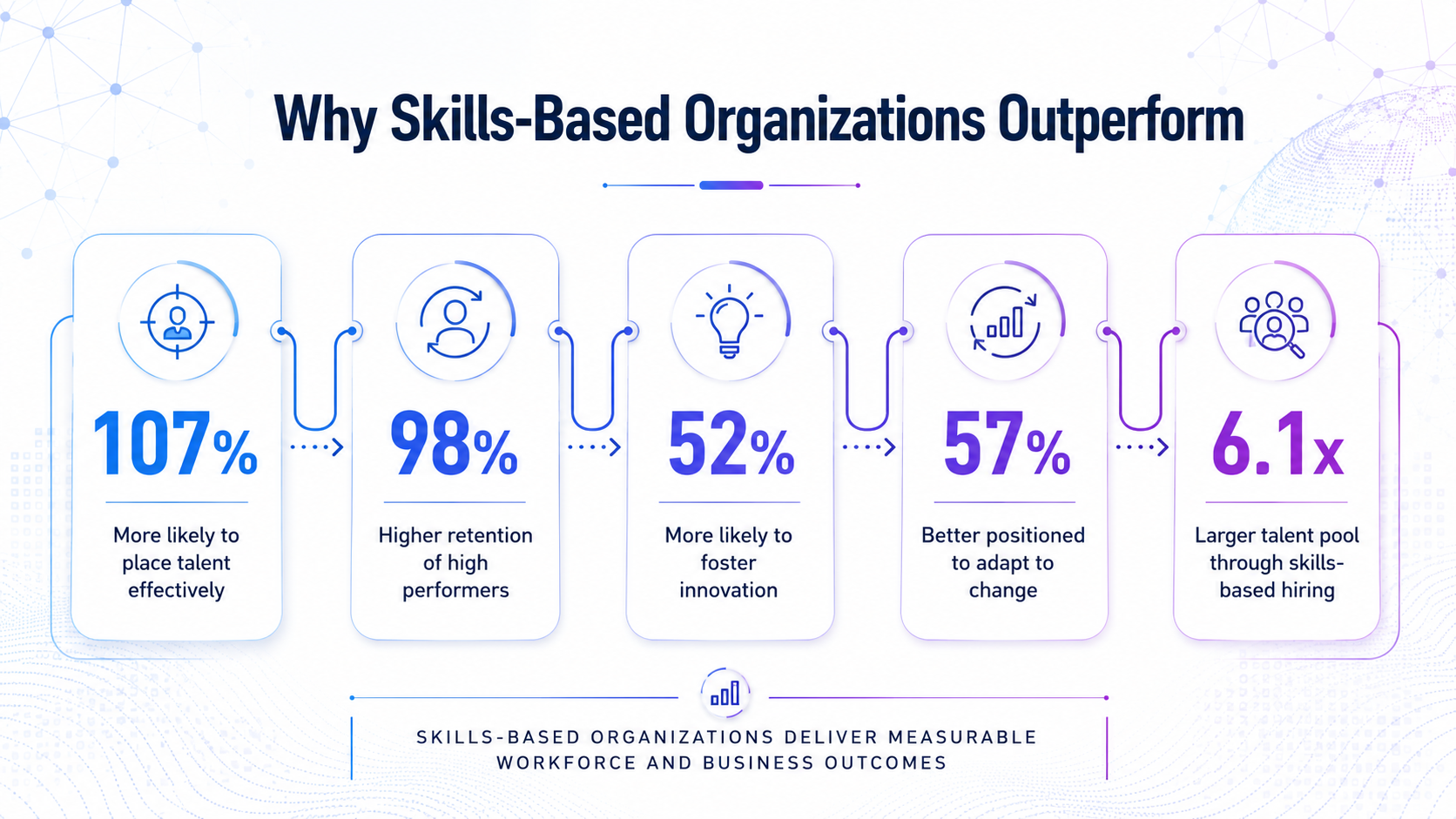
The data on the business impact of this mismatch is unambiguous. Organizations adopting skills-based approaches to talent management are 107% more likely to place talent effectively and 98% more likely to retain high performers (Deloitte, 2025). They are 52% more likely to foster innovation and 57% better positioned to adapt to change. LinkedIn Economic Graph research from March 2025 demonstrates that skills-based hiring expands the available talent pool by 6.1 times compared to credential-based approaches -- and by 8.2 times for AI-related roles, where traditional credential proxies are least effective at identifying genuine capability.
107%More likely to place talent effectively -- the measured performance advantage of organizations with mature skills-based talent management versus credential-based approaches (Deloitte, 2025) |
"The shift to skills-based organizations is not a trend or a preference -- it is a structural response to an environment in which the half-life of job-based talent architectures is shorter than the time required to build them." -- McKinsey & Company, Taking a Skills-Based Approach to Building the Future Workforce, 2024 |
What Is a Skills-Based Organization -- and What Distinguishes It from Skills-Based Hiring?
Skills-based hiring -- replacing credential requirements with skills-based assessment in recruitment -- is widely adopted and well-understood. Approximately 73% of companies used skills-based hiring practices in 2023, with rapid adoption continuing through 2024 and 2025. But skills-based hiring is not the same as a skills-based organization. The difference is fundamental.
A skills-based organization (SBO) is a comprehensive operating model redesign in which skills -- rather than job titles, seniority levels, or organizational positions -- become the primary unit for organizing work, allocating talent, designing development pathways, and managing performance. In a traditional organization, the job title determines what someone does. In a skills-based organization, the skills someone has determines what work they are allocated to -- and work is continuously matched to the skills best suited to accomplish it, regardless of which role those skills currently reside in.
The conceptual shift is from fixed Lego structures to flexible building blocks. A traditional organization hires a 'Marketing Manager' and that title defines a fixed set of responsibilities, reporting relationships, and career paths. A skills-based organization identifies individuals with competencies in customer segmentation, data analytics, content strategy, and stakeholder management -- and deploys those capabilities across the projects, products, and initiatives that need them most, regardless of which team or department they formally belong to.
Research confirms that 65% of employers now believe skills-based hiring is more effective at identifying capable candidates than traditional resume screening, 71% find it more predictive of on-the-job performance, and 65% report lower turnover among employees hired through skills-based processes. But the full transformational value of skills-based approaches -- the 107% talent placement improvement, the 98% retention advantage -- requires implementing the complete operating model, not just reforming recruitment.
What Are the Essential Building Blocks of a Skills-Based Organization?
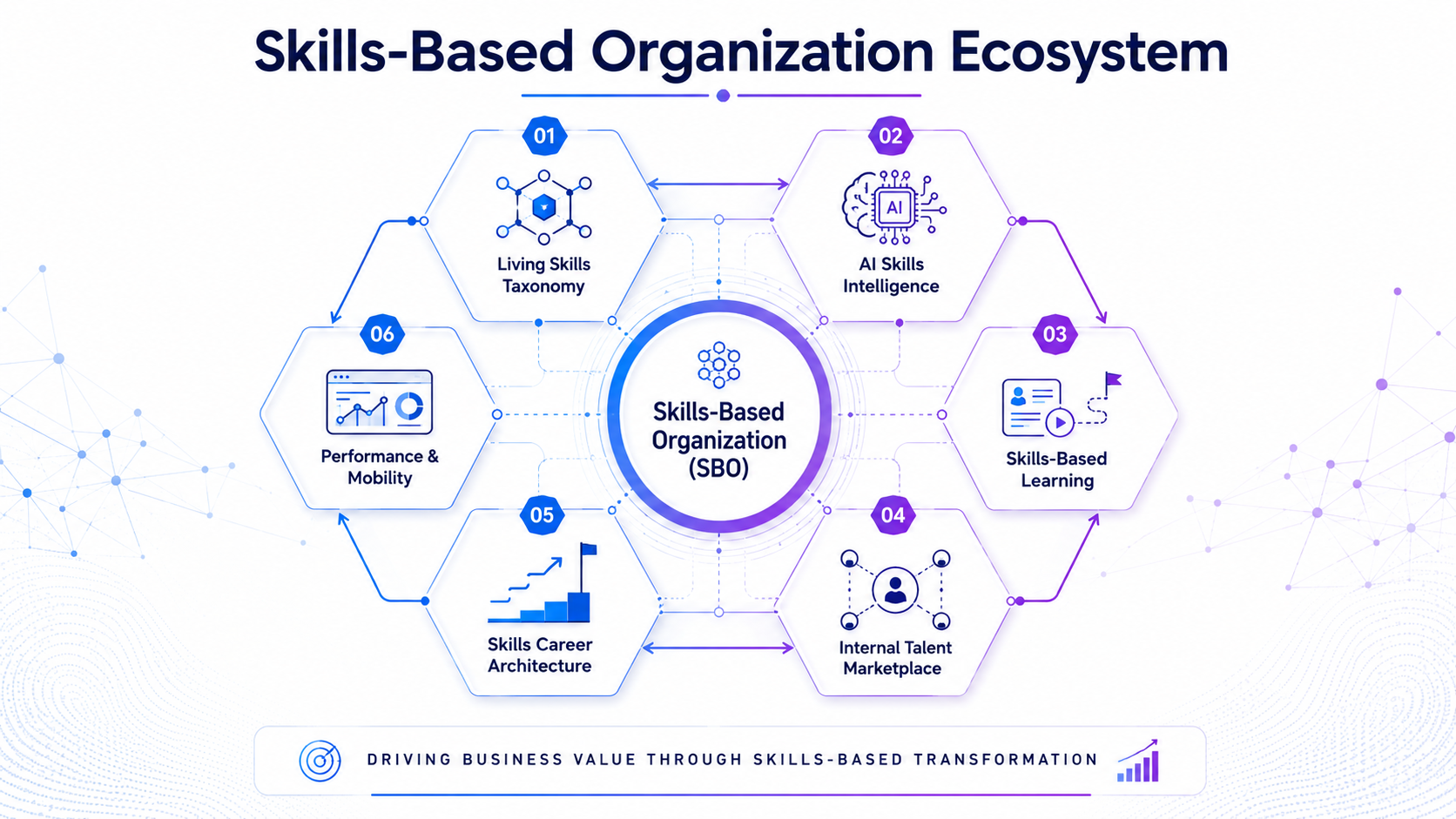
Building Block 1: A Living Skills Taxonomy
The foundational infrastructure of any skills-based organization is a comprehensive, dynamically maintained skills taxonomy: a structured, hierarchical framework that defines the skills the workforce possesses, the skills that roles require, and the skills the organization needs to develop in order to execute its strategy. This taxonomy is not a static document produced by an HR working group. It is a continuously updated organizational asset -- the common language through which all talent decisions are made.
AI is transforming what a skills taxonomy can be. Traditional taxonomy development was manual, slow, and consistently out of date by the time it was published. AI-enabled taxonomy management rapidly extracts skills from thousands of job descriptions, resumes, learning records, and performance reviews at scale; standardizes terminology across business units; automatically categorizes skills into meaningful domains; and keeps the taxonomy current by continuously ingesting external labour market data and detecting emerging or declining skills. The result is a living skills framework that is accurate both today and as the market evolves -- something that static, manually maintained taxonomies cannot achieve.
Building Block 2: AI-Enabled Skills Intelligence
Knowing what skills exist in the taxonomy is insufficient without knowing what skills exist in the organization. Skills intelligence platforms combine validated assessments, AI-driven inference from performance data and work outputs, and structured manager validation to build a continuously updated picture of organizational capability at both individual and aggregate levels.
Unlock the Full Research
Create a free account or sign in to access the complete methodology, deep-dive analysis, and key implementation frameworks.
Don't have an account? It's free to join.
Organization Learning Labs
Research & Insights Division


Comments