Scaling Without Breaking: E-Commerce Operations Excellence Guide

Why fulfillment, returns, and last-mile operations are now a board-level capability. Research-backed roles, metrics, and a roadmap to operations maturity.
Scaling Without Breaking
Designing E-Commerce Operations Capability for Speed, Reliability, and Margin
Introduction: The Growth Every Brand Wants, and the Fragility It Exposes
Every commerce leader wants growth in orders. Far fewer are ready for what that growth does to fulfillment accuracy, returns volume, and cost-to-serve once it arrives. The operational strain shows up first in the numbers nobody puts on a growth slide: U.S. retailers processed nearly 850 billion dollars in returns in 2025 alone, an amount equivalent to roughly 15.8 percent of total retail sales, with online-only return rates running close to 19 to 21 percent, and considerably higher again in apparel and footwear. Beyond the merchandise value itself, the National Retail Federation estimates an additional 75 billion dollars in processing and shipping costs layered on top, since reverse logistics typically runs 20 to 30 percent more expensive per unit than outbound fulfillment because of fragmented, low-volume, high-touch handling.
These are not edge-case numbers from a struggling category. They are the operating reality of digital commerce at scale, and they explain why operations excellence has moved from a supporting function to a strategic differentiator. Brands that can drive traffic and convert orders but cannot fulfill, deliver, and process returns reliably do not fail quietly. They fail publicly, in damaged customer trust and eroded margin, exactly at the moment their growth story should be strongest.
The Operations Capability Stack
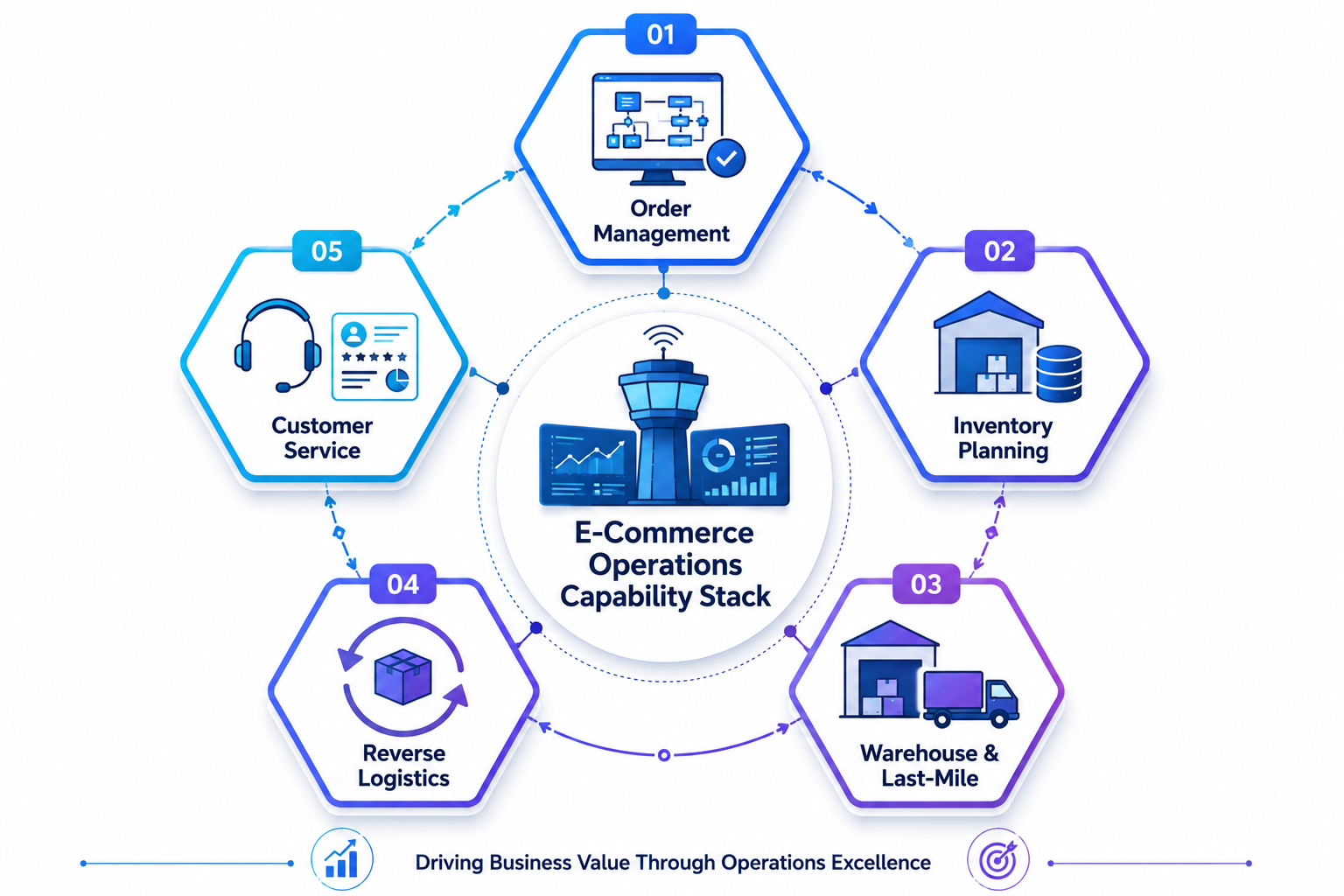
Operations excellence in e-commerce is not one function, it is a stack of interdependent capabilities that must perform together under variable, often unpredictable demand. Order management sits at the top of the stack, deciding how every order is routed, split, and prioritized across warehouses, dark stores, and franchise locations. Inventory planning determines whether the right stock exists in the right place before an order is even placed, which is the single largest lever over both fulfillment cost and customer disappointment. Warehouse and last-mile execution turn a confirmed order into a delivered package, and increasingly account for the largest single share of supply chain spend, an estimated 41 percent according to recent industry analysis, making it the highest-leverage area for cost control through carrier consolidation, route optimization, or micro-fulfillment investment.
Returns and reverse logistics complete the loop, and it is the loop most organizations under-resource relative to its financial weight. Customer service closes gaps the other four capabilities miss, absorbing the operational friction that inevitably occurs at scale. Each of these five capabilities maps to specific systems and specific teams, but the organizations that perform best treat the stack as one connected system with shared visibility, not five separate functions reporting up different chains of command.
Why Warehouse Automation Now Clears the ROI Bar
Leading fulfillment centers now report 18 to 24 month payback periods on goods-to-person robotics, with labor cost reductions of 30 to 40 percent and throughput increases of two to three times prior manual-pick baselines. On the reverse logistics side specifically, automated sorting and AI-powered grading systems can process thousands of returns per hour, cutting labor costs by roughly 30 percent and compressing processing time by 50 to 60 percent. Mid-market retailers should target a more conservative sub-36-month payback threshold when evaluating partial automation, since most mid-market operators still lack the order density that justifies full enterprise-grade automation, a gap reflected in the fact that only about 22 percent of mid-market e-commerce retailers had deployed automated returns management as of early 2026, compared with over 71 percent of enterprise retailers above 500 million dollars in GMV.
Talent Archetypes and Roles
Operations excellence requires a distinct talent model from the marketing- and merchandising-led capabilities most retail organizations built their leadership pipelines around. The e-commerce operations director owns the full stack described above and is accountable for cost-to-serve as rigorously as a merchandising leader is accountable for margin. The inventory and planning lead translates demand forecasts into stock positioning decisions that determine whether same-day and BOPIS promises can actually be kept. The process engineer designs and continuously improves the physical and digital workflows that turn an order into a delivery, treating every recurring error as a process defect to be engineered out, not a training issue to be repeated. The customer experience and service lead owns the recovery moments, the delayed order, the damaged item, the confusing return, that determine whether an operational failure becomes a lost customer or a forgiven one.
• Data fluency is now a baseline operations skill, not a specialist skill: Operations leaders increasingly need working fluency in order management and warehouse management systems, not just the ability to read a dashboard someone else built, because the pace of exception-handling at scale outstrips any process that requires a systems team intermediary.
• Cross-channel thinking separates strong operators from technically competent ones: The best operations leaders think natively across marketing demand signals, fulfillment capacity, and customer experience impact, because a promotional calendar decision made in isolation from operations capacity is one of the most common causes of peak-season failure.
Unlock the Full Research
Create a free account or sign in to access the complete methodology, deep-dive analysis, and key implementation frameworks.
Don't have an account? It's free to join.
Organization Learning Labs
Research & Insights Division


Comments