Retail Talent Ecosystems: Continuous Learning Strategy

How leading retailers are replacing static training programs with talent ecosystems that build learning velocity as a competitive moat. A strategic guide for CXOs and CHROs.
From Retail Training to Retail Talent Ecosystems: Continuous Learning as a Competitive Moat
Across the global retail landscape, a strategic inflection point is quietly redefining which organizations will win and which will fall behind. It is not about real estate. It is not about assortment breadth or pricing algorithms. It is not even about the sophistication of the technology stack.
It is about learning velocity.
The retailers who will dominate the next decade will be those who can sense market shifts faster, build new capabilities more quickly, and execute consistently across thousands of frontline employees -- not occasionally, but continuously. In a world where customer expectations shift in months not years, where product lifecycles compress, and where omnichannel complexity deepens, the capacity to learn at organizational scale is no longer a supporting capability. It is the central competitive capability.
This is the strategic logic behind the shift from retail training programs to retail talent ecosystems -- integrated systems that embed continuous learning into daily work, link capability building to business performance, and build the organizational agility that determines market winners from market laggards.
"The half-life of a professional skill has fallen to approximately five years, and in technology-intensive roles it may be as short as two and a half. Organizations that treat learning as episodic rather than continuous are systematically building capability deficits." -- Deloitte Human Capital Trends, 2025 |
Why the Stakes Are Higher Than They Have Ever Been
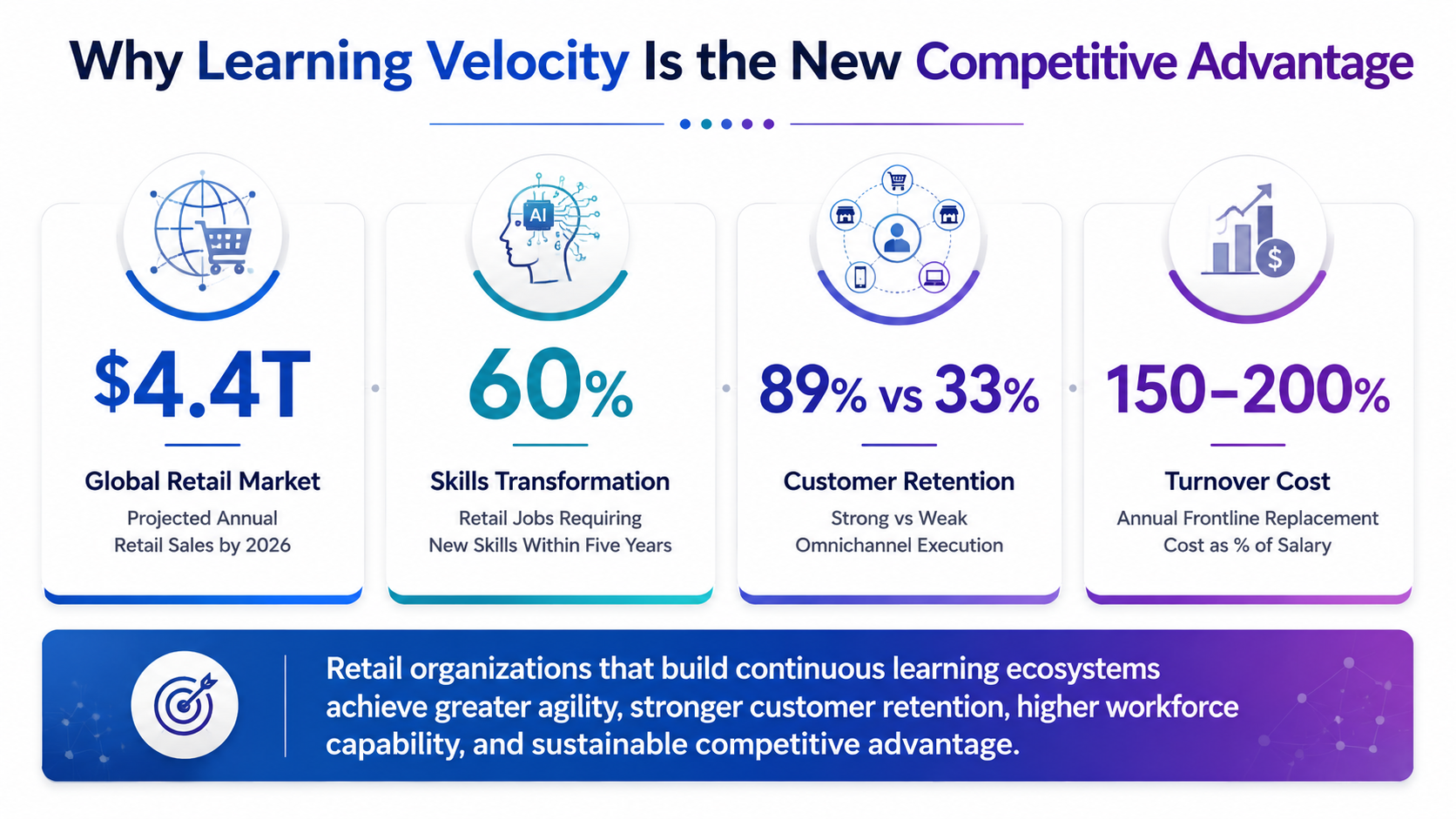
These numbers share a common thread: every business outcome of consequence in modern retail -- customer retention, omnichannel conversion, operational efficiency, talent stability -- is mediated by frontline and managerial capability. And capability does not sustain itself. It must be continuously renewed.
What a Retail Talent Ecosystem Actually Is
A retail talent ecosystem is not an LMS with more courses. It is a connected architecture that combines structured development, external partnerships, performance data pipelines, and embedded learning experiences to continuously build capability at scale. Three defining elements distinguish it from traditional training:
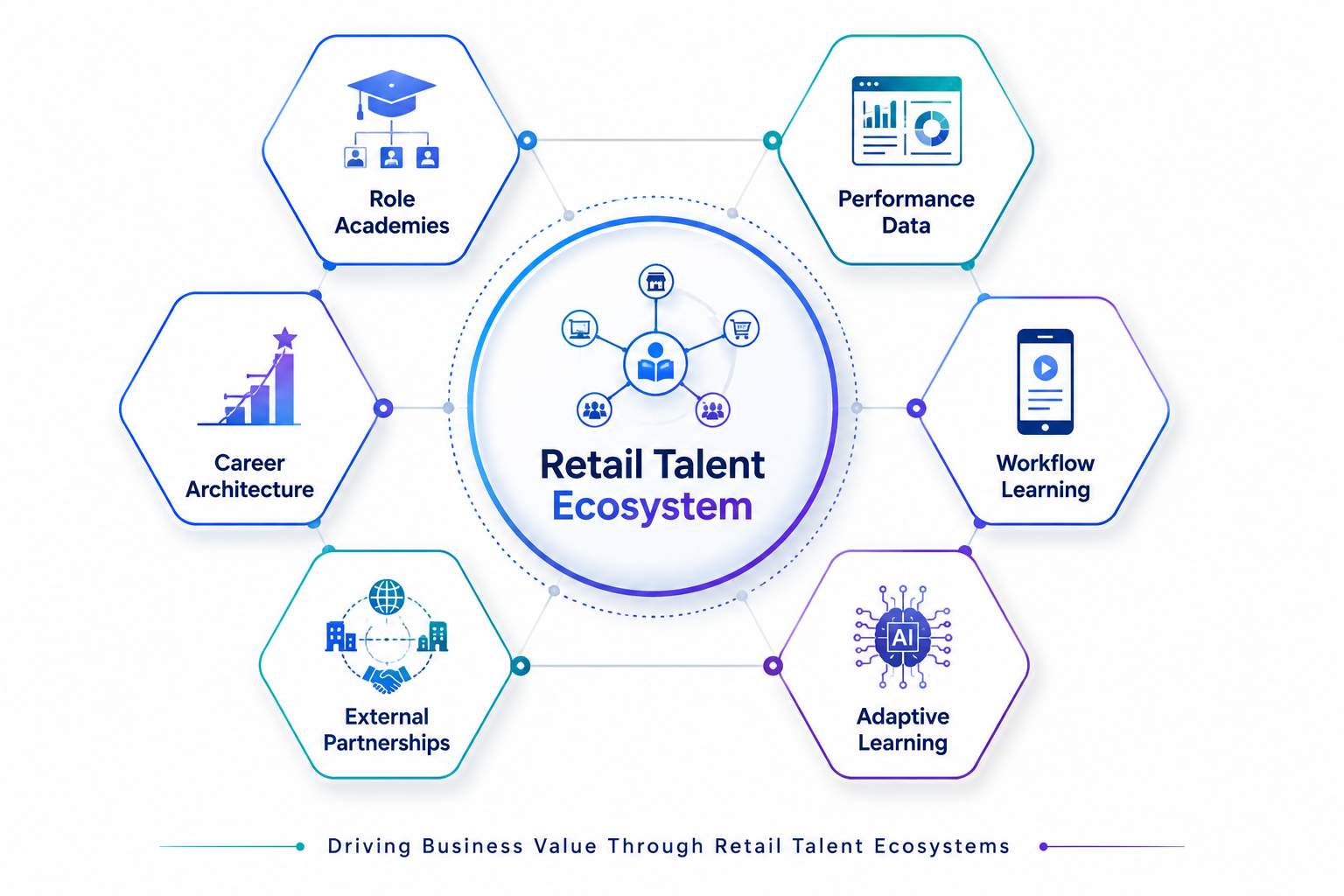
Internal Academies Structured Around Roles
Leading retailers build role-differentiated learning academies rather than generalized training programs. A Frontline Academy addresses sales techniques, digital fluency, product knowledge, and customer recovery for associates. A Store Manager Academy develops leadership, operations excellence, and people coaching capability. An Area Leadership Academy focuses on multi-unit strategy, performance management, and culture architecture.
Each academy has defined learning paths, measurable milestones, and certification standards that create visible career progression. Learning becomes career infrastructure, not a periodic event. McKinsey's 2024 research on skills-based organizations found that companies structured around learning-linked career pathways achieve 40 percent higher employee retention and 30 percent faster internal mobility.
External Partnerships That Extend and Refresh Capability
Talent ecosystems extend beyond organizational boundaries. They integrate ed-tech platforms for digital skills and leadership development, industry bodies for recognized certifications that provide employees with portable career credentials, and technology partners for system-specific training tied to platform adoption. These partnerships keep content current -- a critical advantage in a market where product and process changes outpace internal content refresh cycles.
Data Pipelines That Make Learning Precise
What fundamentally differentiates the talent ecosystem from the training program is data integration. Performance information from POS systems, customer experience platforms, HR databases, mystery shopping audits, and omnichannel analytics flows into learning systems to identify where capability gaps are generating operational drag.
• Stores with low NPS scores trigger targeted service recovery and empathy capability modules
• Low conversion rates activate consultative selling simulations and coaching interventions
• High turnover patterns prompt leadership coaching diagnostics and manager development programs
• BOPIS fulfillment errors trigger omnichannel process and system proficiency interventions
This precision -- learning investment targeted to actual operational gaps -- transforms L&D from a cost center to a performance lever.
Why Traditional Retail L&D Is No Longer Adequate
Most retail training models were built for operational stability in a predictable market environment. Four structural failures define their inadequacy in the current context:
Static Content in a Dynamic Market
Promotional calendars change monthly. Product ranges refresh seasonally. Competitive pricing pressures reshape customer behavior within weeks. Yet in many retail organizations, training materials are refreshed annually at best. By the time content is updated, frontline teams are already operating in a materially different commercial context. The content lag creates a systematic capability deficit that compounds over time.
Infrequent Learning That Fades Rapidly
Cognitive science research consistently demonstrates that without reinforcement, 70 percent of learning content is forgotten within 24 hours of training (Ebbinghaus Forgetting Curve). Quarterly training events and annual onboarding programs cannot sustain capability. Associates revert to established habits, and new hires learn inconsistently from whoever is available on shift.
Measurement Disconnected from Business Outcomes
Unlock the Full Research
Create a free account or sign in to access the complete methodology, deep-dive analysis, and key implementation frameworks.
Don't have an account? It's free to join.
Organization Learning Labs
Research & Insights Division


Comments