Resilient Pharma Workforce: Skills for a Volatile New Era Ahead

Pharma volatility is accelerating fast. Learn the five capability pillars that build a resilient workforce for constant regulatory and scientific change.
Resilient Pharma Workforce: Skills and Mindsets for a Volatile Scientific and Regulatory Landscape
Building a resilient pharma workforce has moved from a nice-to-have leadership theme to an operational necessity. The pharmaceutical industry has always been complex, but today's landscape feels categorically different. Breakthrough modalities like gene therapy and mRNA platforms, cascading regulatory change across global markets, relentless pressure to compress timelines, and cost constraints that tighten every quarter mean pharma professionals are navigating what can only be described as perpetual turbulence.
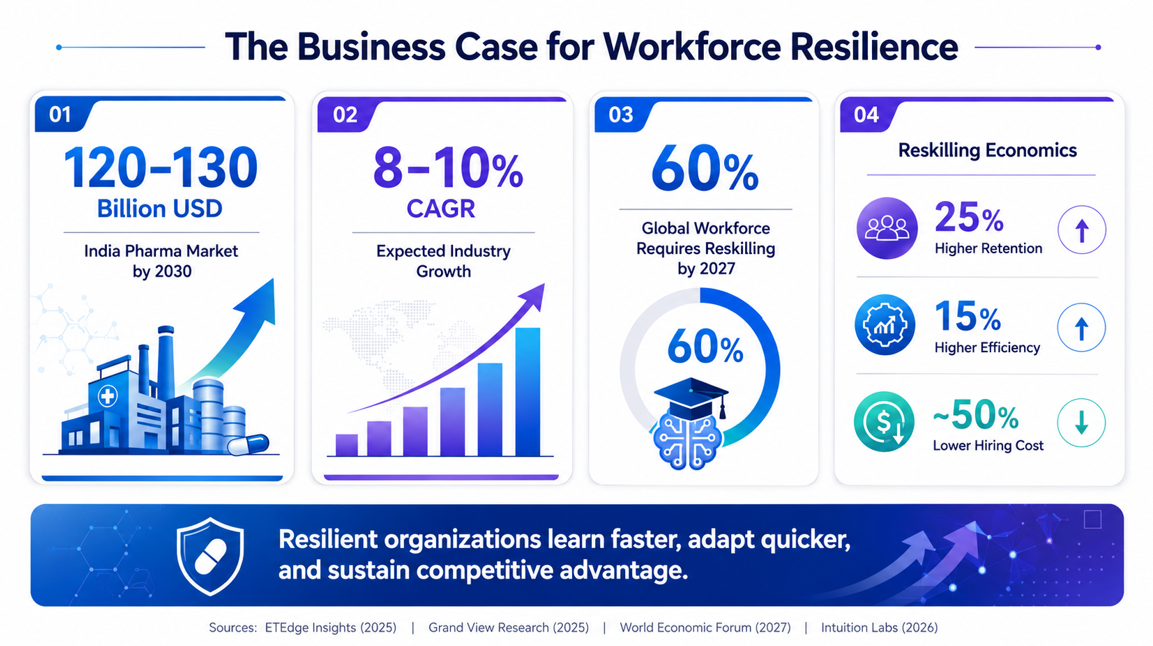
And this volatility is not slowing down. It is accelerating. India's pharmaceutical sector illustrates the stakes clearly: the industry is projected to reach $120 to 130 billion by 2030, growing at 8 to 10% CAGR from its current base. That is not incremental growth. It represents a fundamental shift from volume-driven generics toward high-value innovation in complex generics, biosimilars, injectables, and specialty therapies. But that ambitious trajectory hinges on one factor above all others: a workforce capable of navigating constant change without breaking.
That is where resilience comes in, not as a leadership buzzword, but as a concrete, measurable organizational capability.
Why Workforce Resilience Matters More Than Ever
Consider what pharmaceutical organizations are facing simultaneously. The regulatory environment alone has become a moving target. Through 2026, pharmaceutical companies are grappling with the European Medicines Agency's modernized API certification system (CEP 2.0), Brazil's new CADIFA framework requiring detailed technical dossiers, and accelerated digital submission mandates from the FDA. These are not minor procedural tweaks. They are structural changes that demand rapid organizational adaptation across regulatory affairs, quality, and manufacturing functions simultaneously.
Layer on the AI revolution sweeping through drug discovery, the shift toward real-world evidence integration across regulatory and commercial decision-making, and the emergence of precision medicine, and the picture becomes clear: this is an industry where yesterday's expertise can become outdated within a single product lifecycle. The World Economic Forum estimates that by 2027, roughly 60% of the global workforce will require reskilling or upskilling to keep pace with digital advances. Pharma is no exception to that trend, and arguably faces it with less margin for error than most sectors given the patient-safety stakes involved.
What makes this particularly challenging for pharmaceutical organizations specifically is that the industry's traditional DNA emphasizes precision, control, and risk mitigation. These qualities have served patient safety exceptionally well for decades. But they can also create friction precisely when rapid experimentation, iteration, and learning become necessary for competitive survival. The question is not whether pharma workforces need to be more resilient. It is how to build that resilience without compromising the rigor that legitimately defines the industry.
Understanding Resilience: Beyond Simply Bouncing Back
When discussing resilient pharma workforces, the goal is not people who simply endure stress and absorb pressure. The goal is teams and individuals who can absorb shocks, adapt their approaches, learn from disruptions, and emerge measurably stronger. Research on organizational resilience identifies three core capabilities that resilient organizations consistently demonstrate:
- Anticipate. The ability to foresee potential changes and address vulnerabilities proactively through situational awareness and structured horizon-scanning.
- Absorb. The capacity to withstand the impact of change or disruption effectively without loss of core function or patient-safety integrity.
- Adapt. The capability to adjust or transform strategy, processes, and business models in response to a changed or changing context, rather than defaulting to the pre-disruption playbook.
These are not abstract organizational-behavior concepts. They translate into specific, buildable workforce capabilities that pharmaceutical organizations can develop systematically rather than hope for by accident.
The Five Pillars of Pharma Workforce Resilience
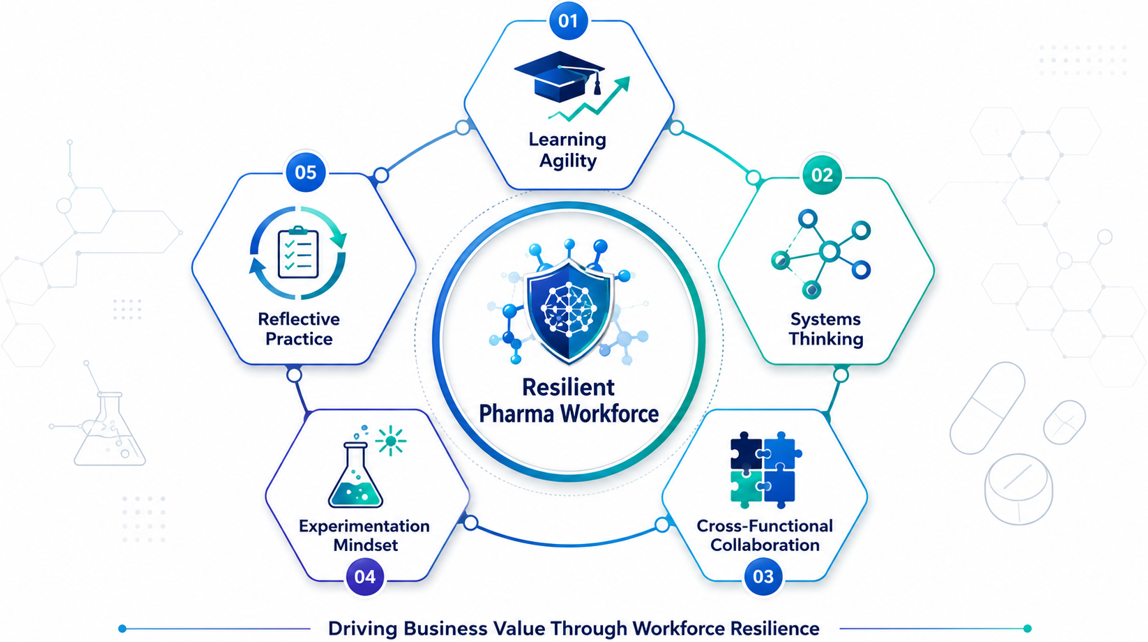
Based on emerging research and industry practice, five interconnected capabilities form the foundation of a genuinely resilient pharmaceutical workforce.
1. Learning Agility: The Meta-Skill
Learning agility, the willingness and ability to learn from experience and apply that learning to perform successfully under new conditions, has emerged as perhaps the single most critical transversal skill for pharma professionals today.
In practical terms, learning agility means a regulatory affairs specialist can quickly grasp the implications of Brazil's new CADIFA requirements and adapt submission strategies accordingly, without waiting for a formal retraining cycle. It means a process chemist with AI training becomes more valuable to the organization than an external programmer with no pharma background, because the chemist can bridge domain expertise with new technological capability in a way a pure technologist cannot.
THE RESKILLING ECONOMICS
Organizations that invest in reskilling existing employees see a 25% boost in retention and 15% efficiency gains, at roughly half the cost of hiring new talent externally. This is not only about saving money. It is about preserving institutional knowledge while building genuinely new capability on top of it.
2. Systems Thinking: Seeing the Whole Board
Pharmaceutical development is inherently a systems challenge. A change in one area, say, a new analytical method introduced in quality control, ripples through manufacturing, regulatory strategy, supply chain planning, and commercial timelines simultaneously. Resilient pharma professionals develop the capacity to see these interconnections rather than optimizing their own function in isolation.
They understand that breaking down silos is not a soft cultural preference; it is operationally essential. When research and marketing teams collaborate early in development, they align product characteristics with market needs and reduce costly late-stage pivots. When regulatory considerations are integrated from the beginning rather than bolted on at the end, timelines compress and compliance quality improves rather than degrades.
Systems thinking also means recognizing that resilience is not purely an individual trait. It is an organizational capability shaped by working conditions, managerial choices, and structural factors. Research on pharmacy practice resilience found that the strongest predictors of individual resilience were not personal coping practices, but organizational decisions about workload, support structures, and resource allocation, a finding with direct implications for how leadership teams should invest.
3. Cross-Functional Collaboration: Breaking the Silos
The pharmaceutical industry's historically siloed structure, where research, development, manufacturing, regulatory, and commercial teams operated in relative isolation, is fundamentally incompatible with today's pace of change. Leading pharmaceutical companies have recognized this directly. Pfizer's integration of R&D and commercial teams has produced more market-oriented development processes, and Roche's emphasis on cross-functional project teams has streamlined its drug development pipeline, improving both efficiency and time-to-market.
- Effective cross-functional collaboration does not happen by accident, however. It requires deliberate enablers:
- Shared goals and metrics that align departments toward common objectives rather than competing functional priorities
- Interdisciplinary training that builds genuine understanding and respect across functional boundaries, not just awareness of other teams' existence
- Digital collaboration platforms that enable real-time data sharing and visibility across the entire drug development lifecycle
- Leadership commitment to breaking down territorial boundaries and actively rewarding collaborative behavior rather than only individual functional performance
Cross-functional teams ensure comprehensive regulatory oversight, accelerate decision-making, and ultimately improve patient outcomes by keeping development efforts patient-centric rather than department-centric.
4. Experimentation Mindset: Permission to Learn Through Failure
Here is where pharma faces one of its most profound cultural tensions. The industry is built on precision, rigor, and control, values that protect patient safety and ensure regulatory compliance. But AI and digital transformation thrive on iteration, rapid testing, and learning from failure, values that sit in genuine tension with the industry's traditional operating instincts.
Unlock the Full Research
Create a free account or sign in to access the complete methodology, deep-dive analysis, and key implementation frameworks.
Don't have an account? It's free to join.
Organization Learning Labs
Research & Insights Division


Comments