Real-World Evidence: Building the Data-Centric Pharma Workforce

RWE has moved from supplementary to central in pharma decisions. Learn the workforce capabilities organizations need to build a data-centric evidence culture.
Real-World Evidence and the Data-Centric Pharma Workforce
Building real-world evidence pharma workforce capability has become one of the pharmaceutical industry's most consequential talent priorities. For decades, randomized controlled trials (RCTs) defined the gold standard of evidence, offering rigor, but often failing to reflect how therapies perform in everyday clinical practice. Advances in analytics, artificial intelligence, and access to real-world data (RWD) are now reshaping that model. Real-world evidence (RWE) has moved from a supplementary role to a central pillar of decision-making across the entire product lifecycle.
The challenge organizations face is not primarily technological. It is human. The workforce responsible for generating, interpreting, and communicating evidence has largely been trained for an RCT-centric world. Medical affairs teams must now assess observational studies. Commercial leaders are expected to interpret comparative effectiveness data. Market access teams must translate real-world endpoints into payer-relevant value. Safety functions are tasked with extracting signals from massive, heterogeneous datasets. Many organizations remain structurally unprepared for this shift, even as regulatory openness to RWE accelerates.
From RCT Dominance to an Integrated Evidence Ecosystem
RCTs remain essential for establishing efficacy and safety, but their limitations are well understood: narrow patient populations, artificial treatment settings, limited follow-up periods, and insufficient statistical power to detect rare events. RWE complements these gaps by capturing outcomes in routine clinical practice, among older patients, those with comorbidities, and across longer time horizons than any trial could practically sustain.
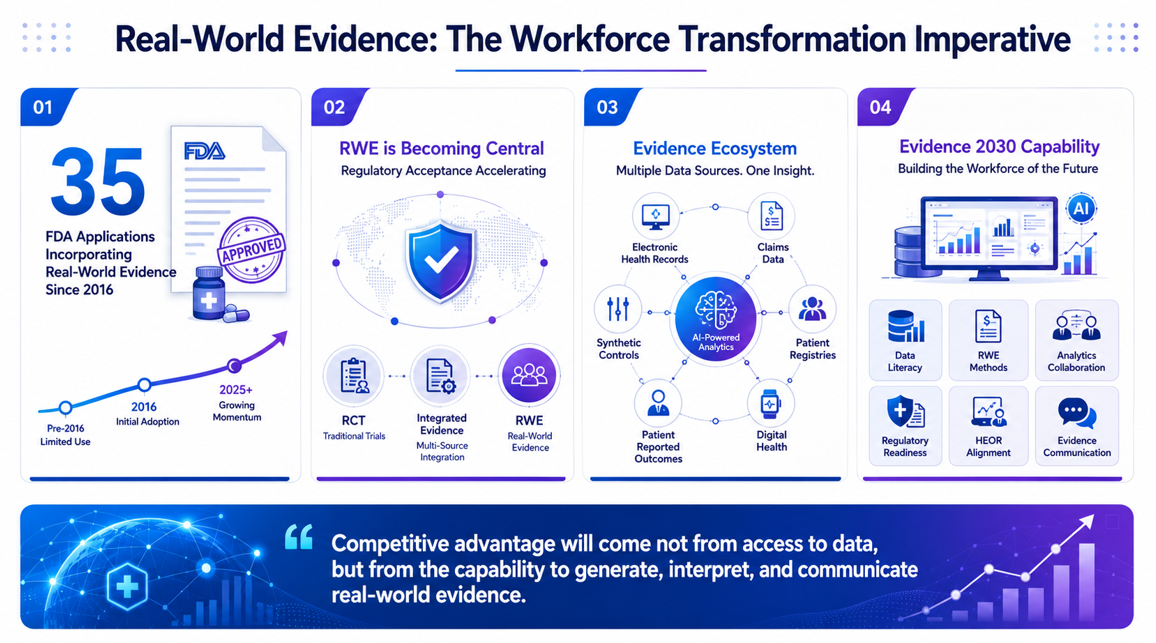
Today's evidence ecosystem integrates multiple sources simultaneously: RCTs, electronic health records, claims data, patient registries, digital health technologies, patient-reported outcomes, and synthetic control arms. This integration enables insights that trials alone cannot provide, including the detection of rare adverse events and a genuine understanding of real-world treatment patterns rather than protocol-driven ones.
Regulators have responded decisively. The FDA, EMA, and Japan's PMDA have all expanded pathways for RWE use, and regulatory submissions supported by RWE are increasing. In a significant December 2025 policy shift, the FDA eliminated a major barrier to RWE use in medical device application reviews, announcing it will accept RWE without requiring identifiable individual patient-level data always be submitted in a marketing application. The agency has signaled its intent to consider extending a similar approach to drugs and biologics, though that broader extension is not yet finalized. Since 2016, only 35 drugs, biologics, or vaccines have incorporated RWE in their applications, a figure regulators themselves describe as below potential given the volume of usable real-world data now available.
Yet regulatory acceptance has outpaced organizational capability. Many RWE-based submissions fail not because regulators are unwilling to consider them, but because underlying studies lack methodological rigor, use data that is not fit-for-purpose, or are communicated unclearly to reviewers who must evaluate evidence quality under time pressure.
The Emerging Skills Gap
Pharmaceutical companies face a genuine paradox: data literacy is becoming essential across nearly every function, but not everyone can, or should, become a data scientist. The most acute shortage lies in hybrid talent, professionals who combine deep domain expertise with the ability to interpret, question, and apply data-driven evidence without needing to build the underlying statistical models themselves.
Across functions, several shared capability gaps recur consistently. Teams often struggle to distinguish between RWD sources and their respective limitations, interpret observational study designs correctly, collaborate effectively with analytics experts who speak a different technical vocabulary, and communicate the same underlying evidence appropriately to regulators, payers, clinicians, and patients, each of whom needs a different framing of the same data. Equally important, and frequently underdeveloped, is the ability to critically evaluate RWE: recognizing bias, confounding, and over-interpretation, rather than treating all real-world studies as either inherently superior to trials or inherently unreliable.
An Evidence 2030 Skills Map
What does a truly data-centric, evidence-capable pharmaceutical organization look like as it approaches 2030? The following competency map spans the roles most directly responsible for generating and applying evidence.
Role | Evidence & Data Capabilities Required |
Medical Affairs | Understand RCTs and RWE; evaluate evidence quality; explain data clearly to HCPs; identify evidence gaps; work cross-functionally with HEOR and analytics |
HEOR / Value & Access | Build economic and outcomes models; design payer-relevant RWE; translate evidence into value stories; understand HTA body requirements |
Commercial Teams | Interpret market and RWE analytics; use evidence in value propositions; convert data into simple customer messages; spot evidence gaps proactively |
Regulatory Affairs | Understand RWE regulations and guidance; assess RWD fitness for submissions; design post-market RWE studies; apply evolving regulatory guidance |
Safety / Pharmacovigilance | Detect safety signals in large datasets; use AI and ML tools appropriately; integrate multiple data sources; assess causality rigorously |
Clinical Development | Use RWE to inform trial design; apply external and synthetic controls; design pragmatic and hybrid trials; prioritize patient-centric outcomes |
Critically, none of these roles operates in isolation. The true competitive advantage comes from cross-functional evidence teams that combine complementary expertise: a medical affairs lead provides clinical context, an HEOR specialist designs the analytical approach, a data scientist executes the analysis, a market access director ensures the study addresses payer needs, and a regulatory expert ensures compliance, all working together from study conception through publication and dissemination rather than handing work sequentially across silos.
Building Evidence Capability at Scale
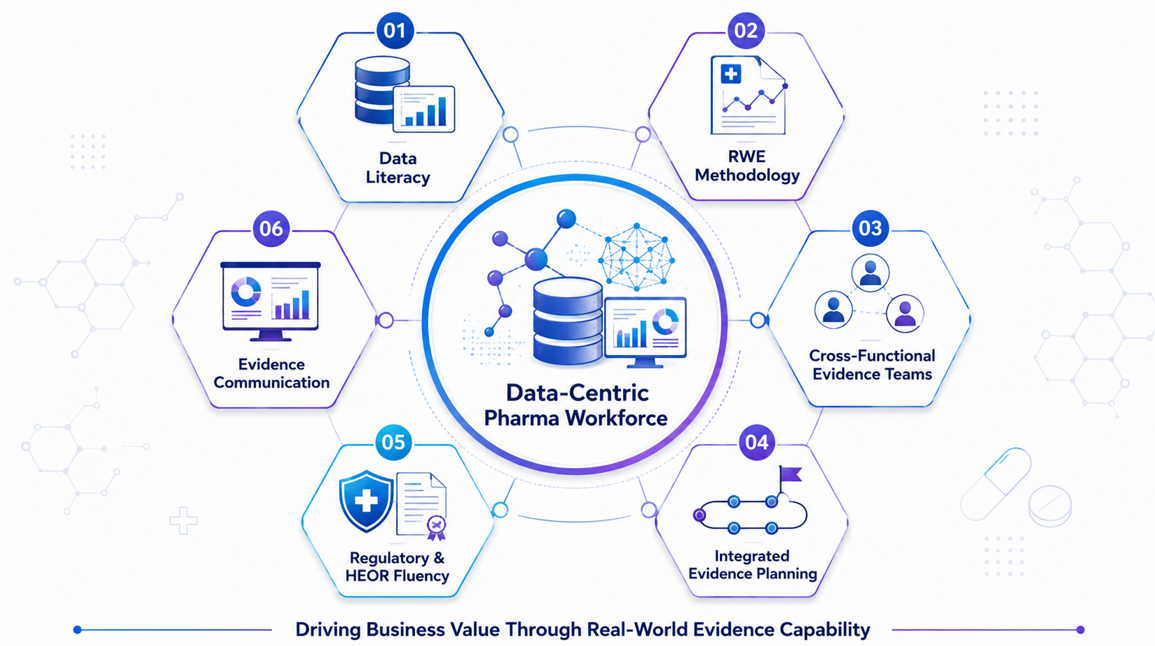
Leading organizations approach capability building as a coordinated system, not a series of disconnected trainings scheduled whenever budget allows. Effective programs share three characteristics: a common foundation, role-specific depth, and experiential learning that forces application under real constraints.
The foundation is data literacy: understanding data quality and governance, basic statistical reasoning, principles of data visualization, and the broader pharmaceutical data landscape. The goal at this stage is not technical mastery but shared language and analytical intuition that lets a clinician and a data scientist have a productive conversation without either needing to become the other.
On top of this foundation, teams require structured exposure to RWE fundamentals: observational study designs, the characteristics of key data sources, core causal-inference concepts, and regulatory and HTA expectations. Conceptual fluency, rather than mathematical execution, is what enables better decisions at the point where evidence strategy is actually set.
Unlock the Full Research
Create a free account or sign in to access the complete methodology, deep-dive analysis, and key implementation frameworks.
Don't have an account? It's free to join.
Organization Learning Labs
Research & Insights Division


Comments