Product Thinking for IT: From Projects to Business Value

Top-performing companies run 70% of IT work through product models. See why product thinking, not project delivery, now defines competitive IT organizations.
Product Thinking for IT: Turning Projects and Platforms into Business Value
Why the shift from order-taker to product owner is now a board-level performance question
The Organization Learning Labs | 2026 Edition
There is a moment in every IT organization when someone asks, "Why are we building this?" If the honest answer is "Because the business asked for it," the problem has already been identified. IT has historically operated as an order-taking function, translating requirements into technical specifications, building what was requested, and handing it over. The most successful IT organizations have stopped operating that way. They function as product owners, and that shift changes essentially everything about how value gets created.
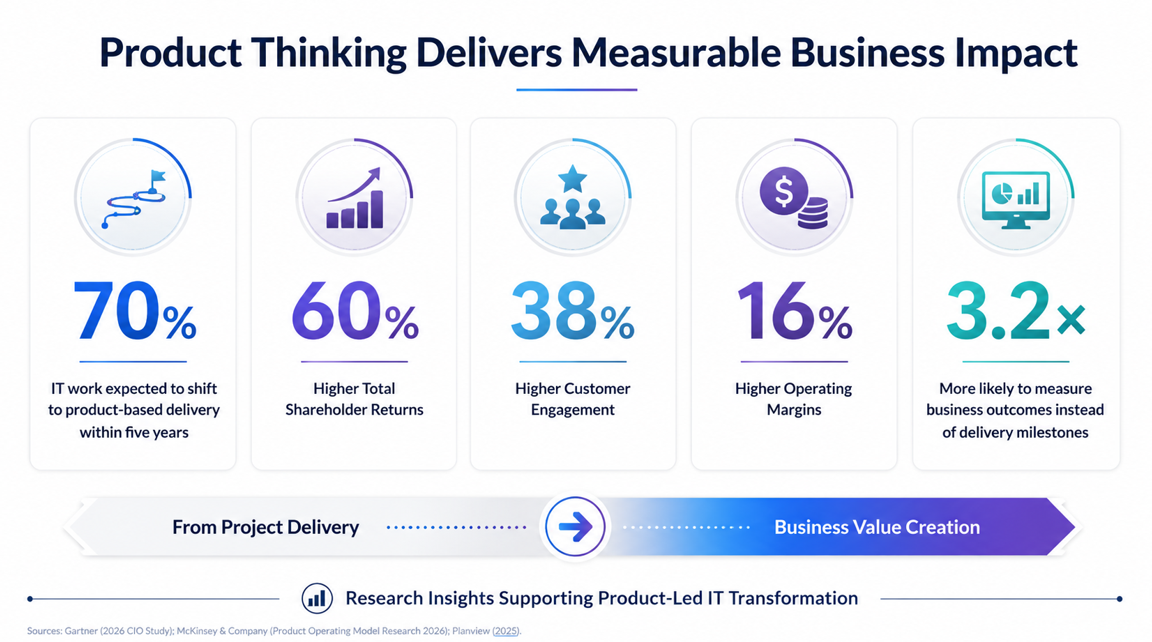
The scale of this shift is no longer a matter of opinion. In a CIO study conducted by Gartner, respondents indicated they expect roughly 70% of their work to run through a product-based delivery model within five years. McKinsey's 2026 Global Tech Agenda research, drawn from more than 600 technology and business leaders, found that nearly two-thirds of top-performing companies say their technology leaders are "very involved" in shaping enterprise strategy, compared with roughly half of other organizations, a direct signal that product-oriented technology leadership correlates with superior business performance.
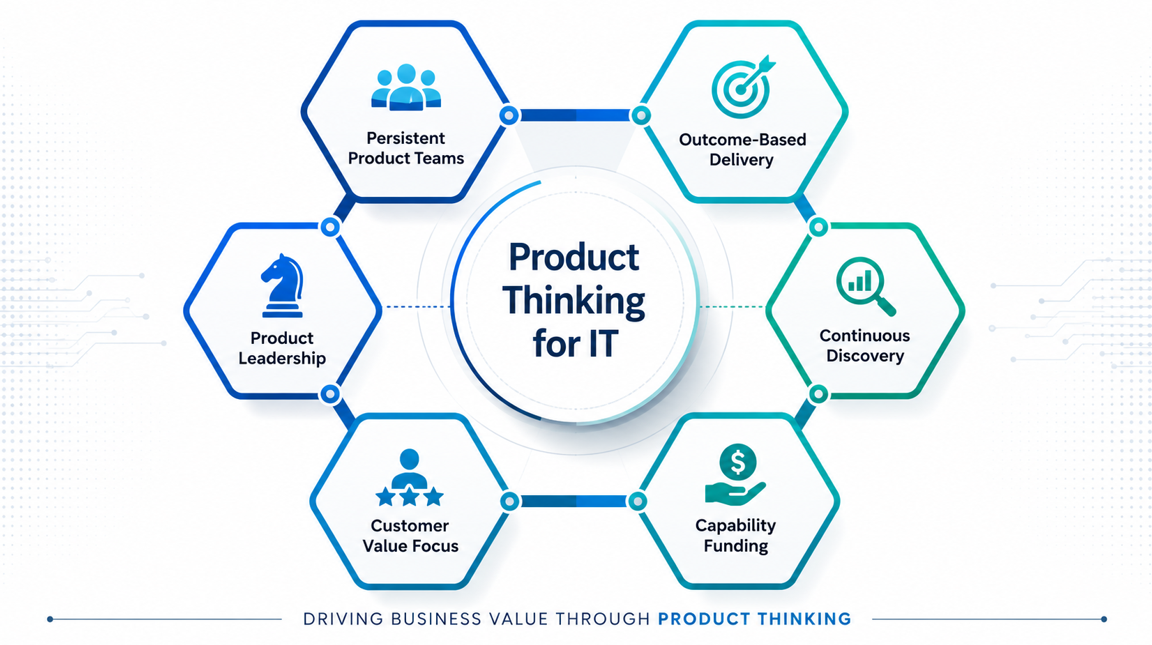
From Order-Taker to Value Creator: The Shift That Matters
The traditional IT setup is familiar to nearly every technology leader: business stakeholders submit requests, IT gathers requirements, estimates effort, and queues the work. Teams deliver what was asked for, close the ticket, and move to the next item in the backlog. The structural problem with this model is not effort or competence. It is that it treats IT as a build shop rather than a partner in creating business value, which caps the ceiling on what technology can contribute regardless of how skilled the engineering team is.
Product-led IT inverts this dynamic. Instead of waiting for fully formed requests, product teams engage early to understand the problem behind the request: what outcome is being pursued, who the users actually are, what success looks like, and how it will be measured. This is not simply good practice. It is the structural difference between building features and delivering value.
ILLUSTRATIVE EXAMPLE A business unit requests a dashboard with 15 specific visualizations. An order-taker team builds exactly what was specified. A product-thinking team starts by asking what decisions those reports inform, and often discovers the actual need is three real-time metrics with threshold alerts, not fifteen static charts. The business outcome, better decision-making, is the same. The solution is simpler, faster to build, and materially more valuable. |
Why Product Thinking Works for IT
Long-lived teams instead of project teams
Traditional IT organizes around projects, temporary teams assembled to deliver a defined scope and then disbanded. Product-led IT organizes around persistent teams that own a platform or capability over its full lifecycle, accumulating deep contextual knowledge that project teams structurally cannot retain, because they dissolve before that knowledge compounds.
Outcomes over outputs
Product teams are measured on the business outcomes their platform enables, adoption, retention, efficiency gains, revenue impact, rather than on whether a fixed scope was delivered on a fixed timeline. Gartner research finds that the top 20% most effective technology organizations are 3.2 times more likely to measure product teams on business outcomes rather than delivery milestones alone.
Unlock the Full Research
Create a free account or sign in to access the complete methodology, deep-dive analysis, and key implementation frameworks.
Don't have an account? It's free to join.
Organization Learning Labs
Research & Insights Division


Comments