Phygital BFSI Frontline Upskilling

Omnichannel BFSI customers move seamlessly across channels; frontlines often can't. See why phygital frontline capability building is a 2035 imperative.
Why Can Customers Move Seamlessly Across Channels When Frontlines Still Can't?
Banking and insurance have entered the phygital era, and customers no longer treat channel as a meaningful boundary. A loan application might start on a mobile app, pause at document upload, continue through a call centre, and conclude at a branch counter. An insurance query may begin on WhatsApp, escalate to a video call, and end with in-person advisory. Customers expect each of these transitions to feel like one continuous conversation, not a series of disconnected restarts.
This is now the default operating reality for BFSI institutions, and it fundamentally changes what good frontline performance looks like. Execution is no longer about handling a transaction within one channel; it is about orchestrating an outcome across several. Yet frontline capability has not kept pace with the platforms customers now expect to move through. While digital infrastructure has advanced rapidly, many frontline and sales teams are still, functionally, trained for single-channel interactions. That gap between technology and human capability is precisely where customer experience breaks down.
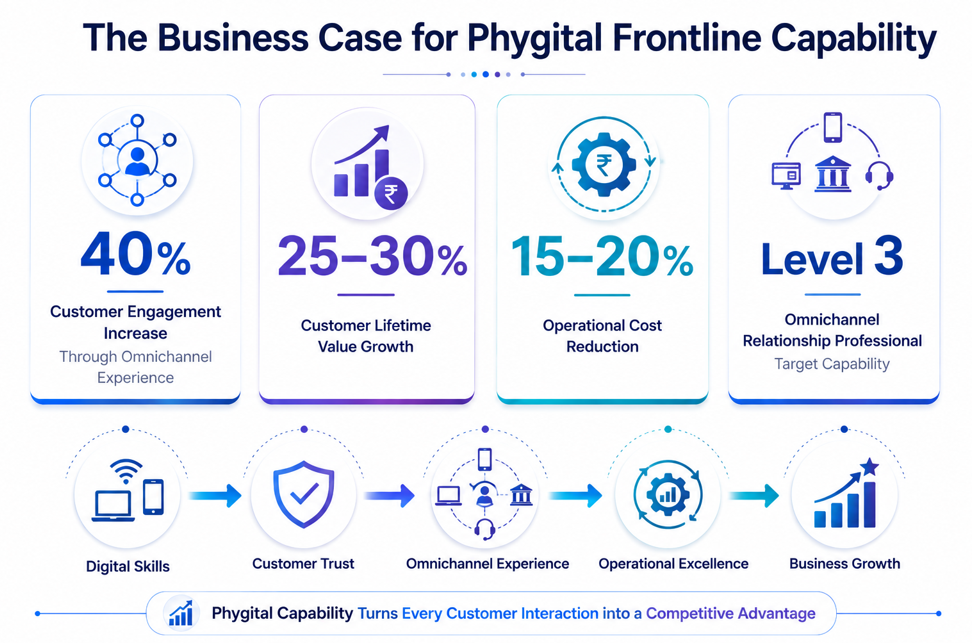
EXECUTIVE SNAPSHOT Phygital customer experience is not primarily a technology deployment. Institutions with strong omnichannel orchestration report customer engagement gains of up to 40 percent and CLV improvements of 25 to 30 percent, but those gains depend on frontline staff who can operate coherently across channels, not just on the channels themselves existing. |
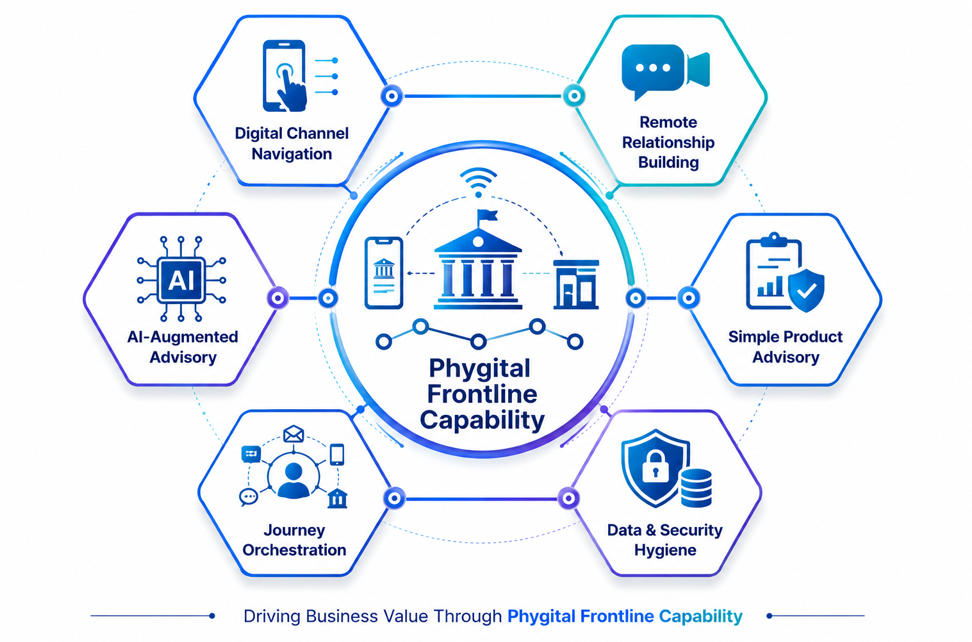
Four Capability Areas Now Critical for BFSI Frontlines
Phygital banking changes what good frontline performance looks like at a structural level. Four capability areas are becoming non-negotiable for customer-facing roles across banking and insurance.
Digital Channel Navigation
Frontline staff must be able to confidently navigate the core digital journeys customers are already moving through: mobile onboarding flows, digital KYC steps, common failure points, and how the different channels connect to one another. Staff do not need to become technologists, but they do need to be fluent enough users that they can guide a customer through a stalled digital journey without hesitation or a hand-off to someone else.
Remote Relationship Building
With video banking, call centres, and asynchronous messaging now routine touchpoints, frontlines must build trust without physical presence in the room. This requires clear written communication, a professional video presence, and the ability to create reassurance and credibility remotely, skills that were never systematically taught to a generation of relationship managers trained for face-to-face interaction.
Explaining Complex Products Simply
Phygital journeys sharply reduce customer tolerance for jargon. Frontlines must translate regulatory and product complexity into plain language, use examples customers actually relate to, and adjust explanations consistently across digital and in-person contexts. In a phygital journey, simplicity itself becomes a trust signal, not just a communication style preference.
Basic Data and Security Hygiene
Frontline professionals increasingly work directly with dashboards, digital leads, and customer data. They need to understand basic metrics, recognise genuine customer signals, and follow strict security and privacy practices as a matter of routine, because poor hygiene at the frontline creates operational and reputational risk that no back-office control can fully offset.
Why Blended Learning and Simulation Matter More Than Either Alone
These capabilities cannot be built through classroom training alone, and standalone e-learning modules do not reliably change behaviour either. Leading BFSI organisations are combining blended learning with simulation-based practice to build both confidence and consistency at the frontline. Blended learning typically layers short classroom immersions, digital microlearning, and on-the-job reinforcement, while simulations then bring these elements together by recreating realistic phygital scenarios in a low-risk environment.
Unlock the Full Research
Create a free account or sign in to access the complete methodology, deep-dive analysis, and key implementation frameworks.
Don't have an account? It's free to join.
Organization Learning Labs
Research & Insights Division


Comments