Owner-Operator to Capability Architect: Franchisee Role

How franchise systems must rethink franchisee development. A strategic guide for CXOs and brand leaders on building capability-architect franchisees for 2035.
From Owner-Operator to Capability Architect: The Evolving Role of the Modern Franchisee
For decades, the franchise model operated on a clear and comfortable division of labour: the franchisor designed the brand, strategy, and systems; the franchisee implemented them. Success was defined by compliance, sales volume, and audit performance. The archetype was a diligent local operator running a proven playbook.
That archetype is obsolete.
The modern franchisee is a business leader managing multiple locations, leading teams of dozens, shaping local strategy, piloting new concepts, and actively influencing how their brand evolves. They are, increasingly, capability architects -- responsible not simply for running stores, but for building the people, culture, systems, and innovation capacity that allow their operation to outperform.
This transformation is not aspirational. It is already underway in high-performing franchise systems around the world, and the pace of change is accelerating. The franchisors who understand this shift and invest in developing capability-architect franchisees will build networks that are resilient, innovative, and consistently profitable. Those that do not will face structural stagnation.
"In the highest-performing franchise systems, the franchisee is no longer a licensee executing a template. They are a strategic partner building a scalable business within a shared ecosystem." -- Global Franchise Magazine, 2024 |
Why This Matters Now: The Forces Redefining the Franchisee Role
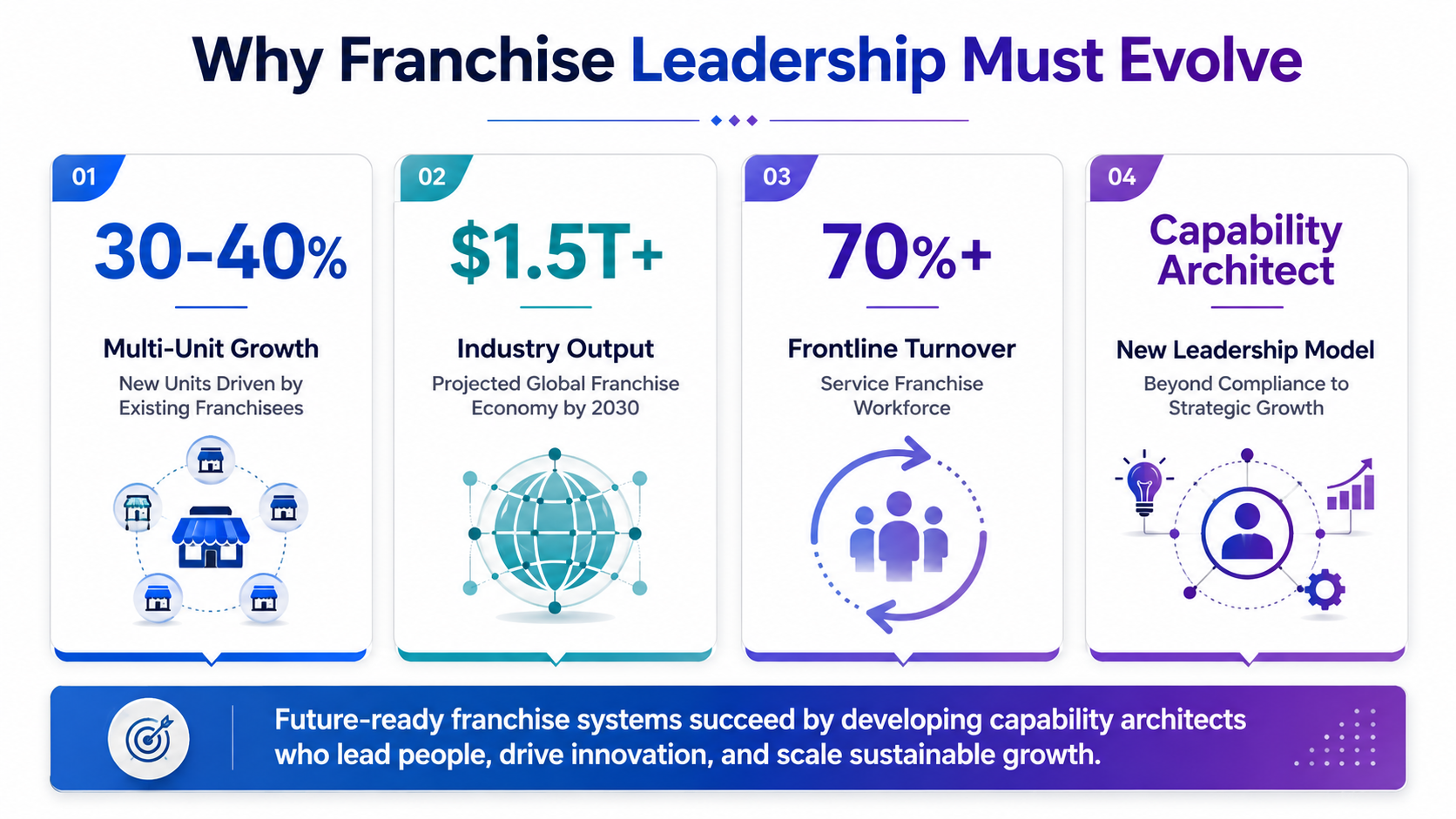
Three structural forces are driving the franchisee role transformation:
Multi-Unit Expansion as the Growth Engine
In many franchise systems, 30 to 40 percent of new unit growth now originates from existing franchisees opening additional locations. These multi-unit operators cannot function as solo executors. They must lead leaders, scale systems, allocate capital across locations, and build organizational resilience. The skill gap between the single-unit operator mindset and the multi-unit leadership mindset is significant -- and very few franchise systems have built the development infrastructure to bridge it systematically.
Intensifying Labour Market Complexity
Talent acquisition and retention have become the primary operational differentiators in labour-intensive franchise sectors. Franchisees who can build strong cultures, create meaningful career pathways, and develop internal talent consistently outperform those who rely on constant external recruitment. This is a capability that must be deliberately developed -- it does not emerge from operational training.
Rising Consumer and Technology Expectations
Customers now expect consistent, digitally-integrated, personalized experiences across every franchise touchpoint. Delivering this requires franchisees who can adopt new technologies, manage omnichannel service standards, and lead their teams through continuous adaptation. The compliance mindset of the legacy franchisee is structurally inadequate for this operating environment.
The Capability Architect: Five Defining Competency Clusters
Research across high-performing franchise systems and leadership effectiveness studies consistently identifies five capability clusters that define the franchise operator who creates lasting competitive advantage:
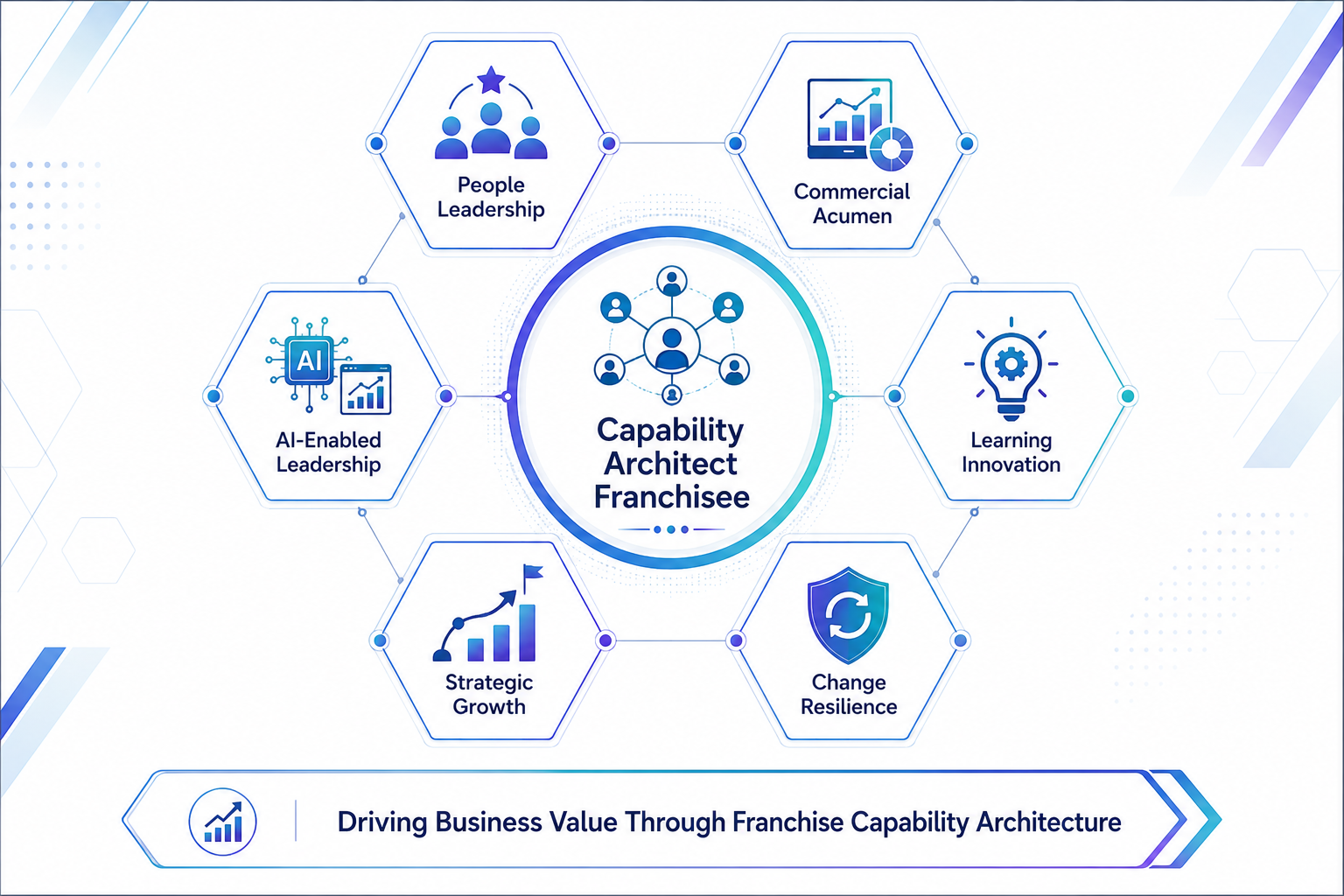
1. People and Culture Leadership
In high-turnover environments, the ability to build and retain exceptional teams is the most powerful competitive differentiator a franchisee can possess. Gallup's 2024 State of the Global Workplace found that highly engaged teams are 23 percent more profitable and demonstrate 59 percent lower turnover. For franchise operators, this is not an HR consideration -- it is a financial one.
• Hiring effectively in tight and competitive labour markets
• Creating structured onboarding that builds capability from day one
• Coaching performance consistently, not just managing incidents
• Building values-driven culture that reduces discretionary churn
• Developing internal talent pipelines for supervisory and management roles
• Creating psychological safety and engagement that drives discretionary effort
2. Commercial Acumen
Modern franchisees must deeply understand their unit economics and commercial performance. Financially literate franchisees make smarter expansion decisions, invest more effectively in labour and marketing, and partner more productively with franchisors on strategic planning.
• Reading and interpreting P&L statements across multiple locations
• Understanding cost drivers, margin dynamics, and contribution analysis
• Analyzing local market dynamics and competitive positioning
• Measuring marketing effectiveness and optimizing investment allocation
• Making data-informed decisions on staffing, pricing, and channel mix
3. Learning Orientation and Innovation Contribution
High-performing franchisees do more than follow instructions. They run disciplined experiments -- in staffing models, scheduling, marketing approaches, or service innovations -- track the results, and contribute successful innovations back to the network. Franchise systems where franchisees are active learning contributors evolve faster and outperform closed, compliance-only networks.
• Designing and running small-scale operational and marketing experiments
• Systematically tracking results and refining approaches based on evidence
• Sharing successful innovations with peers and the franchisor network
• Adapting brand models for local relevance within established guardrails
4. Resilience and Change Navigation
Unlock the Full Research
Create a free account or sign in to access the complete methodology, deep-dive analysis, and key implementation frameworks.
Don't have an account? It's free to join.
Organization Learning Labs
Research & Insights Division


Comments