Orchestrator Workforce: Human-AI Collaboration in Energy

As automation transforms energy operations, the workforce must evolve from operators to orchestrators. Learn the skills, training models, and leadership strategies for the AI-integrated energy enterprise.
The Orchestrator Imperative: Why Automation Is Making Human Judgment More Critical Than Ever
The energy sector is experiencing a transformation in the nature of human work that runs deeper than most workforce strategies have yet grasped. Automation, artificial intelligence, predictive systems, and robotics are not supplementing the energy workforce in incremental ways. They are restructuring it at a fundamental level -- changing what humans do, how they do it, and what capabilities determine whether they do it well.
Power plants regulate themselves through advanced control systems. Grid operators respond to machine-generated dispatch recommendations rather than making calculations manually. AI models identify equipment at risk of failure weeks before that risk would be visible to human inspection. Subsea drones conduct inspections that previously required human divers in hazardous conditions.
The natural reaction to this progression is anxiety about workforce displacement. But the more important and strategically relevant question is different: as machines take over routine control, what is the evolving nature of the human contribution, and what capabilities does it require?
The answer that emerges from field evidence, human factors research, and operational analysis is clear and counterintuitive. Automation increases the importance of human judgment, contextual understanding, and exception-handling capability -- precisely because automated systems fail in ways that routine human operation never encountered. The future belongs not to workers who resist automation, but to workers who orchestrate it.
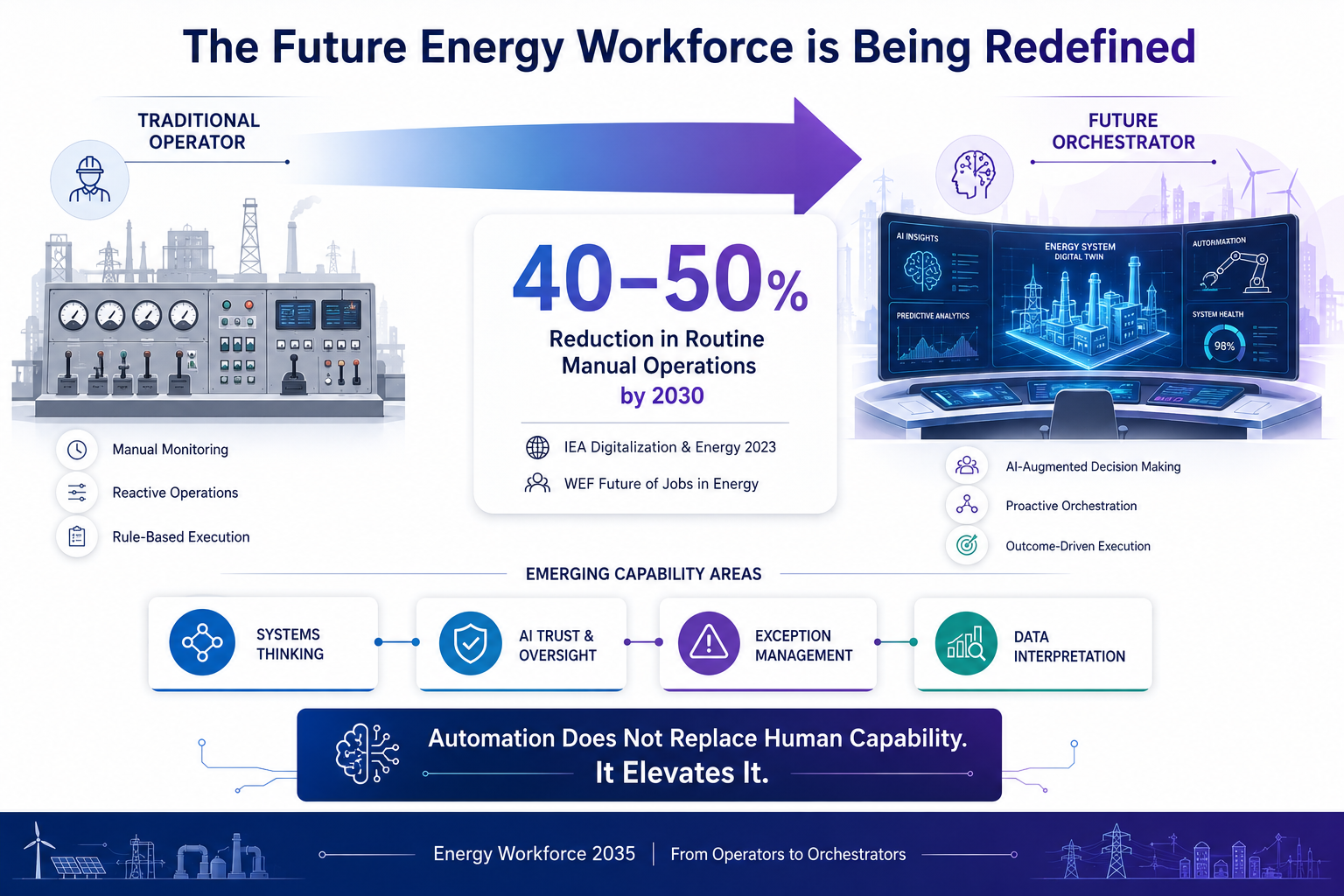
From Control to Orchestration: Understanding the Fundamental Shift
For most of modern energy history, operational roles were defined by direct control. Operators adjusted physical controls, monitored analog gauges, followed detailed procedural scripts, and responded to alarms as they appeared. Skill was measured by procedural knowledge, manual precision, and accumulated experience with specific equipment configurations.
Automation dismantles this equation. In highly automated plants, control rooms, and smart grid operations centres, machines handle routine control with a speed, consistency, and data-processing capacity that no human operator can match. They process thousands of sensor inputs simultaneously, execute control actions in milliseconds, and operate without fatigue or attentional drift.
The human role shifts upward. Instead of controlling individual components, operators increasingly supervise entire systems. Instead of monitoring individual instruments, they interpret dashboards that aggregate information from hundreds of sources. Instead of executing predefined procedures, they exercise judgment about when to trust automated recommendations, when to question them, and when to override them.
"The most serious accidents in automated systems have not occurred when automation failed. They have occurred when humans failed to maintain the situational awareness needed to manage the consequences of automation failure." -- Lisanne Bainbridge, Ironies of Automation, Automatica, 1983 -- the foundational insight that remains definitively true in 2025 |
This is orchestration rather than operation. Humans act as conductors of complex sociotechnical systems, ensuring that machines work together effectively, that anomalies are detected and responded to with appropriate judgment, and that system performance is continuously optimised across time horizons that automated systems cannot independently manage.
The Automation Paradox: Why Machine Capability Raises Human Skill Requirements
Automation redistributes uncertainty -- it does not eliminate it. AI models can predict failures, optimise dispatch, and suggest maintenance schedules, but they operate on assumptions, historical data patterns, and probabilistic reasoning. When conditions deviate from the distributions on which models were trained, human judgment becomes not supplementary but critical.
This creates a structural paradox that researchers call the 'out-of-the-loop' problem. As automation takes over routine tasks, human operators get fewer opportunities to practise the manual skills and situational awareness required to manage system failures. The skills that automation makes unnecessary are precisely the skills humans need to fall back on when automation fails.
Research in human factors engineering -- including the landmark frameworks of Parasuraman, Sheridan, and Wickens -- consistently demonstrates that the most dangerous operating condition is partial automation with undertrained human supervision. Operators who do not understand what the automated system is doing and why cannot intervene effectively when it behaves unexpectedly.
This creates a clear and urgent capability imperative for energy organisations: as you automate, you must simultaneously upskill. The investment in automation technology without investment in orchestrator capability is not just insufficient -- it is actively dangerous.
Fusion Skills for the Orchestrator Workforce
To perform effectively in orchestrator roles, energy workers need a qualitatively different mix of capabilities than traditional operators required. These fusion skills sit at the intersection of systems knowledge, data interpretation, human judgment, and collaborative capability.
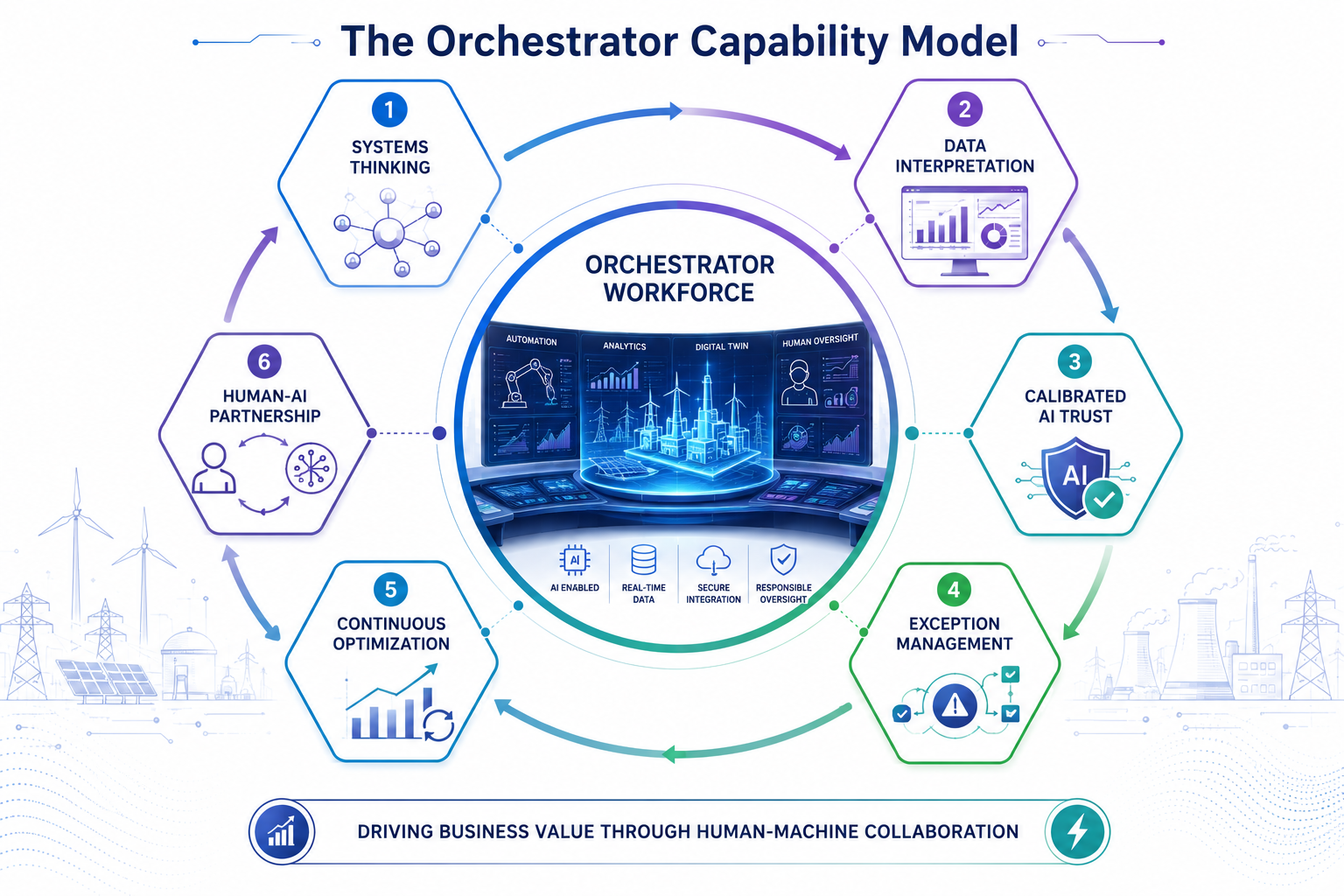
Orchestrator Capability | What It Means in Energy Operations | Development Approach |
Systems Thinking | Understanding how individual components interact within a larger sociotechnical system. Anticipating cascading effects of decisions made in one part of the system on other parts. Reasoning across technical, organisational, and environmental dimensions simultaneously. | System architecture education; simulation of cascading failure scenarios; cross-functional exposure to adjacent system domains. |
Data Interpretation and Sense-Making | Reading trends, recognising weak signals, and distinguishing meaningful anomalies from noise in data-rich automated environments. Understanding what the data represents, what assumptions underpin it, and where its limitations lie. | Data literacy programs anchored in real operational datasets; case studies of incidents where data misinterpretation drove poor decisions. |
Calibrated AI Trust | Knowing when to trust automated recommendations and when to question them. Understanding model confidence levels, potential biases, and failure mode patterns. Developing calibrated rather than binary trust in machine intelligence. | AI systems education focused on failure modes and limitations; practice with overriding automation in controlled simulation environments; structured post-event review of AI recommendation quality. Unlock the Full ResearchCreate a free account or sign in to access the complete methodology, deep-dive analysis, and key implementation frameworks. Don't have an account? It's free to join. O Organization Learning LabsResearch & Insights Division On this pageResearch DetailsIndustryOil and Gas AuthorOrganization Learning Labs PublishedJul 18, 2026 You Might Also Be Interested In Information Technology Designing the future-ready digital engineering organization Banking, Financial Service And Insurance A Systematic, Empirical Framework for Capability Development in Retail Banking Banking, Financial Service And Insurance Why Capability Beats Strategy in Retail Banking Organizations |
Comments