Oil & Gas to Multi-Energy Reskilling: Net Zero Workforce

How do you reskill an oil and gas workforce for a multi-energy, net-zero future? Explore reskilling strategies, transferable skills, and workforce transition frameworks for energy leaders.
The Strategic Case for Reskilling: Why Oil and Gas Expertise Is Multi-Energy Gold
The conventional narrative around energy transition and workforce treats fossil fuel professionals as the transition's casualties -- workers whose skills are becoming obsolete and who must be assisted in moving to new industries. This framing is not only socially corrosive. It is economically irrational and strategically incoherent.
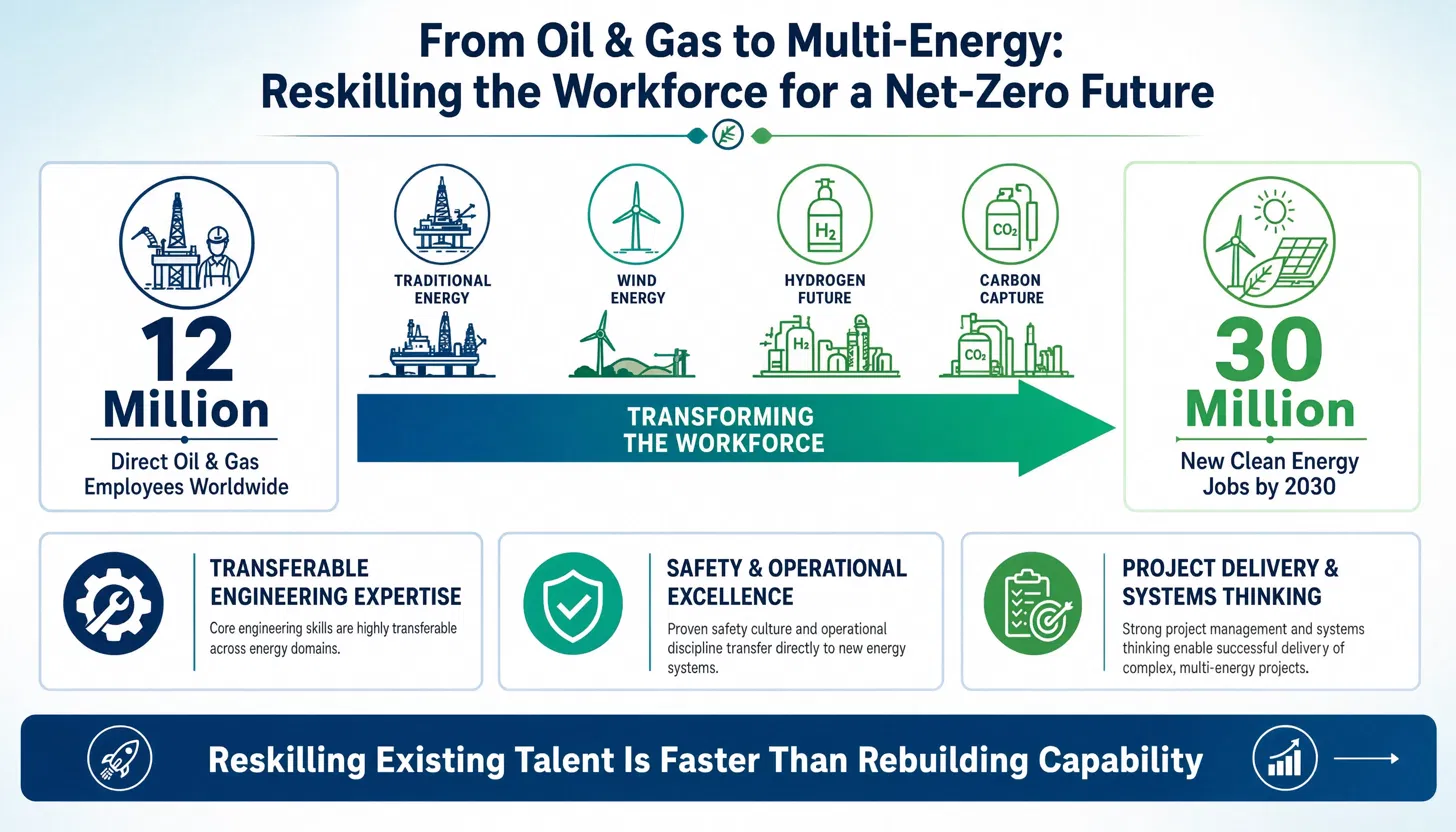
The skills that oil and gas professionals have developed over careers -- subsurface engineering, process operations, offshore systems management, high-hazard safety culture, large-scale project delivery, and complex supply chain coordination -- are not the skills of a declining industry awaiting redundancy. They are precisely the skills that the build-out of offshore wind, CCS, hydrogen production, geothermal energy, and advanced grid systems requires, and that the transition is demonstrably failing to produce fast enough through new-entrant pipelines.
IRENA's World Energy Transitions Outlook projects that the global energy transition will create approximately 30 million new clean energy jobs by 2030. But the same analysis documents that the skills gap in clean energy -- particularly in offshore operations, process engineering, project delivery, and safety management -- is among the most binding constraints on deployment timelines. The expertise needed to fill that gap is already employed in oil and gas.
The Transferability Map: What Oil and Gas Skills Transfer Where
Effective reskilling strategy begins with rigorous skills transferability analysis. Different oil and gas skills transfer to different clean energy destinations with different levels of bridging training required. Understanding this map is the foundation of any credible multi-energy workforce transition strategy.
Oil & Gas Skill Domain | Primary Transfer Destinations | Bridging Training Depth Required |
Offshore Operations and Safety | Offshore wind operations; CCS offshore infrastructure; offshore hydrogen production | Low: common foundation skills (vessel operations, high-risk maintenance, emergency response) transfer directly. Technology-specific modules only. |
Process Engineering and Operations | Hydrogen production (steam methane reforming, electrolysis); biofuels processing; CCS capture plant operations | Low-Medium: process engineering principles transfer; new molecule chemistry and process-specific safety requires dedicated bridging. |
Subsurface Engineering | CCS reservoir characterisation and monitoring; geothermal resource assessment; underground hydrogen storage | Medium: geological and reservoir engineering principles transfer; specific clean energy applications require targeted extension modules. |
Large-Scale Project Management and Delivery | Offshore wind farm development; hydrogen infrastructure projects; large-scale solar and storage | Low: project management, commissioning, and delivery skills transfer across energy technologies with minimal bridging. |
High-Hazard Safety Systems and Culture | All clean energy technologies involving high-pressure, electrical, or rotating equipment hazards | Minimal: safety culture, permit-to-work systems, and high-hazard awareness transfer directly and are in critically short supply in new clean energy sectors. |
Control Room Operations and SCADA | Grid control centres; smart energy management systems; CCS monitoring and reporting systems | Medium: control systems principles transfer; specific platform and protocol training required for each destination technology. |
"Oil and gas professionals have spent careers learning to safely manage large quantities of energy in complex physical systems under high pressure. That knowledge is not obsolete in the energy transition. It is foundational to it." -- IEA, Net Zero by 2050, Chapter on Workforce Transitions |
Why Current Reskilling Programs Are Underdelivering
Despite broad policy and corporate commitment to energy workforce transition, most reskilling programs are underdelivering against the scale and depth of the challenge. Understanding why is the prerequisite for designing programs that actually work.
Insufficient Depth and Duration
Many reskilling programs offer introductory awareness of new energy technologies rather than genuine operational competency. A 3-day course on offshore wind fundamentals does not equip an experienced offshore oil and gas professional for a live wind operations role. The bridging between existing expertise and new-technology operational readiness requires structured, extended programs -- typically 6-18 months -- that build on existing foundations rather than ignoring them.
Failure to Leverage Existing Expertise
Programs designed as if oil and gas professionals were starting from scratch waste both time and motivation. The most effective reskilling programs begin with rigorous recognition of existing competencies, build on transferable foundations, and add only the genuinely novel technical content that specific clean energy roles require. This approach dramatically reduces training duration, cost, and learner attrition.
Disconnect Between Training and Employment
Reskilling programs that are not connected to specific employment commitments -- whether from the sponsoring organisation or from partner employers -- generate skills without destinations. Participants invest in reskilling without confidence that qualified roles will be available at program completion. This uncertainty is a major adoption barrier, particularly for experienced professionals who face significant opportunity cost.
Geographic and Social Dislocation
Unlock the Full Research
Create a free account or sign in to access the complete methodology, deep-dive analysis, and key implementation frameworks.
Don't have an account? It's free to join.
Organization Learning Labs
Research & Insights Division


Comments