Offshore Workforce 2030: Cross-Skilling Oil, Gas, Wind & CCS

Over 90% of oil and gas offshore workers have transferable skills for wind, CCS, and hydrogen. Learn how to build an integrated offshore workforce capable of supporting all energy technologies.
Why the Offshore Energy Transition Demands an Integrated Workforce Strategy
Offshore energy basins around the world are undergoing a structural transformation that is without precedent in the history of the sector. What were once singular-purpose hydrocarbon extraction environments are becoming multi-energy hubs where oil and gas platforms, offshore wind farms, carbon capture and storage infrastructure, and hydrogen production facilities will operate in the same geographic basins, often visible from each other's decks.
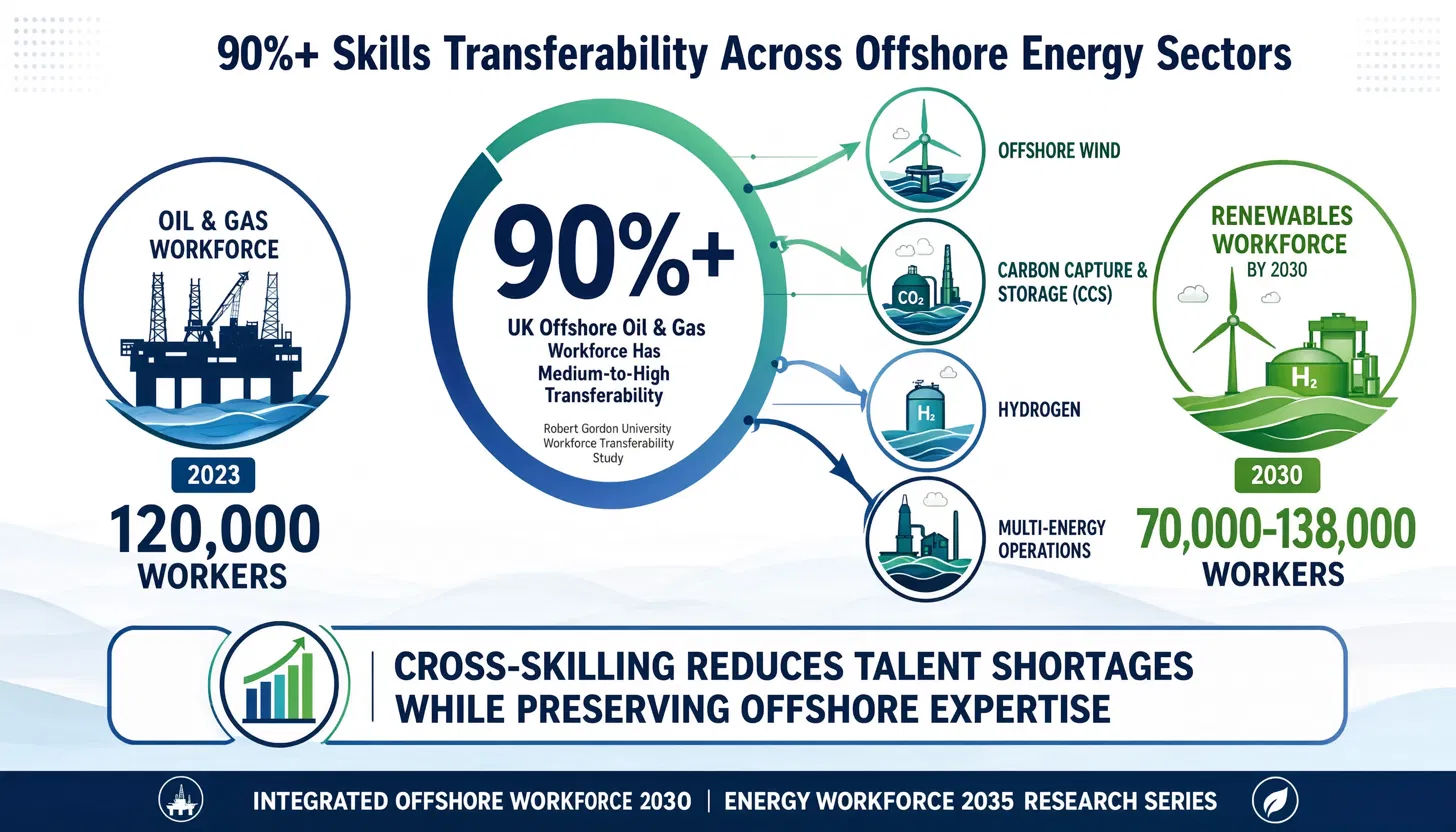
The North Sea provides the clearest current example. The UK government's analysis projects that the UK offshore oil and gas workforce will decline from approximately 120,000 workers in 2023 to between 60,000 and 87,000 by 2030, as older fields decline and decommissioning accelerates. Simultaneously, the offshore renewables workforce -- encompassing offshore wind, CCS, and hydrogen -- is projected to grow to between 70,000 and 138,000 workers over the same period. Offshore wind alone could support up to 100,000 UK jobs by 2030.
The arithmetic is sobering. Without effective cross-skilling, the net employment outcome of the offshore transition could be deeply negative for current workers, even as overall offshore employment holds roughly steady. Experienced professionals lose jobs in declining sectors. New jobs in clean energy remain unfilled because the skills are incorrectly perceived as sector-specific. The transition wastes its most valuable human resource precisely when it most needs it.
The Universal Capability Clusters That Define Offshore Work
The most important insight for integrated offshore workforce development is that offshore work across different energy technologies shares a set of foundational capability clusters that are substantially common across sectors. Identifying and building on these commonalities is the key to enabling genuine workforce mobility.
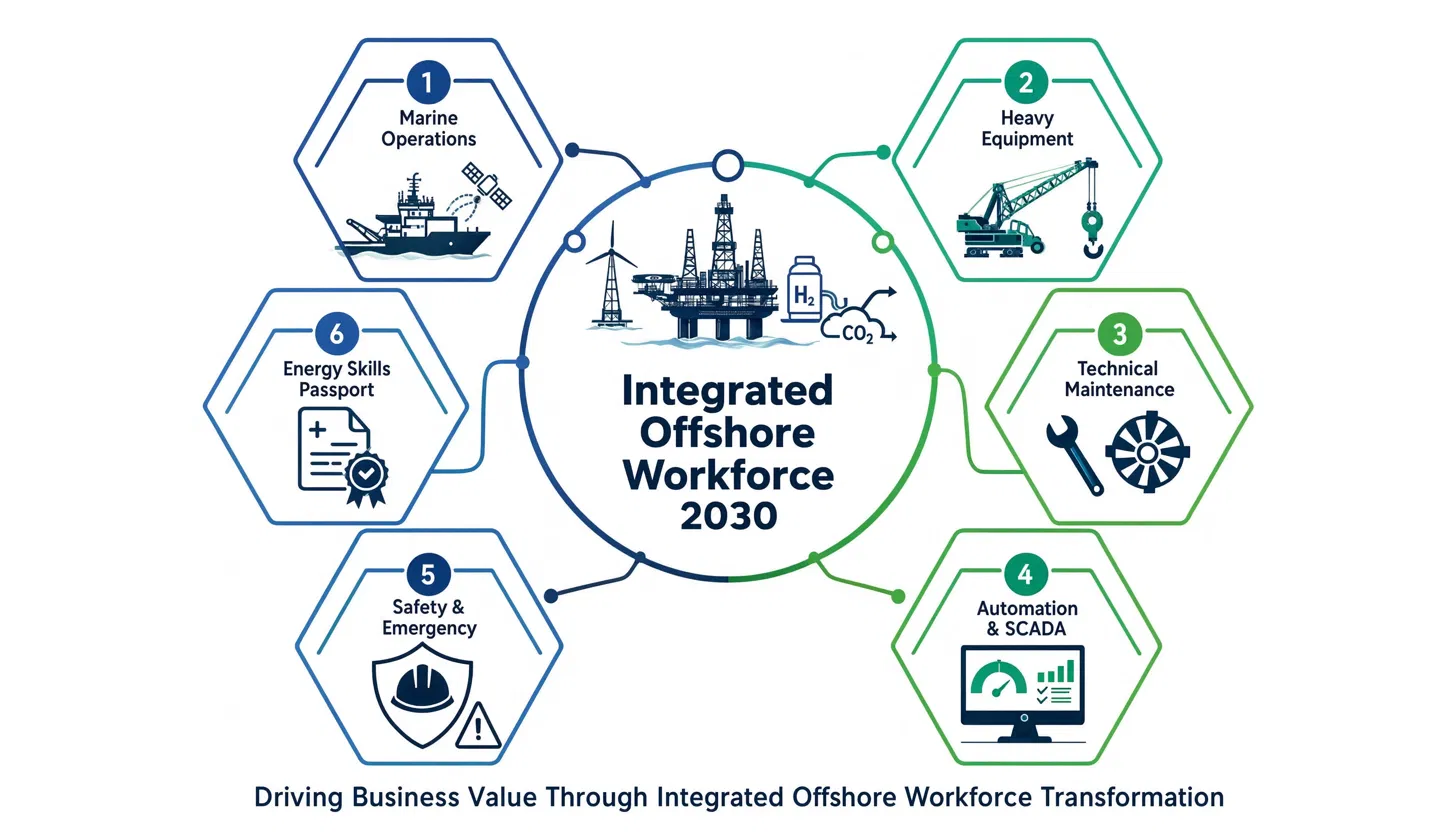
Universal Capability Cluster | Application Across Energy Technologies | Primary Certification Frameworks |
Marine Operations and Vessel Management | Vessel positioning, dynamic positioning operations, weather window planning, sea state assessment, offshore logistics coordination. Applies identically across oil platforms, wind service vessels, and CCS installation support. | Nautical Institute DP Operator Training Scheme; STCW maritime certifications |
Lifting, Rigging, and Heavy Equipment | Load calculation, sling selection, crane operation, banksman duties. Required for drill string replacement, nacelle hoisting on wind turbines, and heavy lift installation across all platforms. | OPITO lifting and rigging; API standards; LOLER compliance; IMCA safe lifting operations |
High-Risk Maintenance and Technical Operations | Confined space entry, working at height, hot work permits, electrical isolation, pressure system management. Apply identically across hydrocarbon processing and wind turbine service. | OPITO competency frameworks; ECITB technical certifications |
Control Systems and Automation | SCADA systems, PLCs, sensor networks, data acquisition. Appear across oil and gas facilities, offshore wind farms, and hydrogen production units with substantial technical overlap. | Sector-specific certifications with growing cross-recognition under Energy Skills Passport |
Safety and Emergency Response | Sea survival, helicopter underwater escape training (HUET), fire fighting, first aid, emergency coordination. The most universally common capability cluster across all offshore sectors. | North Sea Mutual Recognition Framework: UK (OEuK), Norway (Offshore Norge), Netherlands (NOGEPA), Denmark (Dansk Offshore) |
The existence and depth of these common capability clusters fundamentally changes the economics of cross-skilling. Workers transitioning from oil and gas to offshore wind, CCS, or hydrogen do not need to start from scratch. They need bridge training that builds sector-specific technical knowledge on a foundation of transferable offshore expertise that they already possess. This changes the cost, timeline, and feasibility of large-scale workforce transition.
The Energy Skills Passport: A Foundation for Cross-Sector Mobility
Perhaps the most significant structural innovation in offshore workforce integration is the Energy Skills Passport, developed by OPITO in collaboration with ECITB, Cogent, RenewableUK, and IMCA. Launched in January 2025 with GBP 3.7 million in Scottish Government funding, this digital platform allows workers to identify which of their existing qualifications transfer directly to roles in offshore wind, CCS, and hydrogen -- and which gaps they need to fill.
The passport displays current qualifications and required credentials for specific roles across energy technologies, streamlining the transition process and reducing duplicated training costs. Early results demonstrate that qualified offshore technicians, electrical engineers, mechanical engineers, and structural engineers hold substantial portions of the qualification profiles required for equivalent roles in offshore wind and CCS -- reducing bridging training requirements to targeted technical modules rather than full requalification programs.
Unlock the Full Research
Create a free account or sign in to access the complete methodology, deep-dive analysis, and key implementation frameworks.
Don't have an account? It's free to join.
Organization Learning Labs
Research & Insights Division


Comments