Next-Gen Automotive Engineers: T-Shaped Talent Strategy

How automotive organizations build multi-disciplinary, T-shaped engineers for the EV and SDV era -- competency frameworks, development pathways, bootcamps, and career design.
Why the Automotive Industry Is Hunting for a Fundamentally Different Kind of Engineer
Imagine a design review for a new electric vehicle's battery management system. On one side of the table, a mechanical engineer is presenting thermal pathway analysis and packaging constraints. On the other, a software engineer is discussing real-time control algorithm latency. In the middle -- the position that defines the new competitive frontier -- sits a professional who can interrogate both worlds with equal credibility: catching thermal implications in software design decisions, spotting software constraints in hardware specification choices, and synthesizing integration risks before they become expensive programme delays.
This moment -- demanding, cross-disciplinary, analytically exacting -- is rapidly becoming the default operating condition of automotive engineering. And it represents a profound departure from how the industry organized engineering talent for the past century.
For more than a hundred years, automotive engineering excellence was defined by deep specialization. You were a transmission engineer, a chassis dynamics specialist, or an engine combustion designer. Career progression meant going deeper into a single domain, achieving mastery within it, and leading others along the same path. The model worked because vehicle complexity was primarily mechanical: systems were relatively separable, and integration challenges -- while real -- could be managed at the programme level.
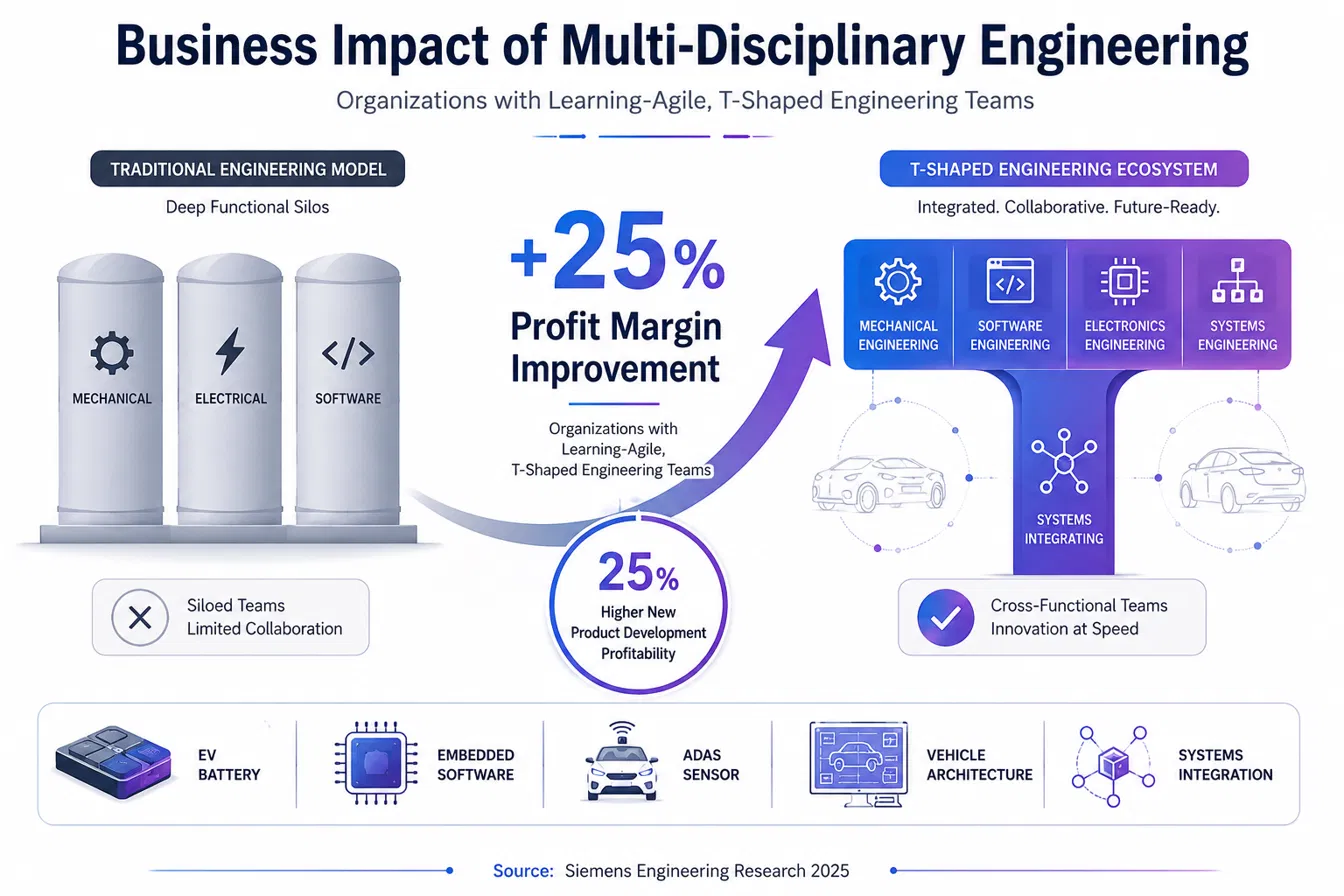
Software-defined vehicles, electrification, and ADAS have collapsed that separability. A software decision in a central domain controller cascades into thermal implications for the battery pack, power delivery implications for the electric motor, and cybersecurity implications for the OTA update pipeline. An engineer who sees only their domain will miss these connections. Research from Siemens' T-Shaped Engineering programme (2025) found that companies with learning-agile, multi-disciplinary engineering teams demonstrate 25% higher profit margins on new product development programmes -- a finding that has catalysed significant investment in T-shaped engineering capability across the automotive sector.
"The engineer who will define automotive leadership in 2030 is not the one who knows everything about one domain. It is the one who knows enough about all domains to ask the right questions about all of them simultaneously." -- Royal Academy of Engineering, Engineers 2030: Redefining the Engineer of the 21st Century |
What Is a T-Shaped or Pi-Shaped Engineer in an Automotive Context?
The 'T-shaped' engineer concept -- deep expertise in one domain (the vertical stroke) combined with credible capability across adjacent domains (the horizontal stroke) -- is well-established in technology-intensive industries. In automotive, it is emerging as the definitive talent model for the EV and SDV era. The evolution toward 'pi-shaped' engineers -- those with deep expertise in two complementary domains, with breadth across others -- represents the next frontier for the most strategically capable automotive engineers.
In automotive practice, T-shaped capability looks like this: A power electronics engineer with ten years of inverter design experience (depth) who also holds credible working knowledge of embedded software control loops, understands what firmware decisions do to power stage behaviour, and can evaluate cybersecurity implications of HV system architectures (breadth). Or a vehicle software architect with deep AUTOSAR and centralized computing expertise (depth) who can engage substantively with mechanical packaging constraints, electrical systems architecture, and thermal management trade-offs (breadth).
The distinction between T-shaped breadth and superficial familiarity is critical. Breadth is not 'I read about it.' It is 'I can ask questions that expose integration risks, have a substantive conversation with domain specialists, and identify where my decisions in this domain create problems for adjacent domains.' That level of credible cross-domain capability is what differentiates effective integrators from well-read generalists.
What New Engineering Role Archetypes Are Emerging in the SDV Era?
As vehicle architectures evolve, certain engineering roles are crystallizing that embody T-shaped capability requirements as their defining organizational purpose:
The Vehicle Software Architect
This role is evolving from the traditional vehicle platform architect, historically focused on hardware architecture and component integration. Today's vehicle software architect must command the entire vehicle stack: centralized computing architectures, embedded software standards including AUTOSAR Classic and Adaptive, communication protocols (CAN, LIN, FlexRay, Automotive Ethernet), OTA update infrastructure design, cybersecurity frameworks (ISO 21434), and the integration of all these elements with underlying hardware platforms. The T-shaped nature of this role is defined by its integration demands: deep software architecture expertise is the vertical stroke; credible knowledge of vehicle physics, mechanical packaging constraints, electrical systems, and supply chain feasibility is the horizontal.
Uplatz's 2025 analysis of vehicle software architect role requirements found that only approximately 12% of automotive engineers currently meet the full technical breadth requirements for this role -- against rapidly growing demand as every major OEM accelerates its SDV programme.
The Systems Integration Engineer (ADAS/Safety/Cybersecurity)
This role sits at the intersection of hardware, software, and validation for advanced driver-assistance systems. A systems integration engineer for ADAS owns the end-to-end integration of multiple sensor modalities (LiDAR, radar, cameras, ultrasonic), embedded software running real-time perception and decision algorithms, hardware interfaces, ISO 26262 functional safety validation, and cybersecurity threat analysis. Their day-to-day work involves model-based systems engineering (using tools such as Simulink and Stateflow), cross-functional fault diagnosis that spans sensor hardware limitations, algorithm issues, ECU communication latency, and power delivery glitches simultaneously.
Jaguar Land Rover's published requirements for Senior Systems Integration Engineers in ADAS diagnostics list six core competency domains spanning model-based engineering, sensor fusion, functional safety, vehicle testing, Six Sigma quality methodologies, and software debugging -- a profile that explicitly operationalizes T-shaped capability at the role specification level.
The Battery Systems Integration Engineer
Electric vehicles shift a massive concentration of technical complexity from powertrain to battery architecture. A battery systems integration engineer must hold together battery cell chemistry and pack architecture trade-offs, BMS hardware monitoring and software control design, thermal management system engineering, high-voltage power delivery architecture, predictive health monitoring diagnostics, and safety systems for over-current protection, thermal runaway detection, and isolation monitoring. This role is inherently cross-disciplinary: a pure battery chemist misses system-level behaviour; a pure software engineer designing BMS control logic without understanding cell behaviour will write algorithms that degrade battery life or miss safety-critical thermal conditions.
Unlock the Full Research
Create a free account or sign in to access the complete methodology, deep-dive analysis, and key implementation frameworks.
Don't have an account? It's free to join.
Organization Learning Labs
Research & Insights Division


Comments