New Doctor Onboarding: Simulation-Based Team Learning Strategy

Why traditional medical onboarding fails new doctors and nurses, and how simulation-based, team-centred onboarding reduces practice shock, errors, and early attrition.
New Doctors, Real-World Demands: Why Simulation-Based, Team-Centred Onboarding Is the New Standard
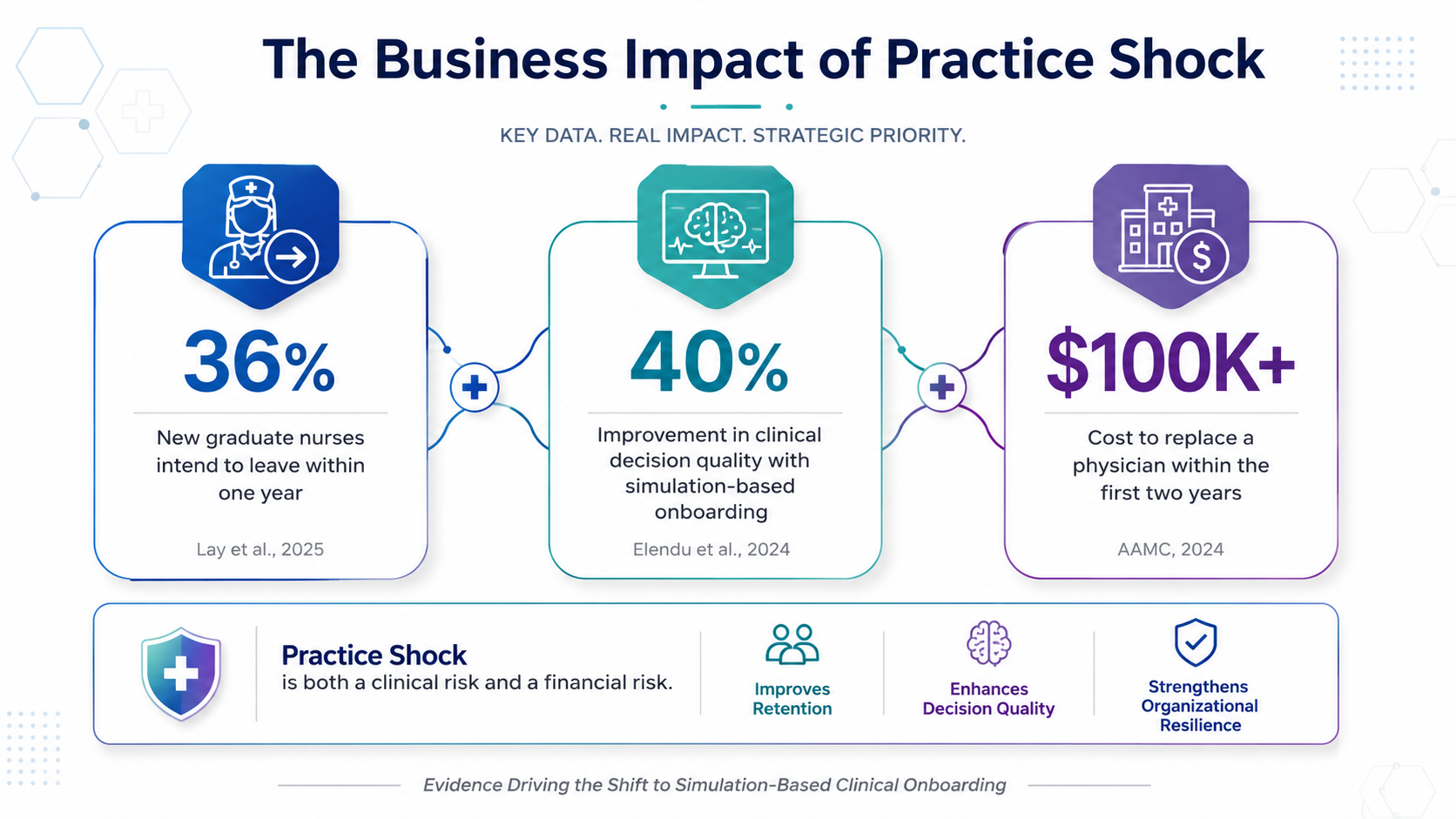
The first year of clinical practice is the most dangerous period in a healthcare professional's career. Not because new clinicians are incompetent, but because no amount of academic preparation fully bridges the gap between clinical knowledge and clinical capability in the conditions of real patient care.
This gap has a name: practice shock. It is the collision between the structured, supervised environments of training and the complexity, ambiguity, and time pressure of real clinical work. It is predictable, documentable, and consequential. It is also, with the right organizational investment, substantially avoidable.
For healthcare executives and clinical leaders, practice shock is not simply a pastoral problem. It is a strategic one. When new clinicians leave in their first year, organizations absorb replacement costs that can exceed $100,000 per physician and $64,000 per nurse, forfeit the institutional investment made in their development, and expose remaining teams to increased workload and patient safety risk. The cumulative cost to healthcare systems globally is in the billions annually.
Simulation-based, team-centred onboarding is the evidence-based response. This article examines why it works, what it looks like in practice, and what healthcare organizations must build by 2035 to make capability formation, not orientation, the standard for every new clinical hire.
Why Practice Shock Is a Systemic Failure, Not an Individual One
The emotional and cognitive experience of practice shock is well documented. The first weeks of clinical practice are energising: knowledge is fresh, motivation is high. By the third or fourth month, the reality diverges sharply from expectation. The ICU at 3 a.m. does not resemble the structured case presentations of medical school. Patients deteriorate subtly. Information arrives incomplete. Escalation norms are implicit rather than explicit. Decisions carry real consequences, not exam scores.
Research from Lay et al. (2025) found that pooled first-year turnover intention among new graduate nurses across multiple countries sits at approximately 36 percent. Burnout onset in resident physicians correlates strongly with early training years, driven by workload, loss of control, and work planning failures that traditional onboarding never addresses (IsHak et al., 2009).
The critical insight is that these are not failures of individual preparation. They are failures of onboarding system design. Traditional orientation models are built to transfer information and confirm compliance, not to build the decision-making architecture, communication fluency, and team integration that new clinicians actually need to perform safely in complex care environments.
"Traditional onboarding tells new clinicians what to know. Simulation-based onboarding teaches them how to think and act when conditions are real, stakes are high, and support is limited." — Institute for Healthcare Improvement, Quality and Safety in Healthcare Onboarding, 2024 |
What Simulation-Based Onboarding Actually Changes
The neuroscience of learning under stress explains why simulation-based onboarding outperforms traditional orientation. When learners face time pressure, incomplete information, and real emotional stakes in simulation, the brain encodes learning through emotional memory pathways that produce significantly more durable recall and transfer. This is the mechanism behind the consistent evidence that simulation-based training improves learning retention by up to 40 percent compared to didactic approaches.
But the benefit extends beyond retention. Simulation builds the situated cognition that clinical practice demands: the ability to recognize pattern deviation, prioritize competing demands, communicate under hierarchy and pressure, and coordinate with teams that do not share the same mental model. These capabilities cannot be taught in lectures. They can only be developed through practice in conditions that approximate real clinical complexity.
New graduate nurses trained through simulation report higher confidence and readiness for practice at first placement. Institutions implementing structured simulation-based residency programs for new physicians and nurses report improved early retention and reduced intent to leave at 6 and 12 months. In the high-cost, high-consequence context of clinical workforce management, these are not incremental improvements. They are substantial operational and financial gains.
Teams Are the Actual Unit of Clinical Performance
Unlock the Full Research
Create a free account or sign in to access the complete methodology, deep-dive analysis, and key implementation frameworks.
Don't have an account? It's free to join.
Organization Learning Labs
Research & Insights Division


Comments