Multi-Skilled Retail Associates: Next-Gen Role Design

How retailers can redesign frontline roles around multi-skilled, multi-channel associates for operational resilience and commercial excellence. Strategic guide for CXOs.
Multi-Skilled, Multi-Channel Associates: Designing the Next-Gen Retail Role
Picture a single retail associate on a peak Saturday afternoon. They assist in-store shoppers with fit and styling guidance. Minutes later, they shift to fulfilling online Buy Online, Pick Up In Store orders. Shortly after, they handle a real-time digital chat from a remote customer. Between interactions, they refresh a visual merchandising display and respond to a customer query that arrived through social media.
To the customer across every channel, the experience is seamless. To the store, operations flow without bottleneck or degraded coverage. To the brand, every interaction reflects consistent service standards.
This is not a vision of 2035. This is the retail operating model that leading organizations are deploying today, driven by the convergence of omnichannel customer expectations, labour market volatility, and the recognition that specialized siloed roles produce organizational fragility precisely when operational resilience is most needed.
The strategic imperative is clear: the next-generation retail role is the multi-skilled, multi-channel associate. And designing this role -- defining its capability architecture, building its development pathway, restructuring scheduling and performance measurement to support it -- is one of the most consequential decisions retail leadership teams can make in the decade ahead.
"Retailers who design around workforce flexibility will outperform those who optimize for narrow specialization. In a world of constant change, adaptability is not a soft skill -- it is the primary organizational capability." -- McKinsey & Company, 2024 |
Why Specialization Is Becoming a Strategic Liability
The specialized role model that dominated retail for decades was built for a stable, single-channel environment where demand was predictable, labour was plentiful, and customer journeys were linear. None of these conditions describe contemporary retail.
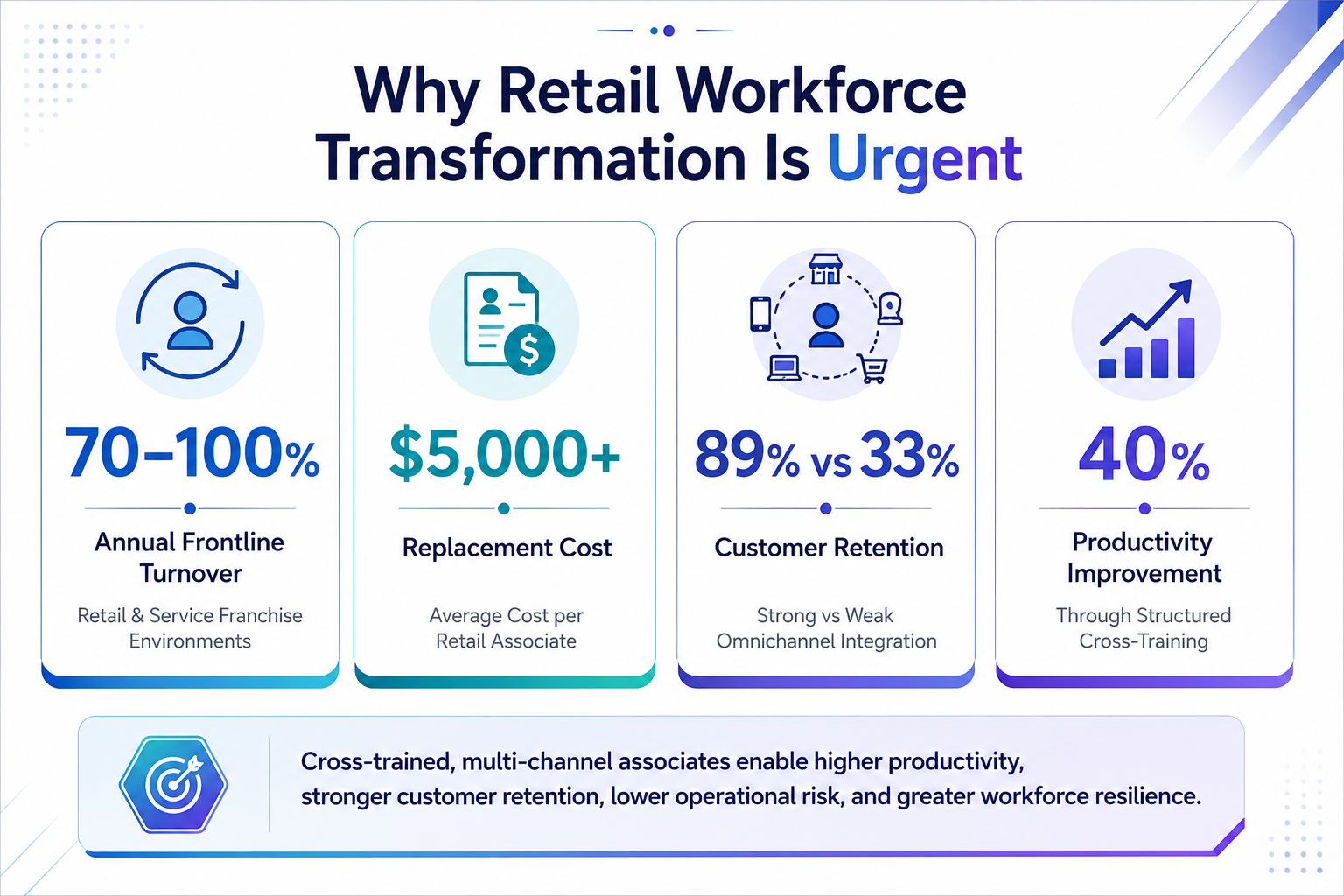
Four structural vulnerabilities define the specialized role model in the current environment:
Labour Inflexibility Under Dynamic Demand
When demand spikes in one area and drops in another -- BOPIS orders surge while floor traffic slows, or checkout queues build while fulfillment is quiet -- specialized teams cannot respond. Revenue opportunities are lost not because the work cannot be done, but because the people available are not authorized or capable of doing it. Multi-skilling eliminates this structural constraint.
Single-Point-of-Failure Operational Risk
If only one or two associates are trained in online fulfillment, advanced POS operations, or returns processing, a single absence creates operational bottleneck. In high-turnover environments, this risk is not occasional -- it is daily. Each absent specialist creates a cascade of operational degradation that a cross-trained team absorbs without disruption.
Turnover Shock Compounding Capability Loss
In specialized teams, losing a trained associate often means losing the capability entirely until a replacement is recruited, onboarded, and trained -- a cycle that takes weeks and degrades service quality throughout. In cross-trained teams, turnover is absorbed by existing capability: the departed specialist is an operational gap, not a capability extinction event.
Scheduling Inefficiency and Labour Cost Inflation
Specialized role scheduling requires maintaining adequate headcount for every function simultaneously, regardless of actual demand patterns. This produces endemic over-staffing in slow operational areas and under-staffing in high-impact ones. Demand-based scheduling enabled by multi-skilling consistently delivers higher labour productivity and lower cost per transaction.
The Multi-Channel Associate: A Redesigned Role, Not Five Jobs
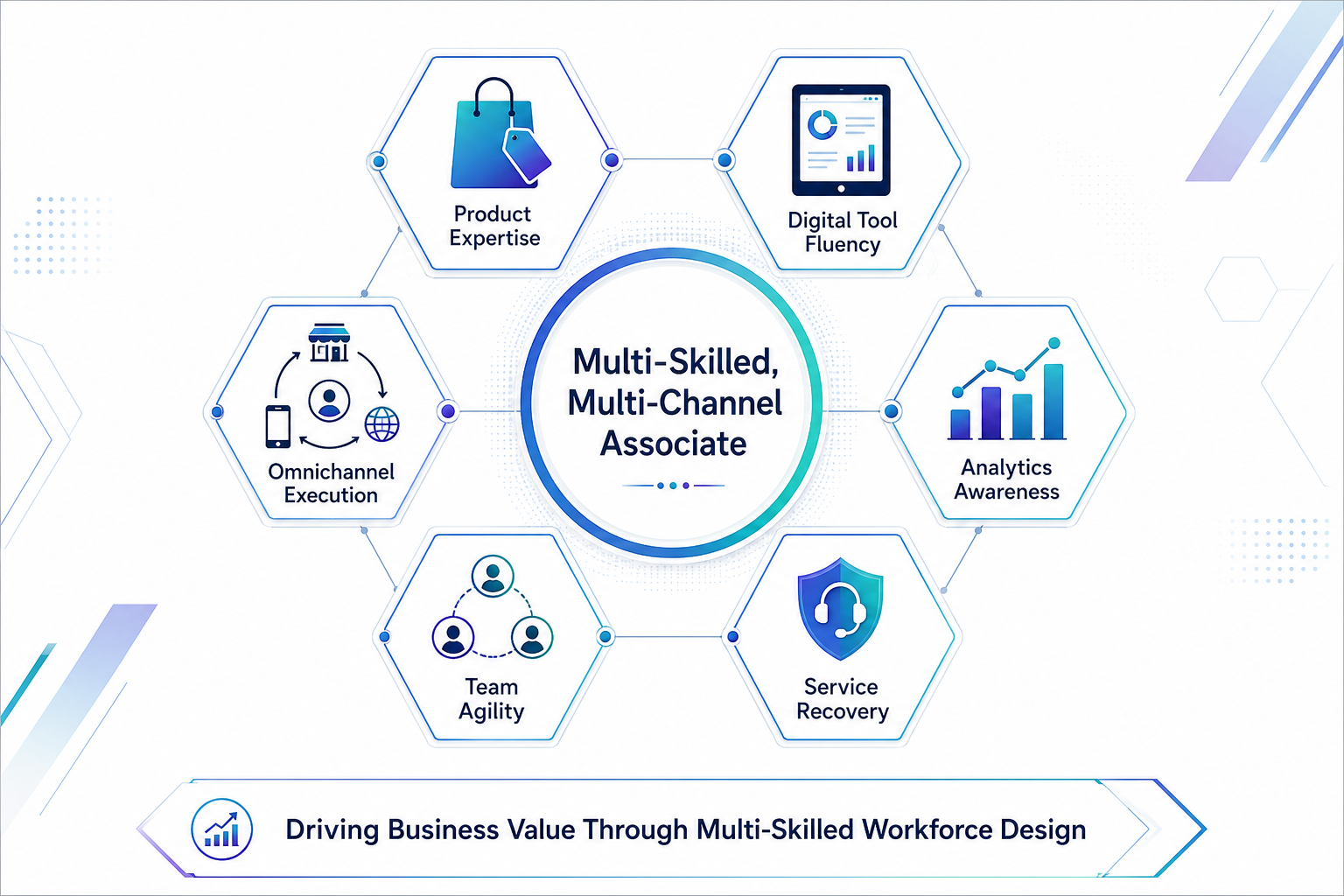
The multi-channel associate is not a single person doing five roles badly. It is a deliberately redesigned role built around integrated capabilities that enable operational flexibility without sacrificing quality or associate wellbeing. Five core capabilities define the architecture:
Core Capability | What It Enables | Business Impact |
Product Depth | Consultative selling across categories; brand storytelling; materials and fit expertise | Higher conversion, larger basket size, stronger brand advocacy |
Digital Tool Fluency | POS, BOPIS, order management, inventory systems, returns processing | Faster transactions, fewer errors, higher system utilization |
Analytics Awareness | Understanding of conversion rates, transaction value, fulfillment speed | Associates connect actions to results; performance orientation increases |
Service Recovery Judgment | Empathetic resolution within guardrails; escalation intelligence | Higher first-contact resolution; lower complaint escalation; stronger NPS |
Teamwork & Adaptability | Role flexing on demand; handoff communication; cross-function collaboration | Operational resilience; lower single-point-of-failure risk; smoother peak coverage |
Restructuring Scheduling and Performance Measurement
From Role-Based to Demand-Based Scheduling
Traditional scheduling assigns fixed roles: two cashiers, two floor associates, one fulfillment operative. This reflects organizational convenience, not customer demand patterns.
Multi-skilled scheduling builds from demand forecasts: projected traffic volume, anticipated online order volume, expected peak hours, known promotional events. Associates are assigned primary roles per shift based on demand priority but are capable of flexing when real-time conditions shift. This produces measurably better coverage during peaks, reduced over-staffing during slow periods, and faster operational response to real-time demand changes.
Unlock the Full Research
Create a free account or sign in to access the complete methodology, deep-dive analysis, and key implementation frameworks.
Don't have an account? It's free to join.
Organization Learning Labs
Research & Insights Division


Comments