Multi-Modal Planning and Collaboration Capability

A leadership guide to building multi-modal planning and collaboration capability that turns mode choice into a source of cost and resilience advantage.
From Mode Choice to Flow Design: Building Multi-Modal Planning and Collaboration Capability in Transportation and Logistics
Why Mode Choice Has Become a Leadership Decision, Not a Planner’s Default
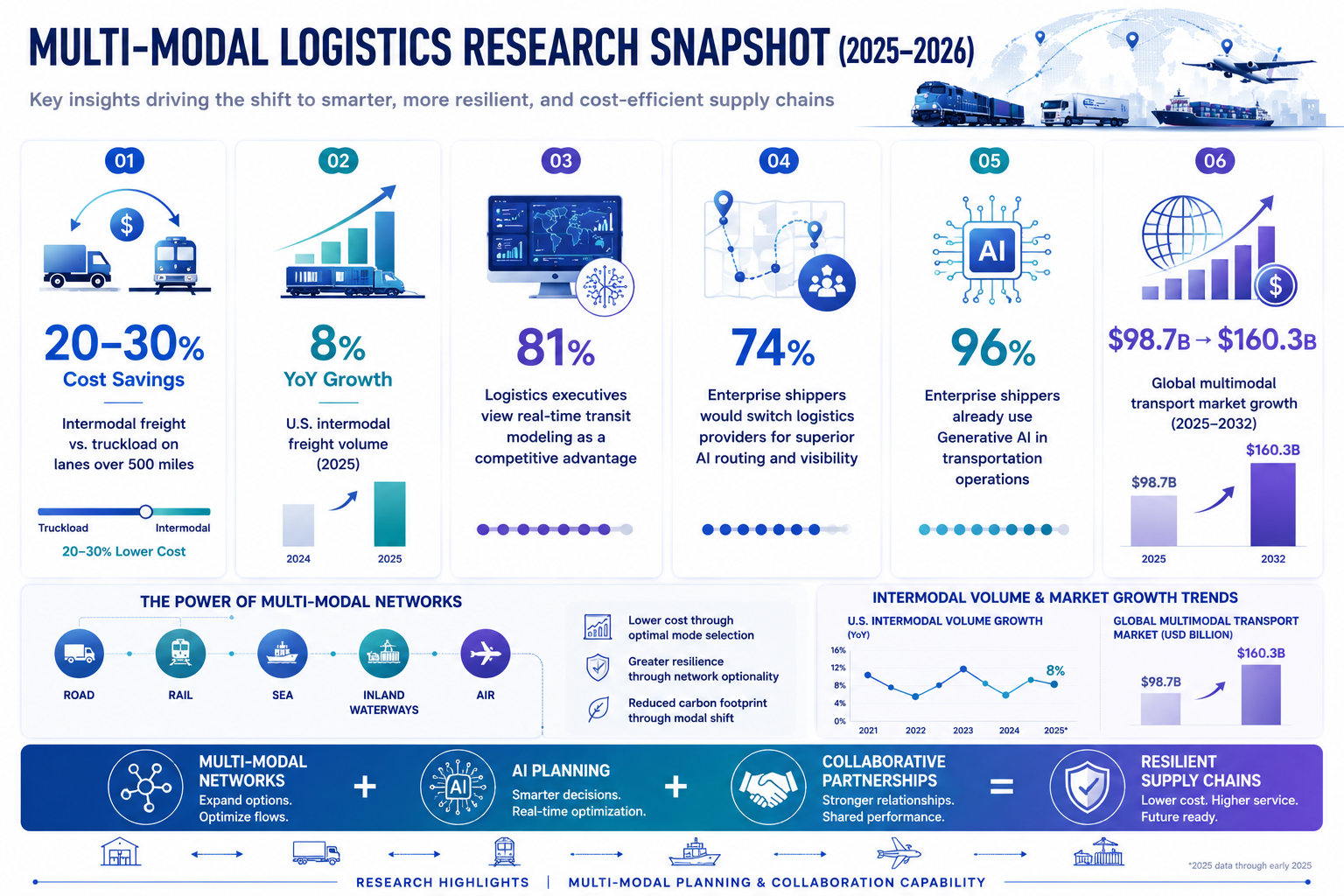
For most of the last two decades, mode choice was a planner-level decision made largely on habit: a lane ran by truck because it had always run by truck. That default is now actively expensive. Intermodal offers 20 to 30 percent cost savings against truckload on lanes over 500 miles, and US intermodal volume grew 8 percent year over year in early 2025 alone, with a projected compound annual growth rate above 13 percent through the rest of the decade. Shippers are shifting loads from pure trucking to rail-road combinations specifically to hedge against tariff volatility and looming carbon surcharges, which means mode choice has moved from an operational efficiency question to a genuine tariff and margin strategy discussion at the leadership table. Organizations that still treat mode selection as a fixed, single-mode default are leaving a structural cost advantage on the table every time a qualifying lane runs by truck alone.
Intermodal freight offers 20-30% cost savings versus truckload on lanes over 500 miles, with US volume growing 8% year over year. Kenmei Audience Analysis, citing McKinsey, CSCMP, and ATA data, 2026 |
Core Capabilities for Running a Genuinely Multi-Modal Network
Lane and Network Design Across Modes
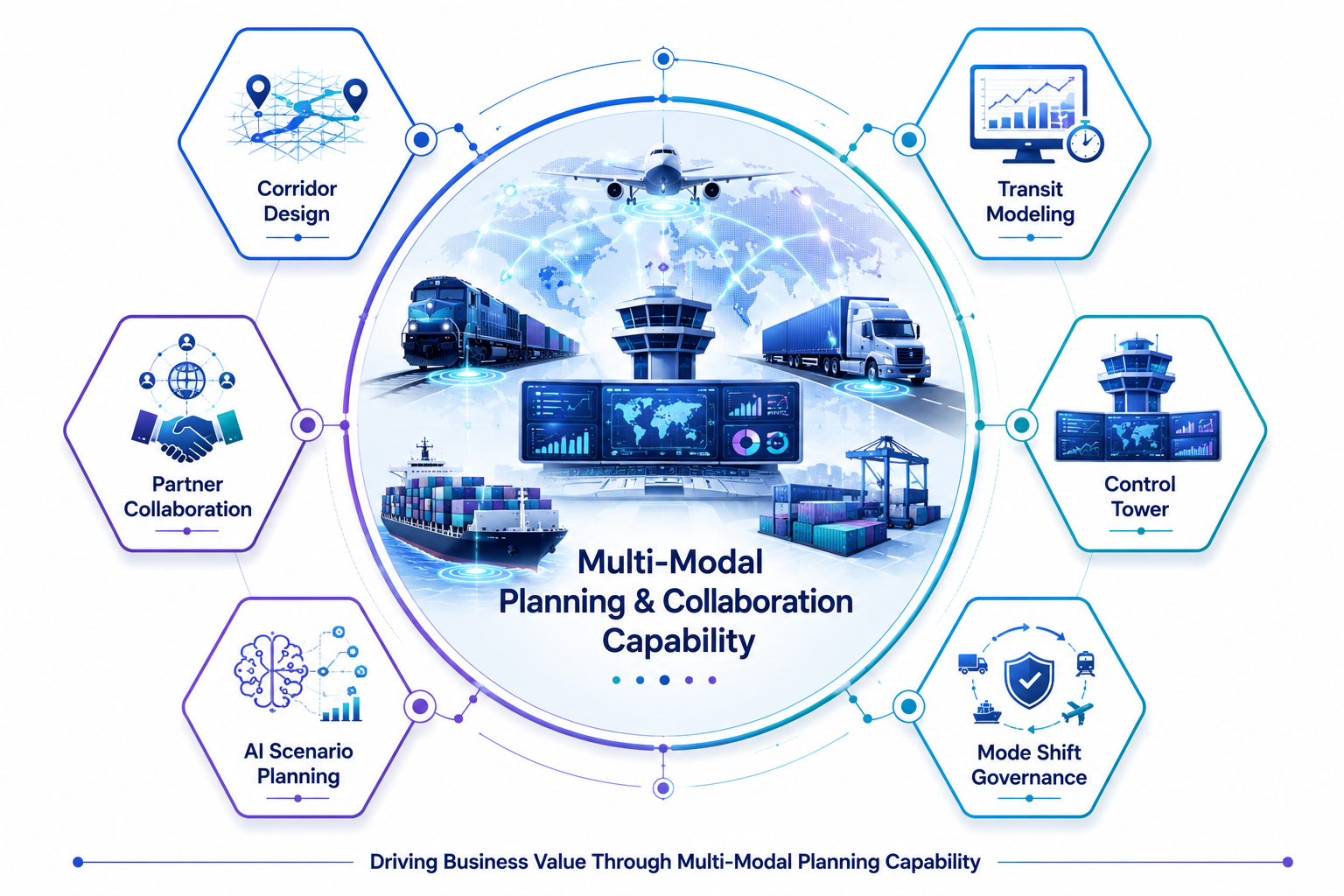
Building multi-modal capability starts with treating the network as a design problem rather than a routing problem. Global rail freight volume is projected to grow from roughly 11,353 billion tonne-kilometers in 2025 toward 14,703 billion by 2035, driven substantially by expanding dedicated freight corridors and modal shift policy from road to rail. Designing a lane network that can flex between modes requires planners to model transit-time and cost trade-offs at the corridor level, not the shipment level, and to treat rail, sea, air, and inland waterway capacity as substitutable resources within defined service parameters rather than fallback options used only when trucking capacity is constrained.
Transit-Time and Cost Modeling, Service-Level Design
Effective multi-modal capability depends on the ability to model, not estimate, the transit-time and cost trade-off for every qualifying lane. Digital control-tower platforms increasingly aggregate GPS, RFID, and electronic logging device feeds specifically so planners can compare rail velocity and gate queues before locking in a booking, a capability that a 2025 Descartes survey found 81 percent of logistics executives now view as a competitive advantage, up sharply from 68 percent just two years earlier. Some platforms have moved further still, automatically shifting a delayed shipment from rail to expedited truck without human intervention to protect high-penalty flows such as automotive and electronics freight, illustrating how transit-time modeling is evolving from a planning input into a live operational control.
Partner Selection and Performance Management
A multi-modal network is only as strong as the carriers, rail operators, and forwarders executing it, and the sector’s partner relationships remain notably fragile. Enterprise shipper retention across the broader logistics sector sits at just 60 percent, with 40 percent annual churn, one of the weakest retention rates in B2B services, driven largely by transactional rate-shopping and low switching costs. Seventy-four percent of enterprise shippers say they would switch third-party logistics providers based on AI routing and visibility capabilities alone, which means partner performance management now has to account for technology fluency alongside the traditional scorecards of cost, reliability, and claims history.
Practical Routines That Build Multi-Modal Muscle
Capability in multi-modal planning is built through recurring, structured routines, not a one-time network redesign project. Organizations that sustain genuine multi-modal flexibility consistently run:
- Monthly lane review cycles grounded in actual cost, transit-time, and reliability data across every mode serving that lane, not an annual network study that goes stale within a quarter.
- Joint planning sessions with key carriers and rail operators specifically focused on redesigning flows, not simply negotiating rate renewals.
- Documented playbooks for switching modes during disruption, port congestion, extreme weather, or labor action, tested before the disruption occurs rather than improvised during it.
- A shared data layer connecting TMS, control-tower, and carrier systems so a mode-shift decision can be evaluated and executed within hours rather than days.
Talent and Learning: From Single-Mode to Multi-Modal Thinking
Unlock the Full Research
Create a free account or sign in to access the complete methodology, deep-dive analysis, and key implementation frameworks.
Don't have an account? It's free to join.
Organization Learning Labs
Research & Insights Division


Comments