Medical Affairs 2030: New Capabilities for Patient Impact Now

Medical affairs is becoming pharma's strategic third pillar. Learn the data, digital, and leadership capabilities the function needs to build by 2030.
Medical Affairs 2030: Building New Capabilities for Evidence, Engagement, and Patient Impact
The pharmaceutical industry is at an inflection point in how it defines medical affairs 2030 capabilities. After decades of playing a supporting role, medical affairs is stepping into the spotlight, not as a service function, but as a strategic pillar with the power to shape patient outcomes at scale. By 2030, the most successful organizations will not simply have strong R&D pipelines and commercial engines. They will have medical affairs teams that lead with data, orchestrate engagement across channels, and drive evidence strategies that transform healthcare delivery, all while keeping patient outcomes at the center of every decision.
The Evolution to the Third Pillar
For years, medical affairs operated in the space between R&D and commercial teams, translating science into accessible information and supporting both functions as needed. That model is shifting. Leading organizations now view medical affairs as a coequal third pillar, sitting alongside R&D and commercial with distinct strategic responsibilities rather than serving as an intermediary between them.
What is driving this elevation? Several converging forces: increasingly complex regulatory landscapes, the explosion of real-world data, mounting pressure from health technology assessment bodies, and the accelerating digitalization of healthcare delivery. Medical affairs teams are uniquely positioned to navigate these challenges because they combine deep scientific expertise with an understanding of the healthcare ecosystem and the trust of clinical stakeholders that neither R&D nor commercial functions typically hold to the same degree.
By 2030, medical affairs will be expected to do far more than respond to medical information requests or coordinate advisory boards. The function will lead rapid-cycle evidence generation grounded in real-world data, orchestrate AI-driven engagement across all channels, and provide strategic direction to the entire organization for maximum patient impact. This is not a vision confined to white papers. Many organizations are already well along this journey, though capability gaps and budget constraints remain real barriers to full realization.
Expanding the Remit: From Support to Strategy
The medical affairs remit is broadening in several critical directions simultaneously, each requiring new ways of thinking and working.
Shaping Evidence Agendas
Gone are the days when medical affairs simply executed evidence plans handed down from R&D. Today's medical affairs leaders are co-architects of evidence strategy, identifying data gaps through sophisticated analytics and designing integrated evidence-generation programs that span health economics and outcomes research (HEOR), real-world evidence, and Phase IIIb and IV studies.
This shift demands more than clinical expertise. Medical teams must understand what payers need to see, what questions community physicians are asking, and where practice guidelines have gaps, then prioritize evidence generation based on quantifiable patient unmet needs rather than internal departmental priorities. One pharmaceutical company used predictive analytics to anticipate growing interest in gene therapy for a specific genetic disorder, allowing its medical affairs team to proactively develop educational resources and identify research partnerships before competitors recognized the same opportunity.
Orchestrating Tailored Scientific Engagement
The second major expansion is in how medical affairs engages with healthcare professionals (HCPs). The traditional model, field-based Medical Science Liaisons (MSLs) conducting periodic face-to-face meetings with key opinion leaders, is giving way to something far more sophisticated and scalable.
By 2030, medical affairs will engage across a genuinely omnichannel landscape, seamlessly integrating in-person interactions, virtual meetings, digital content portals, email communications, and automated messaging to create personalized educational journeys for each HCP. This is not about adding more touchpoints. It is about smarter orchestration: the right scientific information, delivered through the preferred channel, at precisely the moment it is needed to inform a clinical decision.
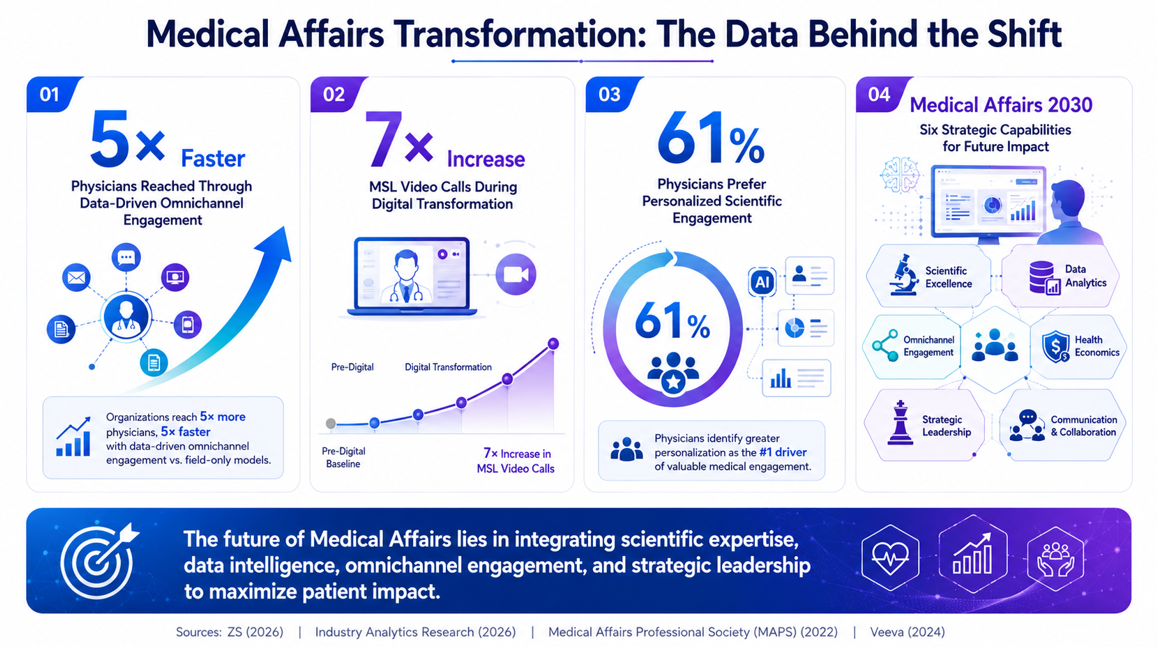
Consider the scale of this shift: organizations implementing data-driven omnichannel engagement can connect with five times more physicians, five times faster, than traditional field models. And they are not only reaching key opinion leaders. They are closing knowledge gaps for community physicians, who treat the vast majority of patients but historically received far less attention from medical affairs teams built around a small number of high-profile relationships.
Informing Cross-Functional Strategy
Perhaps the most significant expansion is medical affairs' growing role in shaping organizational strategy itself. Positioned at the intersection of clinical reality and commercial viability, medical affairs leaders are increasingly involved in decisions about therapeutic area prioritization, launch strategies, lifecycle management, and even business development, conversations from which the function was historically excluded.
This strategic elevation requires medical affairs to speak the language of business. Teams must articulate how evidence strategies will support market access, how engagement activities translate to patient outcomes, and how medical investments generate measurable returns. Medical affairs executives who can champion innovation and establish credible external authority are increasingly finding seats at the executive table and genuine influence over company direction, not just an advisory voice brought in after decisions are made.
The New Capability Set: Beyond Clinical Expertise
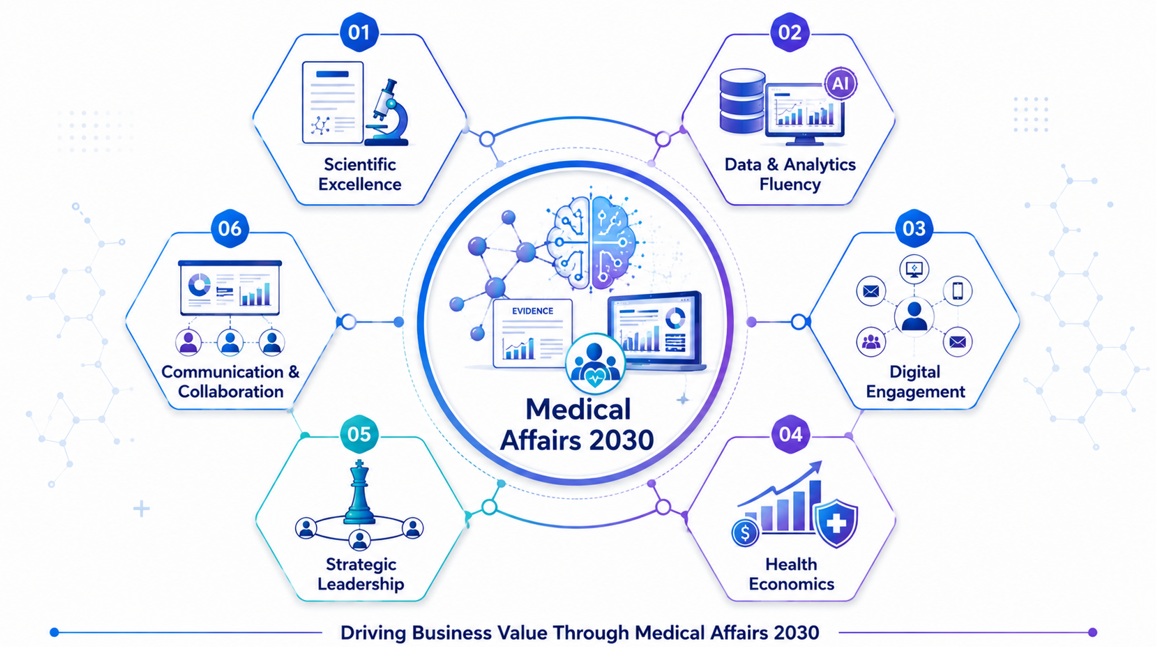
What does it take to deliver on this expanded vision? Medical affairs professionals will need to cultivate capabilities well beyond traditional clinical knowledge.
Data and Analytics Literacy
In this new era of medical affairs, data fluency is not optional. It is foundational. Teams must be comfortable working with real-world data sources, understanding the strengths and limitations of different datasets, and translating analytical insights into strategic action. This does not mean every MSL needs to become a data scientist, but medical professionals do need to interpret predictive models, identify meaningful patterns in HCP behavior data, and leverage analytics tools to inform engagement strategy. Organizations are responding by either building dedicated analytics capability within medical affairs or ring-fencing analytics resources from R&D or commercial teams to serve medical needs specifically.
A widely used medical analytics maturity framework evaluates organizational maturity across data infrastructure, analytical capability, and impact measurement, showing how best-in-class organizations progress from descriptive reporting (what happened) to predictive analytics (what will happen) and ultimately to prescriptive insight (what should we do).
Digital and Omnichannel Engagement
The COVID-19 pandemic accelerated the adoption of digital engagement by years, not months. MSL video calls increased sevenfold as a proportion of all HCP contacts during that period. More importantly, the pandemic proved digital engagement could be just as effective as face-to-face interactions when done thoughtfully rather than treated as a lesser substitute.
Mastering omnichannel engagement requires several competencies simultaneously: understanding HCP channel preferences, creating modular content that works across formats, using technology platforms to manage consent and track engagement, and leveraging advanced analytics to inform next-best scientific actions. It also requires a genuine mindset shift, from episodic meetings to continuous educational journeys spanning multiple touchpoints and channels over time. The payoff is substantial: 61% of physicians identify greater personalization as the main differentiator for making medical engagement more valuable, and companies that moved to data-driven engagement saw prescription lifts of 19%, compared to just 3% with traditional approaches.
Health Economics and Outcomes Understanding
As payers gain more influence over treatment decisions, medical affairs teams must become genuinely conversant in health economics: cost-effectiveness analyses, quality-adjusted life years (QALYs), budget impact models, and the specific evidence requirements of health technology assessment bodies across different markets. MSLs increasingly need to articulate not just clinical efficacy but economic value directly. When a KOL asks about budget impact, or a payer questions why a therapy should be reimbursed, medical affairs must provide compelling, evidence-based answers rather than deferring entirely to market access colleagues. Organizations are addressing this by having MSLs pursue training through bodies like the International Society for Pharmacoeconomics and Outcomes Research (ISPOR) and working directly with health economics teams to translate HEOR findings into field-ready messages.
Unlock the Full Research
Create a free account or sign in to access the complete methodology, deep-dive analysis, and key implementation frameworks.
Don't have an account? It's free to join.
Organization Learning Labs
Research & Insights Division


Comments