Learning-First Culture in IT Services: Future-Proofing CXOs

How IT services CEOs, CHROs, and CIO/CTOs can embed learning-first culture as organisational DNA to outcompete disruption and build durable competitive advantage through 2035.
Rewriting the IT Services DNA: How Learning-First Cultures Future-Proof CXOs in an Age of Perpetual Disruption
Why the firms that lead the next decade will not be those with the best platforms, but those with the deepest organisational capacity to learn faster than disruption arrives
Abstract
The IT services industry faces an existential inflection point. Margin pressure, the commoditisation of vanilla services by artificial intelligence, and accelerating talent attrition are converging to reshape the competitive landscape irrevocably. This article argues that firms with a learning-first culture embedded in their organisational DNA are systematically out-executing those that obsess only over billability.
It maps the shift from capacity-plus-rates to capabilities-plus-adaptability as the core value equation; contrasts event-based training with embedded, in-flow-of-work learning; and sets out the distinct responsibilities of CEOs, CHROs, and CIO/CTOs in building a culture that learns faster than the disruption arrives. Behavioural foundations, a practical measurement stack, and a 12 to 18-month CXO roadmap are provided throughout.
1. The Existential Moment for IT Services
The IT services industry has entered a period of reckoning unlike any in its history. Three forces are converging simultaneously: relentless margin compression as commoditisation strips value from traditional delivery models; the accelerating capacity of artificial intelligence to automate entire categories of work that once defined competitive differentiation; and a talent attrition crisis that drains institutional knowledge at precisely the moment it is most needed.
Firms that respond by optimising around billability — tightening utilisation targets, rationalising headcount, and defending legacy service lines — are managing the present while mortgaging the future. The firms that will lead the next decade are making a different bet: that culture, specifically a learning-first culture embedded in the organisation's DNA, is the strategic variable that determines survival in an age of perpetual disruption.
"Technology choices made today will be reconsidered in twelve to eighteen months. What compounds — what genuinely accumulates as a strategic asset — is not any specific technology capability. It is the organisational capacity to learn." — Jay Barney, Resource-Based View of Competitive Advantage, adapted |
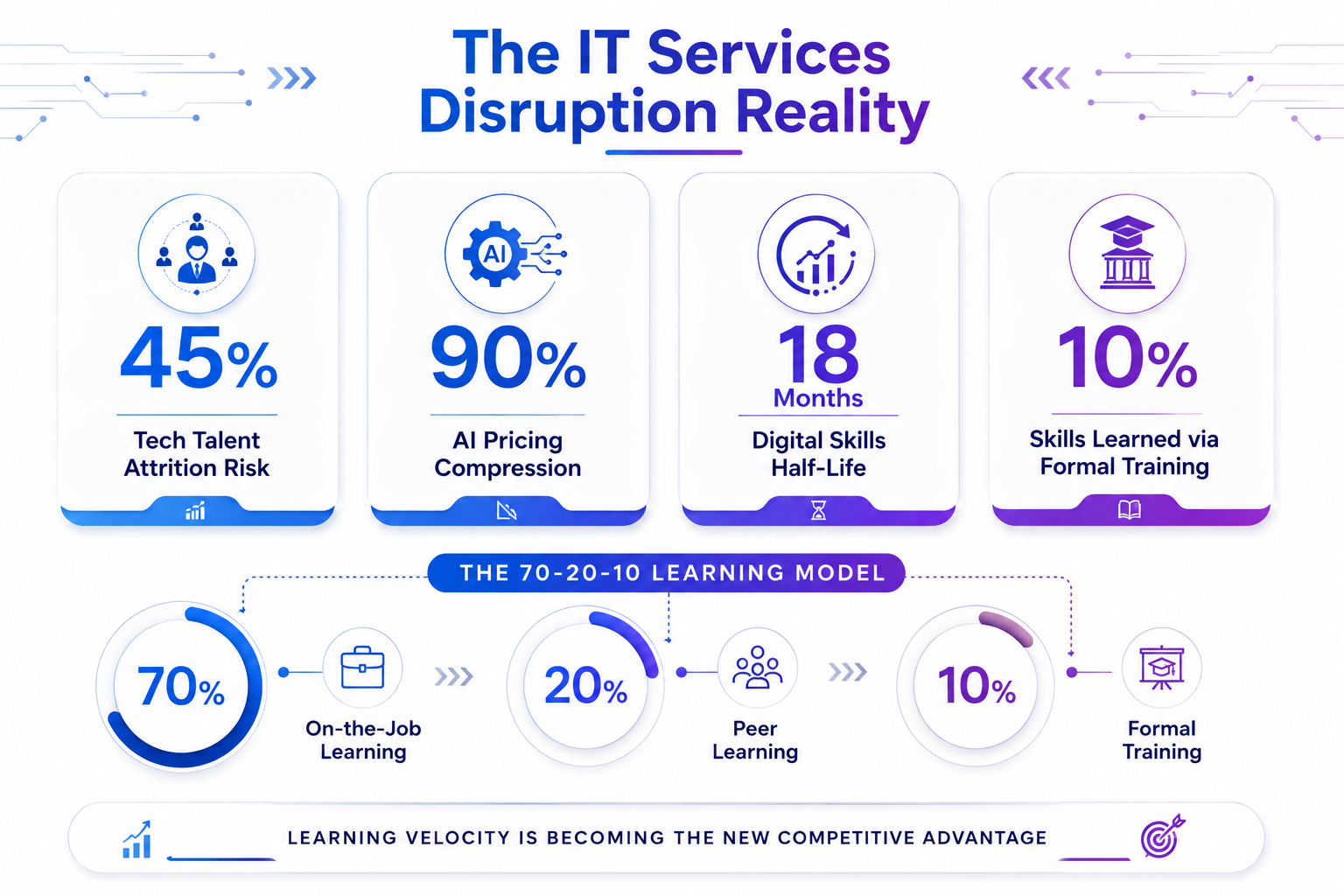
The data points to a crisis already in progress. Harvey Nash's 2024 technology workforce survey found that 45 percent of technology professionals were planning to leave their current employer within twelve months, with career development absence cited as a primary driver. LinkedIn's 2024 Workplace Learning Report found the half-life of digital skills has compressed to approximately eighteen months. And the 70-20-10 model — validated across professional service contexts — confirms that only 10 percent of the skills people use at work are learned through formal training, with 70 percent coming from on-the-job experience and 20 percent from peer interaction. Firms whose primary capability mechanism is a training catalogue are addressing 10 percent of the problem.
2. The New Value Equation for IT Services
For two decades, IT services competed on a straightforward equation: capacity plus competitive rates. Scale your talent pool, manage pyramid structures, and keep day rates below client alternatives. That model is collapsing.
The new value equation is capabilities plus adaptability. Clients do not simply need bodies and hours — they need partners who can co-create solutions to problems that did not exist twelve months ago, deploying skills that were not in the mainstream talent market two years earlier. The premium on adaptability is structural, not cyclical.
Learning Velocity as a Core Enterprise KPI
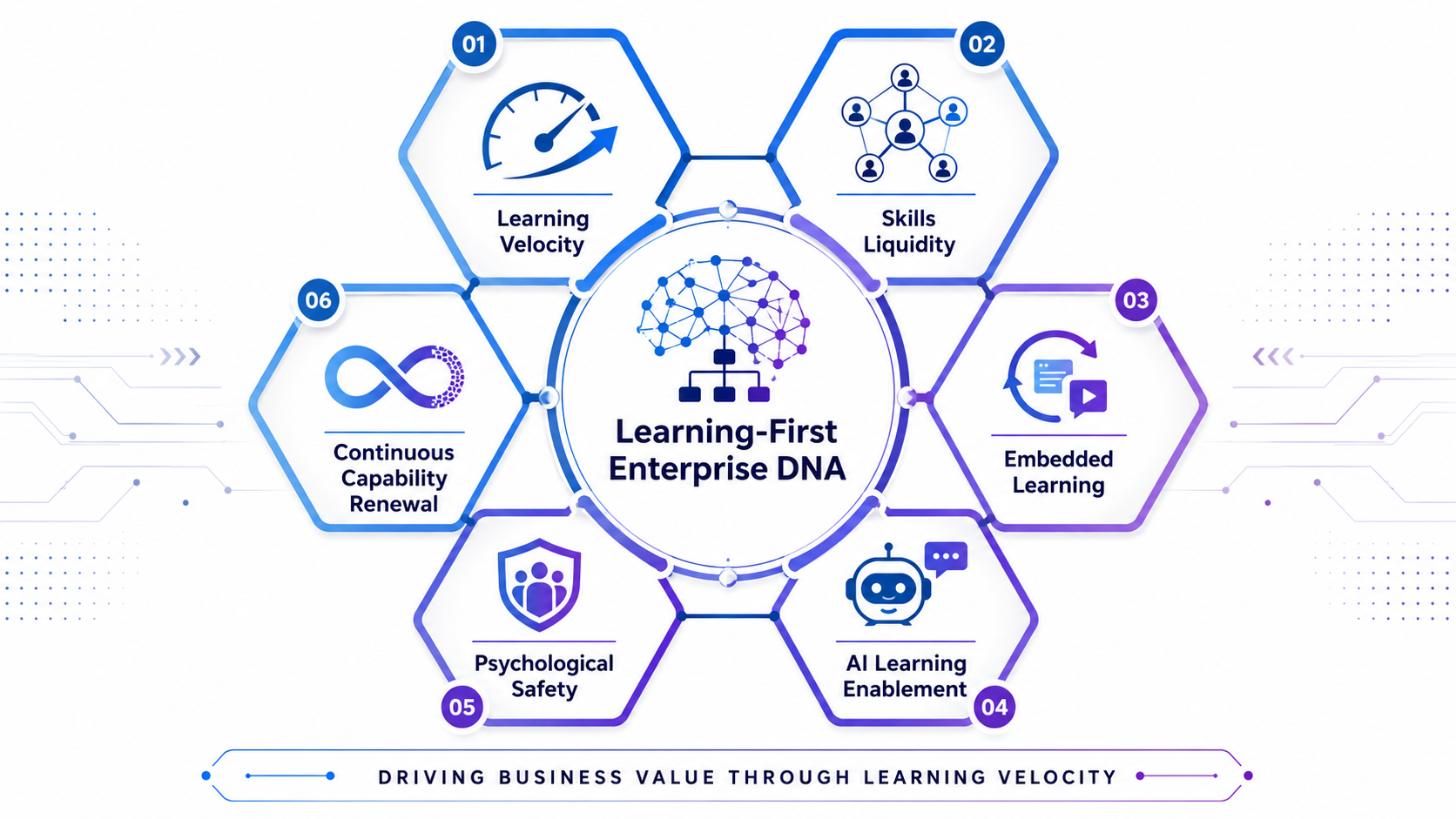
In this environment, learning velocity — the rate at which an organisation acquires, deploys, and scales new capabilities — is no longer a training metric. It is a core business performance indicator. A firm that can absorb and deploy a transformative technology significantly faster than its competitors possesses a compounding advantage. That gap, repeated across multiple technology cycles, becomes insurmountable.
Firms still managing primarily to utilisation targets are optimising a metric that is rapidly becoming a lagging indicator of strategic decay. When the most profitable contracts are won by demonstrating cutting-edge capability rather than competitive day rates, the firm that is too busy billing to learn has built its own trap.
3. From Training to Learning-First Culture
The Training Trap
Traditional training is event-based: a course, a certification programme, a compliance module deployed at intervals. It is designed around content delivery, measured by completion rates, and largely disconnected from the actual performance context in which skills must be applied. The result is well-documented: employees learn 70 percent of skills on the job, 20 percent from peers, and only 10 percent through formal training sessions (Docebo, 2020, citing the 70-20-10 model). For IT services firms navigating continuous disruption, an event-based training philosophy is structurally inadequate.
Embedded Learning: In the Flow of Work
A learning-first culture embeds capability development into the rhythm of daily work. Learning is not a separate activity that competes with delivery — it is integrated into delivery. This takes multiple forms: performance support tools that surface relevant knowledge at the moment of need; peer-learning structures that transfer expertise laterally across teams; after-action reviews that convert project experience into institutional knowledge; and AI-assisted coaching that personalises development within the working day.
Behaviour Change as the Real Mechanism
Culture change is not achieved through content — it is achieved through behaviour change. Three mechanisms drive the shift to a learning-first culture. Nudges make the learning behaviour easier than the non-learning behaviour. Role-modelling by senior leaders who are visibly and consistently learning in public signals that curiosity and intellectual humility are valued at the top. And system design removes structural barriers by recognising learning in performance frameworks, linking capability growth to career advancement, and measuring learning velocity as a performance indicator with the same rigour applied to delivery metrics.
4. CXO Responsibilities in Building Learning-First DNA
The CEO: Setting the Narrative and the Non-Negotiables
Unlock the Full Research
Create a free account or sign in to access the complete methodology, deep-dive analysis, and key implementation frameworks.
Don't have an account? It's free to join.
Organization Learning Labs
Research & Insights Division


Comments