Key Account Logistics Capability for Leaders

A leadership guide to building customer service and key account capability that turns transport and logistics relationships into a lasting retention advantage.
Logistics as Relationship: Building Customer Service and Key Account Capability in Transportation Organizations
Why Retention, Not Rate, Is Now the Defining Metric
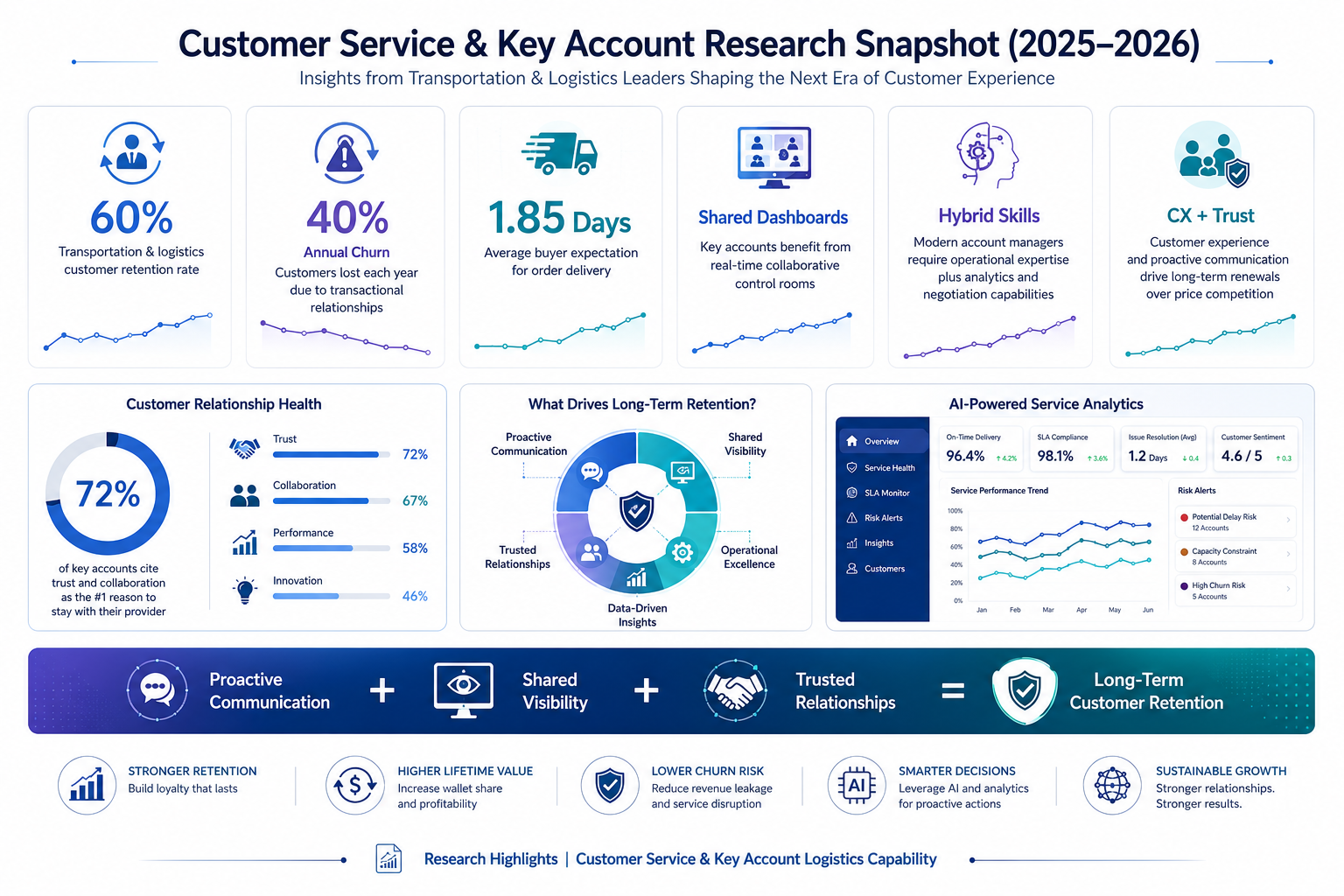
Transportation and logistics carries one of the weakest customer retention profiles in B2B services: roughly 60 percent retention, with 40 percent annual churn, driven substantially by transactional rate-shopping behavior and low switching costs. That statistic alone should reframe how leadership teams think about customer service and key account management. Logistics used to be evaluated almost exclusively on cost and speed; today, customer experience, the full end-to-end interaction between a shipper and its customers, is shaping competitive advantage, and companies that excel at delivering transparent, proactive, and personalized experiences keep more customers, command better contracts, and win business even where price and speed are comparable to competitors. Organizations still treating account management as a quarterly check-in layered on top of otherwise transactional service are competing in a market where relationship depth, not rate, increasingly decides who survives the next renewal cycle.
The transportation and logistics sector’s customer retention rate is just 60%, with 40% annual churn, among the weakest in B2B services. Kenmei Audience Analysis, Enterprise Shipper Landscape, 2026 |
The Capability Stack Behind Genuine Key Account Management
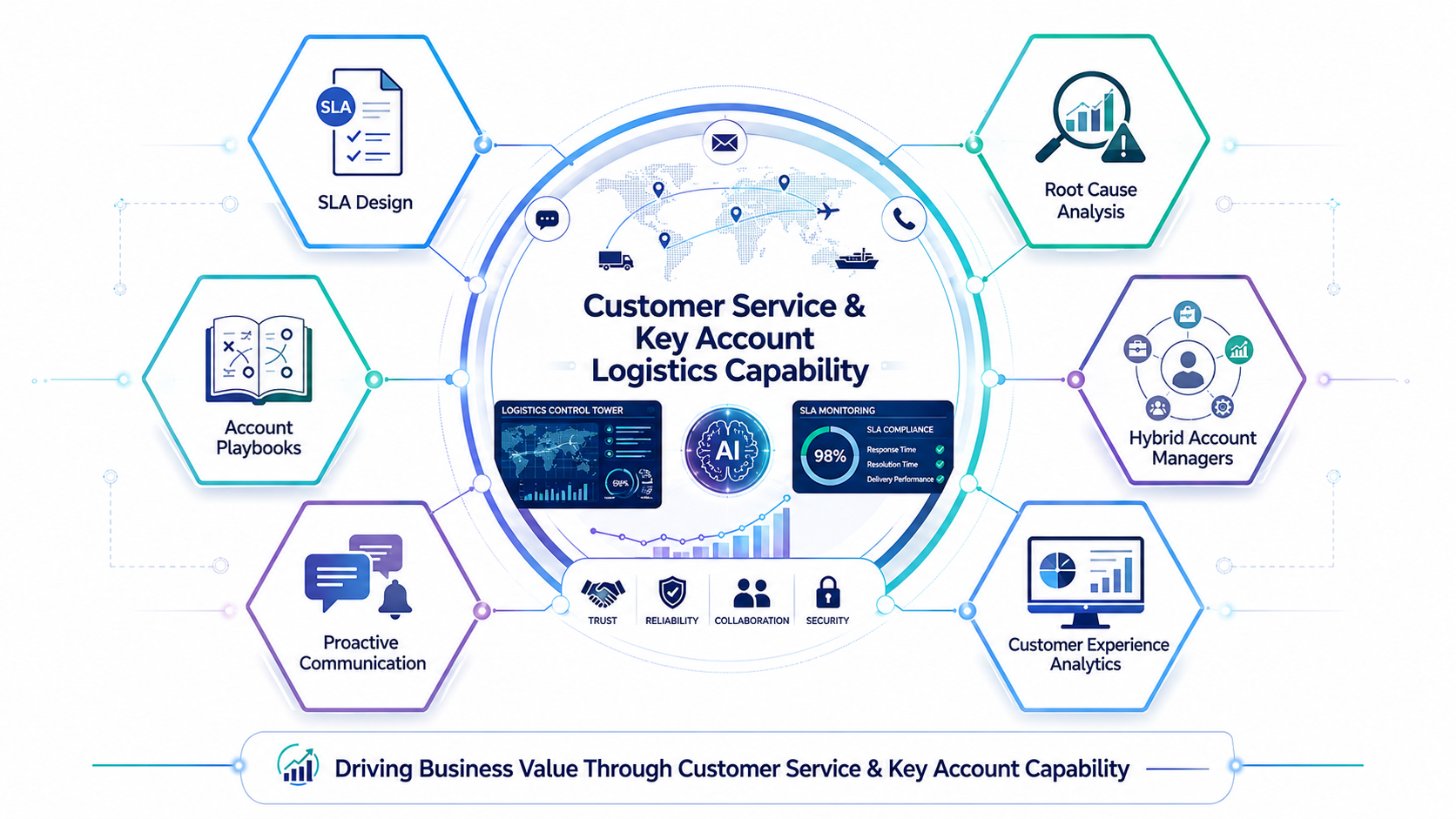
Service Design and SLAs, Account-Specific Playbooks
Service level agreements have historically been treated as static, boilerplate contract terms. That is no longer adequate: buyers now expect orders to arrive within roughly 1.85 days on average, down from 2.36 days just a few years earlier, and a strong SLA needs corrective mechanisms, not just penalty clauses, such as a defined improvement period when a carrier repeatedly misses an on-time threshold, paired with performance bonuses for partners who consistently exceed it. SLAs also need to be understood by function: B2B agreements typically prioritize strict delivery windows to protect just-in-time production schedules, where a miss can halt a customer’s operations entirely, while B2C agreements prioritize speed and last-mile consistency against consumer expectations that shift year over year. An account-specific playbook translates these generic SLA principles into the operational detail, escalation contacts, exception protocols, communication cadence, that make the difference between a documented agreement and a functioning one.
Structured Communication Routines
Winning customer experience in logistics is rarely about a single dramatic intervention; it is about orchestrating consistent, contextual communication across the entire service lifecycle. Generic tracking links are increasingly insufficient; systems need to deliver contextual alerts that reduce manual status calls and build confidence in the delivery process, while customers increasingly prefer to self-serve answers through portals covering tracking, documentation, proof of delivery, and even claims. Independent verification matters here as much as the communication itself: relying solely on self-reported performance data from a carrier or 3PL, which carries an inherent conflict of interest, is a documented blind spot; organizations that build independent tracking, exception dashboards, and satisfaction correlation catch service gaps weeks before they surface in a customer complaint.
Root-Cause Analysis and Joint Continuous Improvement
The accounts that renew consistently are the ones where problems become shared improvement projects rather than one-sided blame exercises. This requires genuinely separating fulfillment performance from carrier performance in reporting, since a late delivery caused by a carrier transit-time miss is a fundamentally different problem, with a different owner and a different fix, than one caused by a fulfillment error, and conflating the two in a single dashboard metric erodes trust with the customer and obscures the actual root cause from the account team itself.
Implementable Practices That Build Account Trust
Durable key account relationships are built through structured, recurring practices rather than relationship charisma alone:
- Key account "control rooms" with shared dashboards visible to both the logistics provider and the customer, replacing one-sided internal reporting with a genuinely joint view of performance.
- Quarterly business reviews focused on performance trends and improvement initiatives, not simply a price renegotiation disguised as a relationship meeting.
- Simple, clearly documented escalation ladders with named responsibilities, so a service failure has an immediate, known owner rather than triggering an ad hoc scramble to find one.
- Independent performance verification, mystery-shopping test orders, exception dashboards, and satisfaction correlation, run alongside carrier-reported data rather than in place of it.
Talent and Learning: The Hybrid Account Manager
Unlock the Full Research
Create a free account or sign in to access the complete methodology, deep-dive analysis, and key implementation frameworks.
Don't have an account? It's free to join.
Organization Learning Labs
Research & Insights Division


Comments