Just Transition Oil & Gas: People-First Workforce Strategy

Just transition is not charity -- it is the strategic infrastructure for successful energy transformation. Learn how to design people-centric workforce strategies that build credibility, capability, and social licence.
Why Just Transition Is the Energy Sector's Most Important Unfinished Business
The energy transition is the largest intentional restructuring of the global economy since the industrial revolution. It will reshape employment patterns, community economies, and professional identities across dozens of countries and hundreds of communities over the next two decades. The pace and scale of this restructuring create the conditions for either the most successful managed transformation in economic history, or one of its most traumatic failures.
The difference between those outcomes is not primarily technological or financial. It is human. The energy transition will succeed or fail based on whether the people most directly affected -- oil and gas workers, fossil fuel community members, and the families whose economic security depends on the industries being transformed -- believe that they have been treated with dignity, given genuine opportunities, and included in the design of their own futures.
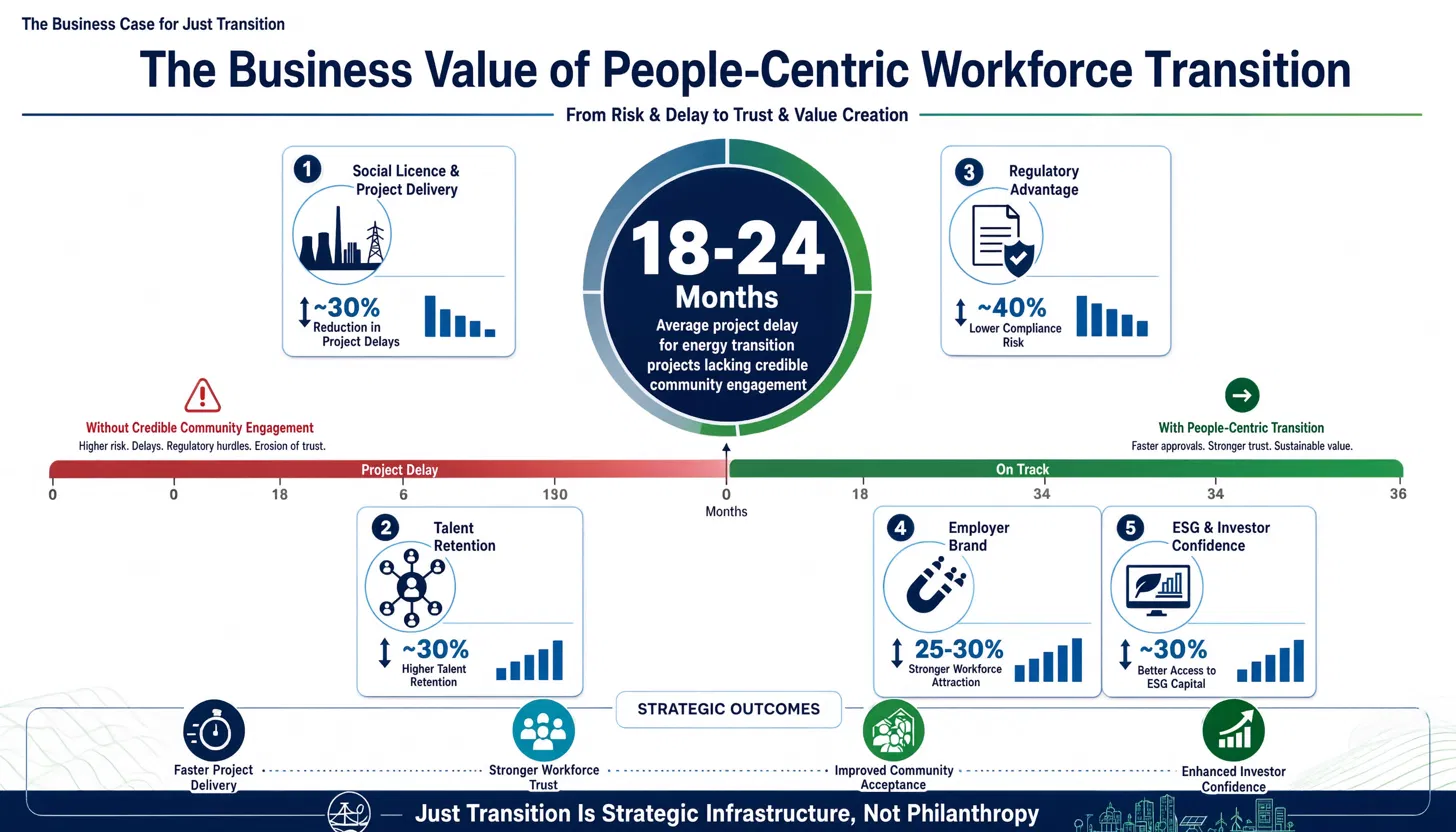
WEF research indicates that energy transition projects in communities without credible just transition programs face an average of 18-24 months of additional regulatory and social delay compared to projects with demonstrated community and workforce engagement. The cost of that delay -- in project economics, first-mover advantage, and investor returns -- dwarfs the investment required to avoid it.
What Just Transition Actually Requires: Beyond Good Intentions
Just transition is frequently invoked in corporate communications and policy frameworks in ways that bear little relationship to the actual experience of workers and communities undergoing transition. Understanding what genuine just transition requires -- as opposed to what is typically delivered -- is the prerequisite for designing programs that actually work.
Early Engagement, Not Late Announcement
The most common failure mode in workforce transition is announcing significant workforce changes -- redundancies, facility closures, asset decommissioning -- with insufficient lead time for workers to engage meaningfully in planning their own futures. Genuine just transition begins communicating transition timelines and building support infrastructure years before transition events occur, not months. This requires strategic workforce communications that go beyond legal compliance to genuine dialogue.
Individual Agency and Choice, Not Managed Exit
Workers experiencing transition have diverse preferences, capabilities, and personal circumstances. Some want to reskill for clean energy roles within the same organisation. Some want to transition to entirely different sectors. Some are approaching retirement and want dignity in that process. Some want to remain in fossil fuel operations for as long as they are commercially viable. Just transition programs that provide genuine individual agency -- that support workers in identifying and pursuing their preferred transition pathway rather than channeling them into a single programmatic solution -- achieve significantly higher satisfaction and social licence outcomes.
Community Transition, Not Just Individual Transition
When major energy employers reduce activity in a community, the impact extends far beyond direct employees. Contractors, supply chain businesses, hospitality, retail, and professional services that depend on the energy sector's economic activity are all affected. Just transition programs that focus exclusively on direct employment and ignore community economic transition fail to address the full scope of their impact and lose the social licence benefits that comprehensive engagement would deliver.
Skills and Opportunity, Not Just Income Support
Income support during transition -- redundancy payments, unemployment benefits, wage subsidies -- addresses the immediate financial dimension of transition but does not address the professional identity, purpose, and long-term economic security dimensions that determine whether workers experience transition as dignified or traumatic. Skills development, reemployment support, and genuine connection to new career opportunities are the sustainable elements of just transition investment.
The Business Case for People-Centric Workforce Strategies
The moral case for just transition is foundational and non-negotiable. The business case reinforces it and ensures that commercial organisations have the incentive structure to invest adequately.
Business Case Dimension | Evidence Base | Strategic Value to Organisation |
Social Licence and Project Delivery | WEF research: 18-24 month delay in transition projects without credible community engagement. IEA: social acceptance is among the top three barriers to renewable energy deployment in OECD markets. | Accelerated permitting, reduced community opposition, faster construction and commissioning timelines. Every month of avoided delay is worth millions in project economics. |
Talent Retention and Internal Capability | Deloitte research: organisations with credible just transition programs retain 30% more operational talent during transition periods than those without. Retained talent carries institutional knowledge critical to managed asset decline. | Reduced capability loss during transition, maintained safety performance, institutional knowledge retention for optimised asset tail operations. |
Regulatory and Policy Relationship | Jurisdictions with active just transition policy frameworks -- UK, EU, Australia, Canada -- are tying regulatory approvals and public funding access to demonstrated workforce and community transition commitments. | Maintained access to public development finance, smoother regulatory engagement, reduced compliance risk in just-transition-active jurisdictions. |
Employer Brand and Talent Attraction Unlock the Full ResearchCreate a free account or sign in to access the complete methodology, deep-dive analysis, and key implementation frameworks. Don't have an account? It's free to join. O Organization Learning LabsResearch & Insights Division On this pageResearch DetailsIndustryOil and Gas AuthorOrganization Learning Labs PublishedJul 18, 2026 You Might Also Be Interested In Information Technology Designing the future-ready digital engineering organization Banking, Financial Service And Insurance A Systematic, Empirical Framework for Capability Development in Retail Banking Banking, Financial Service And Insurance Why Capability Beats Strategy in Retail Banking Organizations |
Comments