IT Training Programs Are Broken: The Capability Academy Fix

IT skills now have a 2.5-year half-life. Learn why one-off training fails and how IT capability academies build durable, business-aligned technical talent.
Why Your IT Training Programs Are Broken: The Capability Academy Blueprint for 2026
Why one-off training fails IT organizations, and the capability academy model that replaces it
The Organization Learning Labs | 2026 Edition
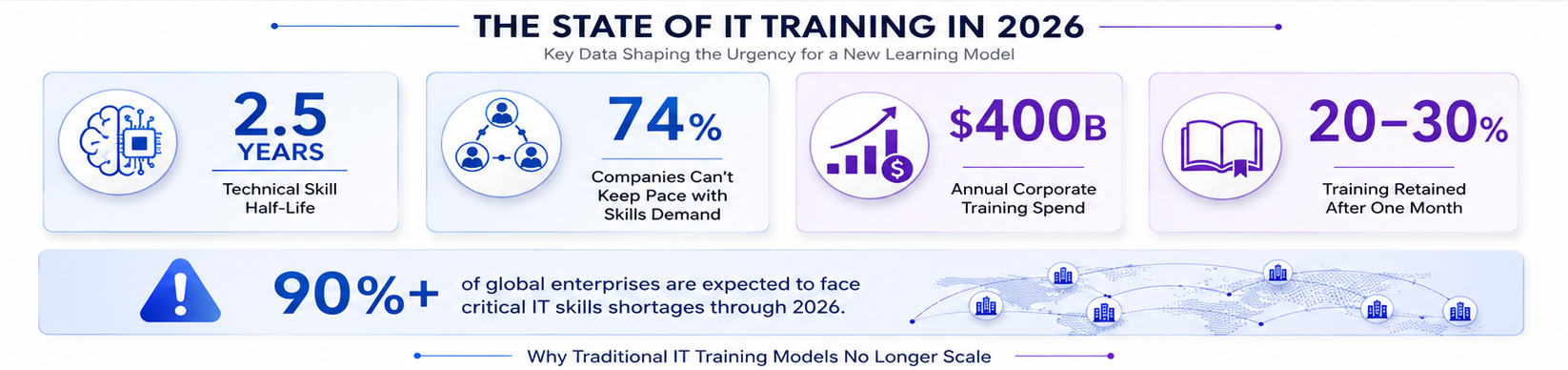
The half-life of a technical skill is now roughly 2.5 years. That single number should reframe how every CIO, CHRO, and CLO thinks about learning investment, because it means that a substantial share of what an IT organization's engineers, architects, and analysts know today will be functionally obsolete before most multi-year training contracts even renew. Cloud platforms, security protocols, and AI/ML frameworks are compounding this decay: workforce researchers now describe reskilling not as a periodic event but as a continuous operating requirement.
And yet most organizations still buy learning the way they did a decade ago: a workshop here, a certification voucher there, a compliance module before the next audit. The Josh Bersin Company's February 2026 research on corporate learning found that the global training market has grown to roughly $400 billion a year, while 74% of companies report they still cannot keep pace with the skills their strategy demands. The problem, that research concludes, is not spend. It is model.
The Real Cost of a Broken Training Model
Consider a familiar scene inside a mid-sized financial services firm: a director of infrastructure attends a three-day cloud architecture workshop, returns with a notebook full of insights, briefs the team, and by the time a critical infrastructure decision surfaces six months later, the specifics have faded and the team defaults to familiar patterns. This is not a failure of motivation. It is the Ebbinghaus forgetting curve doing exactly what cognitive science predicts: without structured reinforcement, people forget the majority of new information within 24 hours, and compressed multi-day formats give learners no time to process, practice, or apply what they have absorbed.
The downstream effects compound across the organization. Skill decay slows cloud initiatives, widens security exposure, and throttles the pace at which IT can support the business. ISC2's 2025 Cybersecurity Workforce Study, drawing on more than sixteen thousand respondents, found that 95% of cybersecurity teams report at least one critical skills gap and that 88% experienced a significant security event in the past year tied directly to a skills shortfall. IDC separately estimates that unresolved skills gaps could cost the global economy in the trillions annually in lost productivity and delayed digital initiatives.
DATA POINT According to IDC, more than 90% of global enterprises are expected to face critical IT skills shortages through 2026, with the resulting productivity loss estimated in the trillions of dollars worldwide. |
Talented people notice the mismatch first. When skill obsolescence outpaces an organization's ability to reskill its own workforce, engineers begin to look elsewhere, not primarily for compensation but for a credible growth path. Surveys of the technology workforce consistently find that a majority of IT professionals want learning tightly coupled to real work rather than abstract theory delivered in generic workshops. When that connection is missing, skill gaps widen, frustration rises, and voluntary attrition becomes a second, more expensive symptom of the same root cause.
Why One-Off Training Programs Consistently Fail
The forgetting problem
Cognitive science has understood the forgetting curve for over a century, yet most corporate learning design still ignores it. A three-day bootcamp or week-long certification sprint concentrates content delivery into a period too short for the brain to consolidate it into durable, retrievable knowledge. Without spaced repetition, applied practice, and real-world reinforcement, most of what is taught simply does not survive contact with the next quarter's workload.
The application gap
Even when training content is retained, only a fraction of it gets applied. Learning and development researchers have long observed that somewhere between one-fifth and one-third of workshop content is actually used within a month of delivery, because there is no structured mechanism translating classroom frameworks into on-the-job behavior. Employees return to environments where legacy habits, organizational inertia, and unchanged incentive structures quietly override what was just taught.
The relevance gap
Unlock the Full Research
Create a free account or sign in to access the complete methodology, deep-dive analysis, and key implementation frameworks.
Don't have an account? It's free to join.
Organization Learning Labs
Research & Insights Division


Comments