IT Leadership for Constant Change: Building Change Muscles

Cloud migrations, AI pilots, and re-orgs now overlap constantly. Learn why IT leaders need change muscles, not just project skills, to lead sustainably.
IT Leadership for Constant Change: Building Change Muscles, Not Just Project Skills
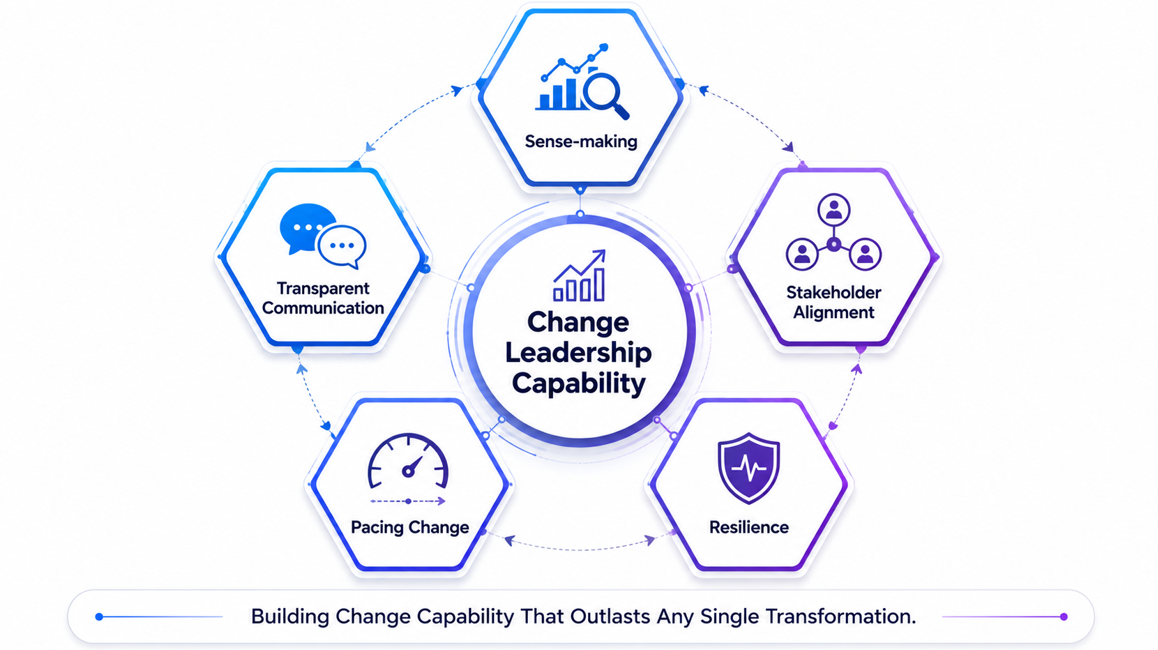
Building the change capability that outlasts any single transformation program
The Organization Learning Labs | 2026 Edition
Ask most IT leaders what "change management" looks like in their organization and they will describe a project methodology: timelines, milestones, stakeholder matrices, status reports. None of that is wrong. But when cloud migrations run parallel to new ways of working, re-orgs collide with system upgrades, and AI pilots stack on top of security overhauls, project skills alone stop being sufficient. What is missing is something more fundamental: the capability to lead through constant, compounding change without burning out the team, or oneself, in the process.
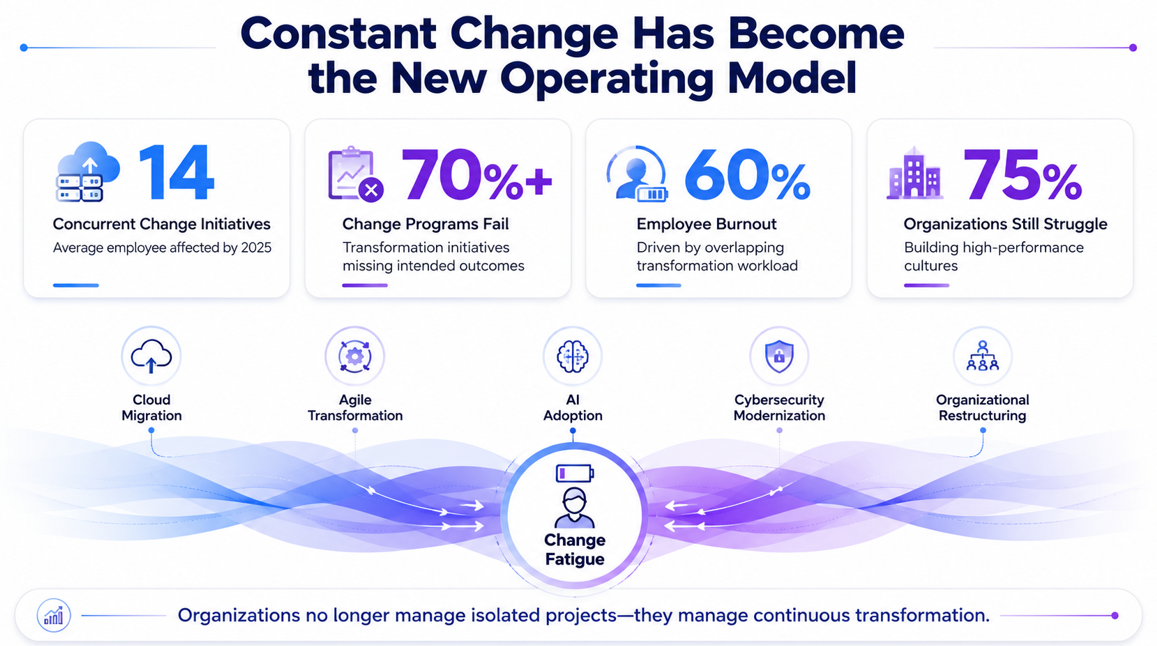
Change fatigue is not a buzzword. McKinsey's State of Organizations 2026 research, drawn from more than ten thousand senior leaders across fifteen countries, describes organizations as having entered a state of perpetual transformation in which technology infusion, economic disruption, and shifting workforce expectations are converging simultaneously rather than sequentially. Separate research tracking enterprise change volume found that the average employee experienced roughly ten planned organizational changes in 2022, a figure that climbed to around fourteen concurrent change initiatives by 2025, with overlap rates between initiatives exceeding 60% in many organizations.
The Reality: When Transformations Collide
Most IT organizations are not running one big transformation. They are running three, four, sometimes five overlapping initiatives, each with its own timeline, its own executive sponsor, and its own competing sense of urgency. A cloud migration is underway, lifting and shifting workloads, retraining teams on new architectures, rethinking governance. At the same time, an agile transition is pulling people into cross-functional squads. The org chart has been redrawn again, and reporting lines are still settling. Layered on top is an AI pilot leadership wants live now, plus a cybersecurity remediation effort triggered by a recent audit.
Individually, each of these changes might be manageable. Together, they create dependencies and conflicts that no one has fully mapped. Cloud migration requires specific skills, but the agile transition has fragmented the team holding those skills across different squads. The re-org reset trust and cohesion just as teams were finding their rhythm. The AI pilot needs clean data that the security remediation effort is simultaneously restricting access to. Research by Emergn cited in current change-management literature finds that more than 70% of change programs fail to achieve their stated aims, and close to 60% of employees report burnout driven specifically by the increased workload transformation efforts create. This is not exhaustion from any single project. It is systemic erosion of trust, energy, and organizational capacity to absorb what comes next.
SYSTEMIC RISK Change fatigue is not simply tiredness. Organizational psychology research links unaddressed change fatigue to measurable increases in strain, burnout, and intent to leave, alongside declines in teamwork, performance, and job satisfaction, a compounding risk that project-management discipline alone cannot fix. |
Why Project Skills Alone No Longer Cut It
Traditional change management methodology assumes a before, a during, and an after: a defined transformation with a start date, an end date, and a return to a new steady state. That model breaks down when the next wave of change arrives before the last one has settled. Gantt charts, stakeholder matrices, and RACI documentation remain useful tactical tools, but they were never designed to answer the harder question IT leaders now face: how do you sustain team performance and wellbeing when transformation itself has become the steady state, not the exception to it?
Unlock the Full Research
Create a free account or sign in to access the complete methodology, deep-dive analysis, and key implementation frameworks.
Don't have an account? It's free to join.
Organization Learning Labs
Research & Insights Division


Comments