IT Career Lattices: Skills-Based Growth Paths for Tech Talent

94% of employees would stay longer with real career investment. See why IT organizations are replacing career ladders with flexible, skills-based lattices.
IT Career Lattices, Not Ladders: Designing Skills-Based Growth Paths for Tech Talent
Why flexible, skills-based growth paths are replacing the single climb to management
The Organization Learning Labs | 2026 Edition
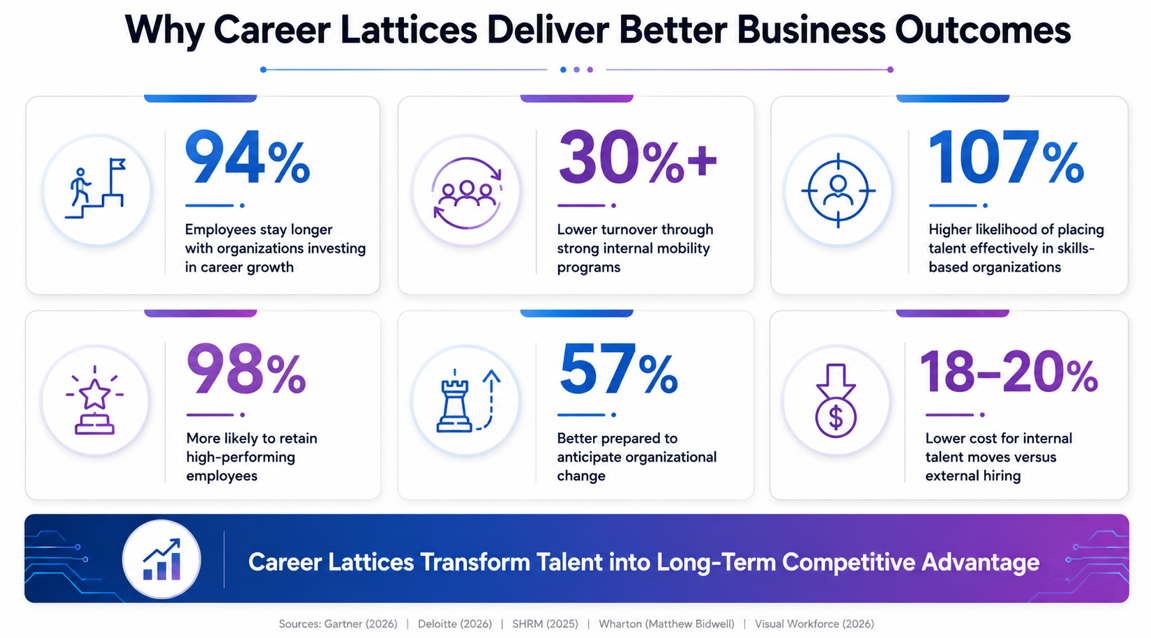
Every software engineer starts a career with roughly the same internalized story: climb the ladder. Become a senior engineer. Eventually become an engineering manager, then director, then VP. It is clean, linear, and increasingly the reason talented technologists walk out the door. Research on workforce development consistently finds that a large majority of employees, often cited around 94%, would stay longer at a company that genuinely invests in their career growth, yet a meaningful share still leave because advancement feels structurally blocked.
The disconnect is structural, not motivational. The traditional ladder was designed for a simpler era, when promotions moved people up, sideways moves were rare, and career success was synonymous with management. Modern technology organizations do not work that way, and Gartner's research heading into 2026 makes the strategic stakes explicit: as new roles are created, roughly one in five employees will need to be redeployed by 2030, and most organizations are not structurally prepared for that scale of internal movement.
Why Ladders Are Broken, and Your Best Engineers Already Know It
For decades, the career ladder followed a predictable sequence: individual contributor, senior engineer, technical lead, engineering manager, senior manager, director. Move up or move out. It worked reasonably well until the underlying assumption stopped holding: that growth necessarily means acquiring authority over people. Not every strong engineer wants to manage a team. The architect with an obsessive focus on system design, the security specialist who thinks in threat models, the infrastructure engineer who understands distributed systems better than anyone else in the building, none of them necessarily want to run a team. They want to go deeper technically.
Under a pure ladder model, these engineers face an unforced choice: become a manager and set aside the technical work they are genuinely excellent at, or hit a ceiling. Most hit the ceiling. Some leave. Others become reluctant managers, quietly filling the leadership pipeline with people who would rather still be writing code, a dynamic that degrades both management quality and technical depth simultaneously.
THE SIDEWAYS MOVE PROBLEM Under the ladder model, a lateral move, backend engineer to platform infrastructure, or infrastructure to security, looks like a demotion or a lack of direction. Under a lattice model, the same move is understood as legitimate growth, because it deepens capability rather than simply changing title. |
Enter the Career Lattice
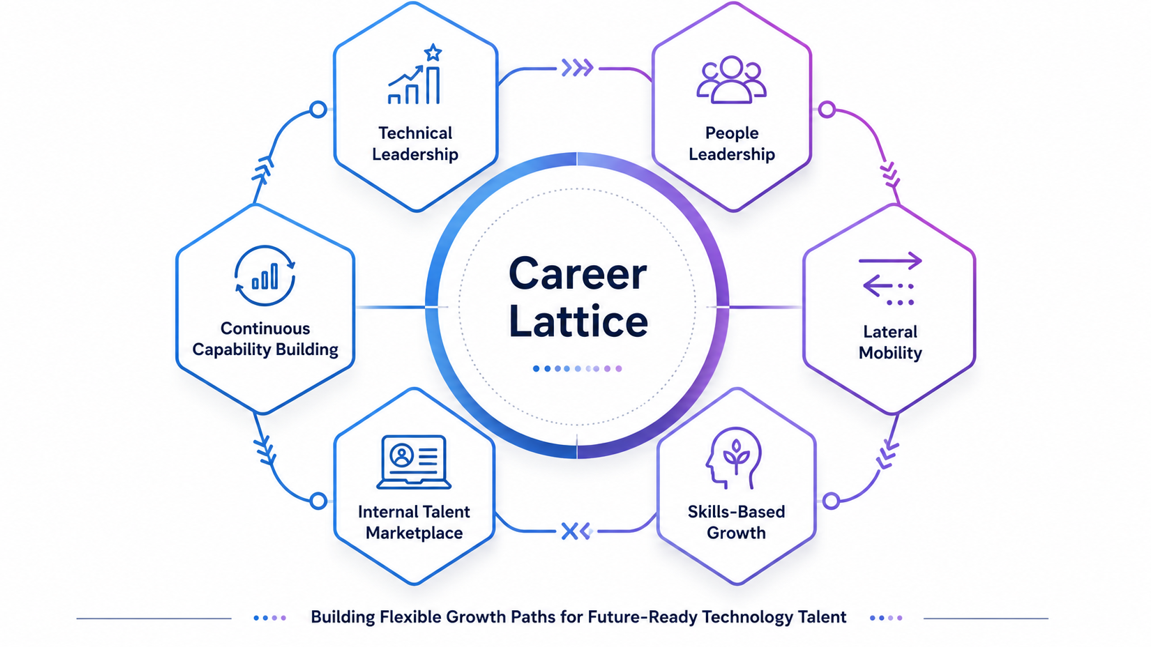
A career lattice is a flexible, multi-directional growth model in which talented engineers can move up, sideways, diagonally, and occasionally strategically backward, without it registering as failure. Instead of a single path to the top, a lattice creates dozens of interconnected pathways: a technical leadership track running alongside a management track, architecture deep-dives alongside platform innovation, security specialization alongside data engineering mastery, each with its own recognized seniority levels and compensation bands.
The business case is not soft. Organizations investing meaningfully in development see retention improvements frequently cited in the range of 50% or higher, while companies with robust internal mobility programs report turnover reductions exceeding 30%. Deloitte research on skills-based organizations found they are 107% more likely to place talent effectively, 98% more likely to retain high performers, and 57% more likely to anticipate change than organizations still operating on rigid, title-based structures.
Unlock the Full Research
Create a free account or sign in to access the complete methodology, deep-dive analysis, and key implementation frameworks.
Don't have an account? It's free to join.
Organization Learning Labs
Research & Insights Division


Comments