India's Manufacturing Capability: A National Talent System

India's manufacturing rise depends on capability, not just capacity. Learn the talent, learning and behavior systems leaders must build for 2035.
Manufacturing as a National Capability: Building India's Talent, Learning and Behavior Systems for Global Manufacturing Leadership
India's manufacturing ambition is well capitalized and well supported by policy. Whether it becomes a durable global capability now depends on talent, learning infrastructure and behavior, not incentives alone
1. Introduction: India's Manufacturing Rise
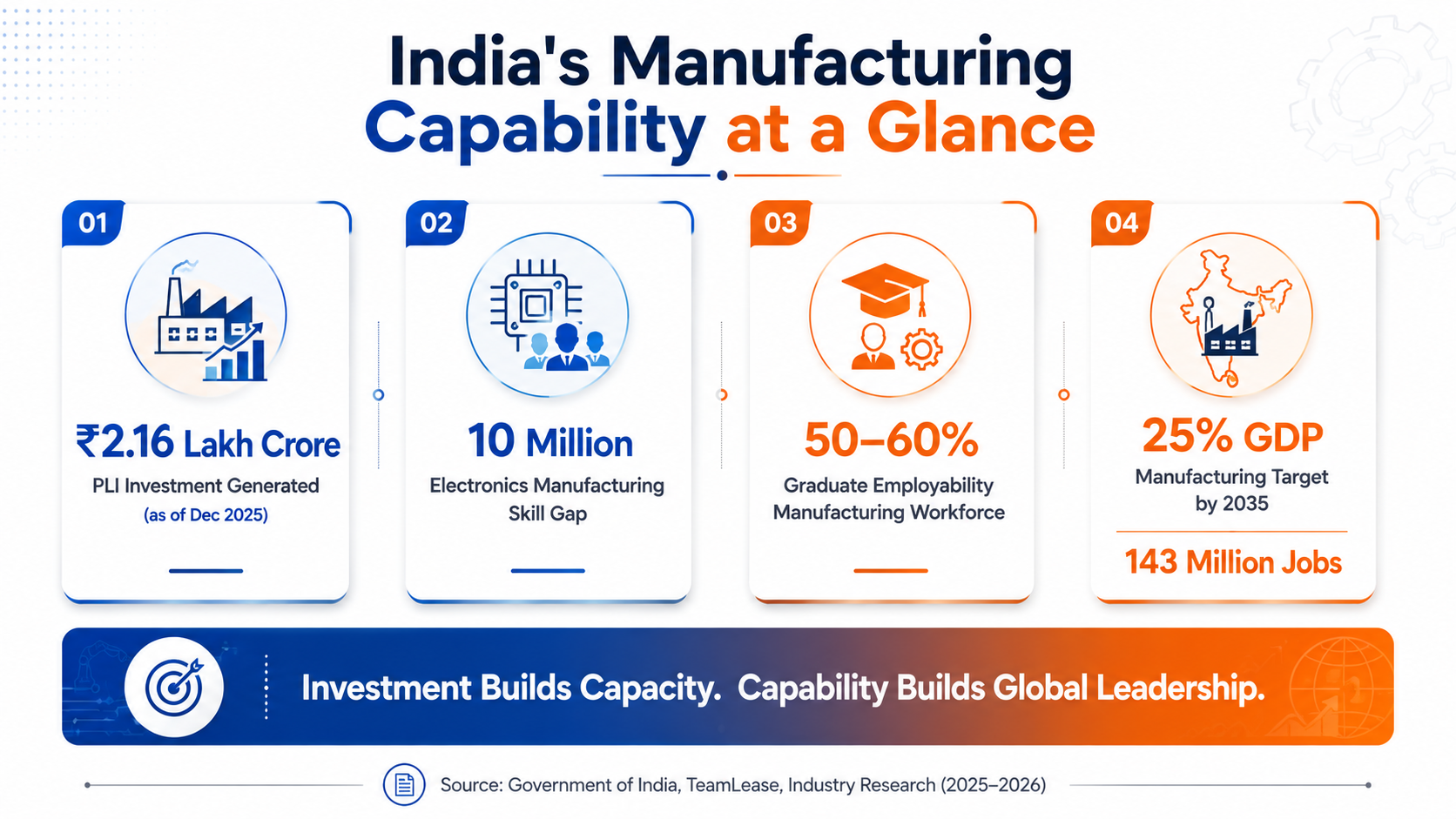
India manufacturing capability building has become the defining constraint standing between the country's considerable policy and capital momentum and its stated ambition to become a global manufacturing hub. The macro indicators are genuinely strong. The Index of Industrial Production recorded manufacturing growth of 8.1 percent in December 2025, the highest in over two years, with the Purchasing Managers' Index at 55.4 in January 2026, comfortably above its long-run average. Production-Linked Incentive schemes have generated investment commitments exceeding 2.16 lakh crore rupees, driving incremental production of over 20.41 lakh crore rupees and creating more than 14.39 lakh direct and indirect jobs as of December 2025.
The government's National Mission on Manufacturing, announced in the 2025-26 budget, sets an explicit target of raising manufacturing's share of GDP to 25 percent by 2035, alongside the creation of 143 million jobs and an expansion of merchandise exports to roughly 1.2 trillion dollars through deeper integration into global value chains. Electronics manufacturing has grown fivefold in five years, semiconductor investment is accelerating under the India Semiconductor Mission, and India ranks sixth globally among DeepTech ecosystems according to NASSCOM. By almost any capital or policy measure, the momentum behind India's manufacturing ambition is real.
What underpins this article is a more uncomfortable question that capital and policy metrics alone cannot answer: does India have the talent, learning infrastructure and workplace behavior systems to convert this investment into durable, globally competitive manufacturing capability, or is the country building capacity faster than it is building the people who will run it. The evidence suggests the gap is real, specific and closing more slowly than the capital investment that depends on it.
India's Electronics Manufacturing sector stands at a pivotal moment, driven by transformational government initiatives and growing global demand, yet burdened by a significant ten million skill gap that threatens to hinder its potential. — Sumit Kumar, Chief Strategy Officer, TeamLease Degree Apprenticeship, 2026 |
2. National Capability Stack
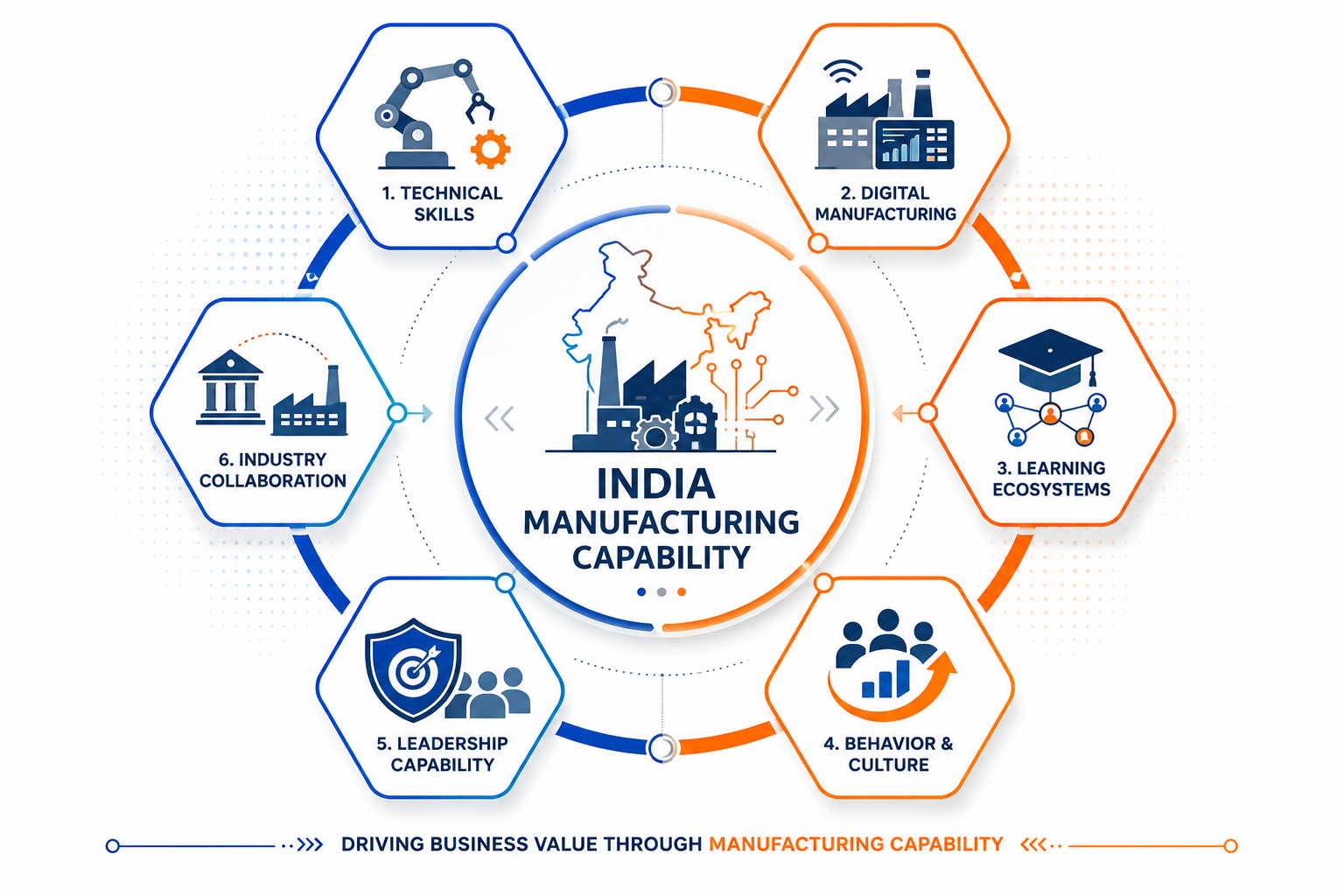
A national manufacturing capability system, distinct from an individual company's capability stack, spans three interdependent layers. Technical skills, spanning automation, robotics, digital literacy and increasingly AI-adjacent competencies, form the most visible and most frequently measured layer, and it is here that the electronics sector's documented ten million person gap and the broader engineering employability figures of 50 to 60 percent sit most starkly. Soft skills, including problem solving, teamwork and communication, have become measurably more important in employer hiring criteria; TeamLease's most recent workforce survey found physical strength is now a low priority for manufacturing roles, cited by just 25 percent of employers, while communication skills at 89 percent and basic computer proficiency at 81 percent have emerged as the dominant hiring criteria, a genuine inversion of what manufacturing hiring looked like a decade ago.
Management capabilities, the third layer and the one least addressed by national skilling programs, determine whether a well-trained technical workforce is actually deployed effectively, whether shop floor leadership can manage the multi-skilled labor architecture India's manufacturing sector has structurally shifted toward over the past decade, and whether quality, safety and continuous improvement disciplines are embedded as management practice rather than imposed as external compliance. Education and vocational training institutions, corporate training functions, and ecosystem actors including sector skill councils and industry associations all bear some responsibility for these three layers, but coordination between them remains fragmented relative to the scale of the ambition.
Capability Layer | Current State | Primary Gap |
Technical skills | Strong policy support via PLI, Semicon India, PMKVY | 10 million person gap in electronics alone; automation and robotics skills scarce |
Soft skills | Employer priorities shifting toward communication, digital literacy | Traditional ITI and vocational curricula have not fully adapted to new hiring criteria |
Management capability | Growing multi-skilled labor architecture on the shop floor | Limited structured investment in frontline and mid-management capability building |
3. Talent Pipeline Challenges
India's manufacturing skills shortage is not evenly distributed; it concentrates in specific sectors and specific competency types in ways that a single national statistic obscures. Electronics manufacturing, the sector with arguably the strongest policy tailwind through PLI, the Electronics Components Manufacturing Scheme and Semicon India, simultaneously carries the most acute documented gap, roughly ten million people, against a workforce that must also absorb 12 million new direct and indirect jobs projected over the next three years. India's participation in the global electronics value chain remains under one percent, and dependence on imported critical components persists precisely because the skilled workforce needed to move up the value chain from assembly to component manufacturing has not scaled at the same pace as investment.
Regional disparities compound the sectoral concentration. Manufacturing investment and PLI-driven capacity expansion have concentrated in a subset of states and industrial corridors, while the vocational training infrastructure needed to supply those corridors with skilled labor has not always scaled at matching pace or matching geography, creating pockets of acute local shortage even as national unemployment figures ease. The Worker Population Ratio has risen to 52.2 percent and female labour force participation has improved to 33.7 percent, genuine progress, but the quality and sector-alignment of that labour supply matters as much as its quantity for a manufacturing strategy that depends on precision, automation literacy and export-grade quality standards.
Unlock the Full Research
Create a free account or sign in to access the complete methodology, deep-dive analysis, and key implementation frameworks.
Don't have an account? It's free to join.
Organization Learning Labs
Research & Insights Division


Comments