India Graduate Expectation Gap: GCC Readiness Strategy

How GCC and IT leaders close the gap between graduate capability and workplace expectation -- through skills-based hiring, simulation assessment, and structured team-readiness development.
India's Hidden Talent Crisis: The Gap Between Graduate Capability and Workplace Expectation
India produces approximately 1.5 million engineering graduates and over 400,000 MBA graduates annually. By almost every headline metric, this represents an extraordinary talent pipeline -- the largest in the world for certain disciplines. Yet the picture beneath the headline is considerably more challenging. Mercer Mettl's India Graduate Skill Index 2025 finds that overall graduate employability stands at 42.6%, down from 44.3% in 2023. TCS reported 80,000 unfilled positions in 2024 attributable to the skills gap. The financial services sector saw 1.8 million vacancies go unfilled in a single year. Business schools produce approximately 400,000 graduates annually, of which 80-85% are assessed as work-experience deficient by CII Higher Education Summit 2025 panelists from IIT Delhi and leading industry bodies.
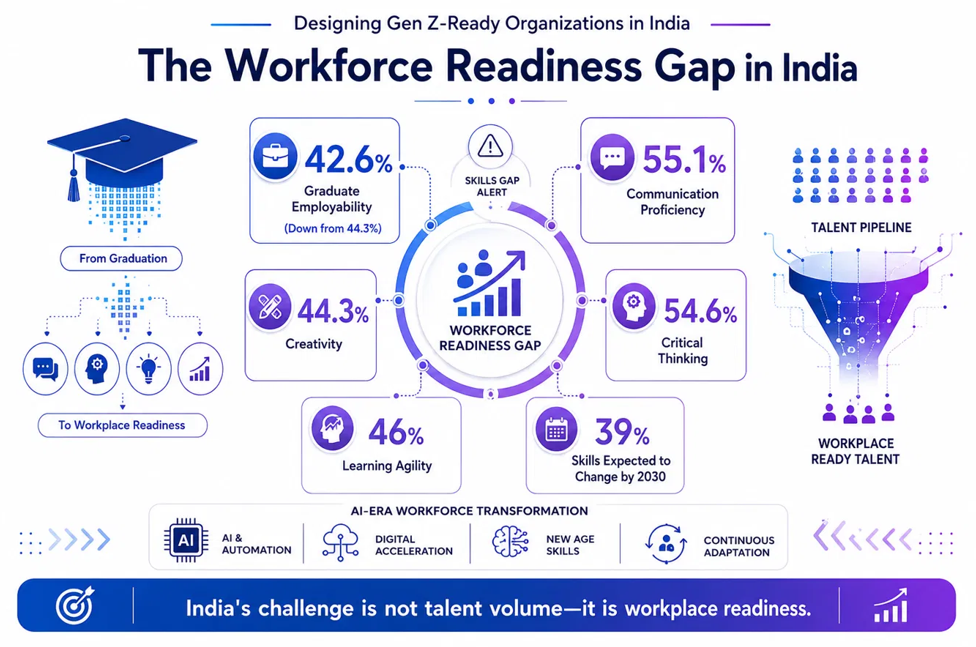
This is not a volume problem. It is a readiness problem -- more precisely, an expectation gap: the structural misalignment between what graduates can demonstrate when they arrive and what the modern workplace, particularly in GCCs and IT services, needs them to do from their first weeks of employment. Understanding where this gap operates most acutely, and how organizations can systematically address it, is one of the defining strategic workforce challenges of the current decade for Indian business leaders.
42.6%Overall graduate employability in India -- declining from 44.3% in 2023 despite record degree volumes, as soft-skills deficits drag down technical gains (Mercer Mettl Graduate Skill Index 2025) |
"India faces a paradox of rising youth unemployment and skill gaps, with employability dropping to 42.6%, as the education system struggles to align with industry demands in an AI-era economy." -- Drishti IAS Analysis of Mercer Mettl Graduate Skill Index 2025 |
Where the Expectation Gap Is Most Acute: The Evidence
The specific dimensions of the expectation gap are well-documented. Only 55.1% of Indian graduates are proficient in communication, 54.6% in critical thinking, and 44.3% in creativity. Overall soft-skills proficiency sits at approximately 50%, with learning agility at only 46%. These numbers matter because they describe the exact capabilities that differentiate contribution in knowledge-intensive, project-based environments from mere task completion.
The WEF Future of Jobs Report 2025 identifies the top employer-required core skills as analytical thinking (cited by 70% of companies as essential), resilience and agility, leadership and social influence, creative thinking, and motivation and self-awareness. Critically, 39% of existing core skills will be disrupted or replaced by 2030. The expectation gap is therefore not static -- it is widening, as the skills employers need evolve faster than the education system can update its curricula.
The project economy amplifies this dynamic. PMI's Global Talent Gap Report 2025 projects that the world will need 30 million new project professionals by 2035. South Asia alone could see project management talent demand grow between 68% and 91%. The World Economic Forum ranks project management as the 12th fastest-growing job globally. In GCCs and IT services, the project is the primary unit of delivery -- making team-readiness not a supplementary attribute but the core operating requirement.
Only 4.4% of Indian youth have undergone formal vocational training, and just 16.6% have engaged in informal training. The education-to-employment pipeline produces individuals who have been assessed on individual academic performance but have rarely been required to demonstrate collaborative delivery under pressure, ambiguity tolerance, or stakeholder communication -- the exact skills that GCC and IT project environments require daily.
How the Expectation Gap Manifests in GCC and IT Environments
In practice, the expectation gap shows up in predictable and measurable ways. Freshers who can solve algorithmic challenges in isolation struggle to participate effectively in agile standups where the question is 'what is blocking you and how can the team help?' Engineers who have strong domain knowledge cannot explain a design decision to a non-technical product stakeholder. Analysts who perform well in individual assessments do not know how to disaggregate a complex problem across a team with differentiated skills.
The talent strategies being adopted by high-performing GCCs in India reflect this diagnosis. GCC hiring has shifted from credential-heavy shortlisting to skills-based assessment frameworks that explicitly test collaboration quality, problem-solving approach under ambiguity, and communication clarity -- not just technical accuracy. GCCs are rewriting job descriptions around outcome statements rather than requirement lists. Leading assessment providers for GCC hiring now integrate behavioural psychometrics, situational judgment frameworks, and simulation-based team exercises alongside technical screening -- precisely because technical screening alone does not predict team contribution.
Unlock the Full Research
Create a free account or sign in to access the complete methodology, deep-dive analysis, and key implementation frameworks.
Don't have an account? It's free to join.
Organization Learning Labs
Research & Insights Division


Comments