India Energy Workforce 2035: Skills Strategy for the Transition

India needs 2-3 million new energy workers by 2035. Explore workforce skill strategies, capability gaps, and talent development imperatives for India's energy transition.
How India Builds the Workforce That Determines Whether Its Energy Transition Succeeds
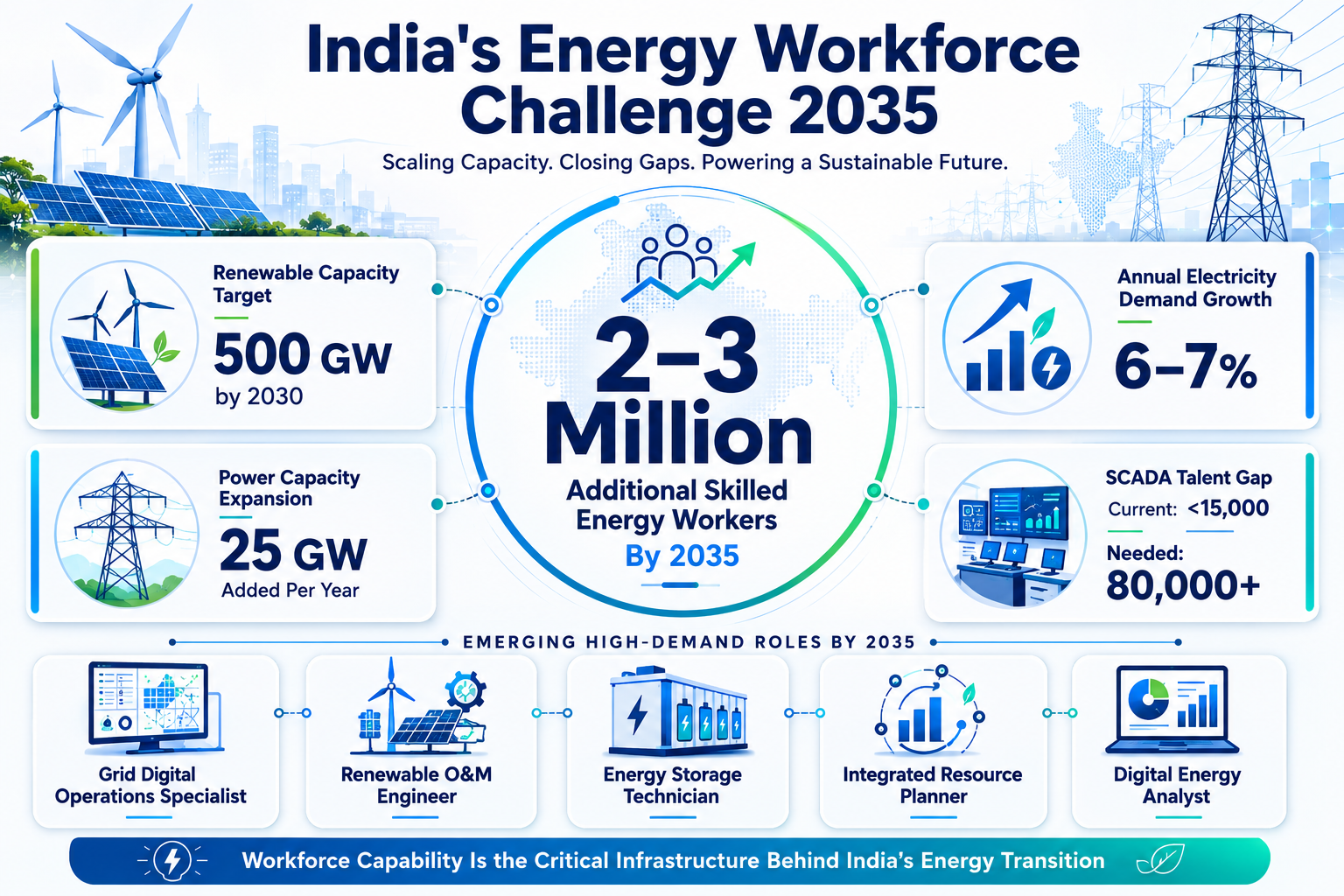
India's energy ambitions are among the most consequential on the planet. The world's most populous nation and one of its fastest-growing major economies is simultaneously expanding its energy system at unprecedented scale and transforming its structure from fossil fuel dependency to a renewable-led, increasingly digital architecture. The scale is staggering: 500 GW of renewable capacity targeted by 2030, a national grid undergoing structural modernisation, an electric vehicle ecosystem being built from near-zero, and industrial electrification proceeding across manufacturing, logistics, and infrastructure.
The IEA's India Energy Outlook projects that India will account for the largest share of global energy demand growth through 2035 among major economies. Electricity demand is expected to grow at 6-7% annually through 2030, outpacing total energy demand growth as sectors electrify and digitalize. This will require the country to expand its power generation capacity by approximately 25 GW per year -- a build rate unprecedented in Indian energy history.
But the constraint on this ambition is not primarily financial or technological. India's capital markets are deepening. Renewable technology costs are falling. International climate finance is available. The constraint is human. India does not simply need more energy workers. It needs workers with different skills, operating in new roles, across a far more complex and interconnected system than anything the country's energy training infrastructure was designed to produce.
India's Energy Growth Trajectory and the Workforce Implication
India's projected energy demand growth through 2035 is unmatched among major economies by rate, by absolute volume, and by the pace of structural change in the generation mix. Understanding what this trajectory means for workforce requirements is the prerequisite for strategic capability investment.
The Generation Mix Is Restructuring
Thermal generation, which has historically dominated India's power system, will remain significant through 2035 but will decline as a share of total generation. Solar and wind are scaling rapidly: India has committed to 500 GW of non-fossil fuel capacity by 2030, including 280 GW of solar and 140 GW of wind. Energy storage -- both utility-scale and distributed -- is becoming a system necessity as variable renewable penetration increases. Green hydrogen production is emerging as a strategic national priority with dedicated mission frameworks.
Each of these transitions changes not only where energy comes from, but how it must be managed. Solar and wind introduce variability and require real-time balancing capabilities that conventional thermal dispatch did not demand. Storage introduces power electronics, battery chemistry, and thermal management complexity. Grid modernisation introduces digital control systems, cybersecurity requirements, and advanced protection architectures. The workforce must be capable of operating this system -- not the system of 2010.
The Workforce Scale Requirement
IRENA's World Energy Transitions Outlook estimates that India will need 2-3 million additional energy workers by 2030-2035 to deliver its transition targets, spanning renewable energy O&M, grid modernisation, storage system management, energy efficiency, and digital operations. The National Skill Development Corporation's renewable energy skill gap studies document current shortfalls in certified technicians, protection and control engineers, SCADA specialists, and energy storage professionals across all major Indian states.
This is not a gap that the existing pipeline -- current university output, national skill programs, and corporate training -- can close without structural reform. The scale, pace, and capability depth required demand a fundamentally different approach to energy workforce development.
The Changing Nature of Energy Work in India: From Asset-Centric to System-Centric
Understanding what changed in the nature of energy work is essential to designing the workforce strategy that addresses it. Two shifts are fundamental.
From Specialisation to Systems Thinking
Historically, many energy roles in India were asset-centric and siloed. Thermal plant engineers specialised in boilers or turbines. Transmission engineers focused on towers and conductors. Distribution engineers worked on substations and feeders. Career paths were linear. Technical knowledge was deep but narrow.
Modern energy systems require fundamentally different cognitive architecture. Engineers must understand how generation, storage, networks, and demand-side management interact as a system. A decision about renewable dispatch affects grid stability, which affects thermal plant economics, which affects the merit order for storage. Technicians must work across hardware and software interfaces that are increasingly inseparable. Operators must manage system uncertainty, not system stability.
The Rise of Hybrid Roles
Perhaps the most consequential structural shift in India's energy workforce is the emergence of hybrid roles that do not map cleanly onto existing professional categories. Grid engineers who work with advanced forecasting algorithms and automated protection systems. Renewable O&M professionals who use remote monitoring platforms, predictive analytics, and drone inspection systems. Planning professionals who integrate storage, demand response, and distributed generation into system capacity models that require both engineering rigour and data science fluency.
These hybrid roles cannot be filled by traditional engineering graduates or conventional technician certification programs alone. They require a new kind of education-to-employment pipeline that does not yet fully exist in India at the scale required.
Emerging Role Category | Key Capabilities Required | Current Supply Gap |
Grid Digital Operations Specialist | SCADA/EMS operation, advanced protection and control, real-time cybersecurity, demand forecasting | Severe. India has fewer than 15,000 certified SCADA professionals against an estimated need of 80,000+ by 2030 |
Renewable Energy O&M Engineer | Performance analytics, condition monitoring, remote diagnostics, rapid fault response in dispersed locations | Significant. Most existing O&M workforce is construction-trained, not operations-optimised |
Energy Storage System Technician | Battery chemistry, power electronics, thermal management, control algorithms, safety protocols | Critical. Storage workforce is near-zero; training programs barely nascent Unlock the Full ResearchCreate a free account or sign in to access the complete methodology, deep-dive analysis, and key implementation frameworks. Don't have an account? It's free to join. O Organization Learning LabsResearch & Insights Division On this pageResearch DetailsIndustryOil and Gas AuthorOrganization Learning Labs PublishedJul 18, 2026 You Might Also Be Interested In Information Technology Designing the future-ready digital engineering organization Banking, Financial Service And Insurance A Systematic, Empirical Framework for Capability Development in Retail Banking Banking, Financial Service And Insurance Why Capability Beats Strategy in Retail Banking Organizations |
Comments