Human OS for AI-Native IT Services: Talent & Behaviour

How IT services CIOs and CHROs can build the Human OS: talent archetypes, learning culture, and behavioural guardrails to make AI adoption generate sustained business value.
The Human OS of AI-Native IT Services: Re-Imagining Talent, Learning and Behaviour for an Autonomous Enterprise
Why becoming AI-native is fundamentally a human capability problem — and how CIOs and CHROs can build the talent archetypes, learning architecture, and behavioural safeguards to make AI adoption stick
Abstract
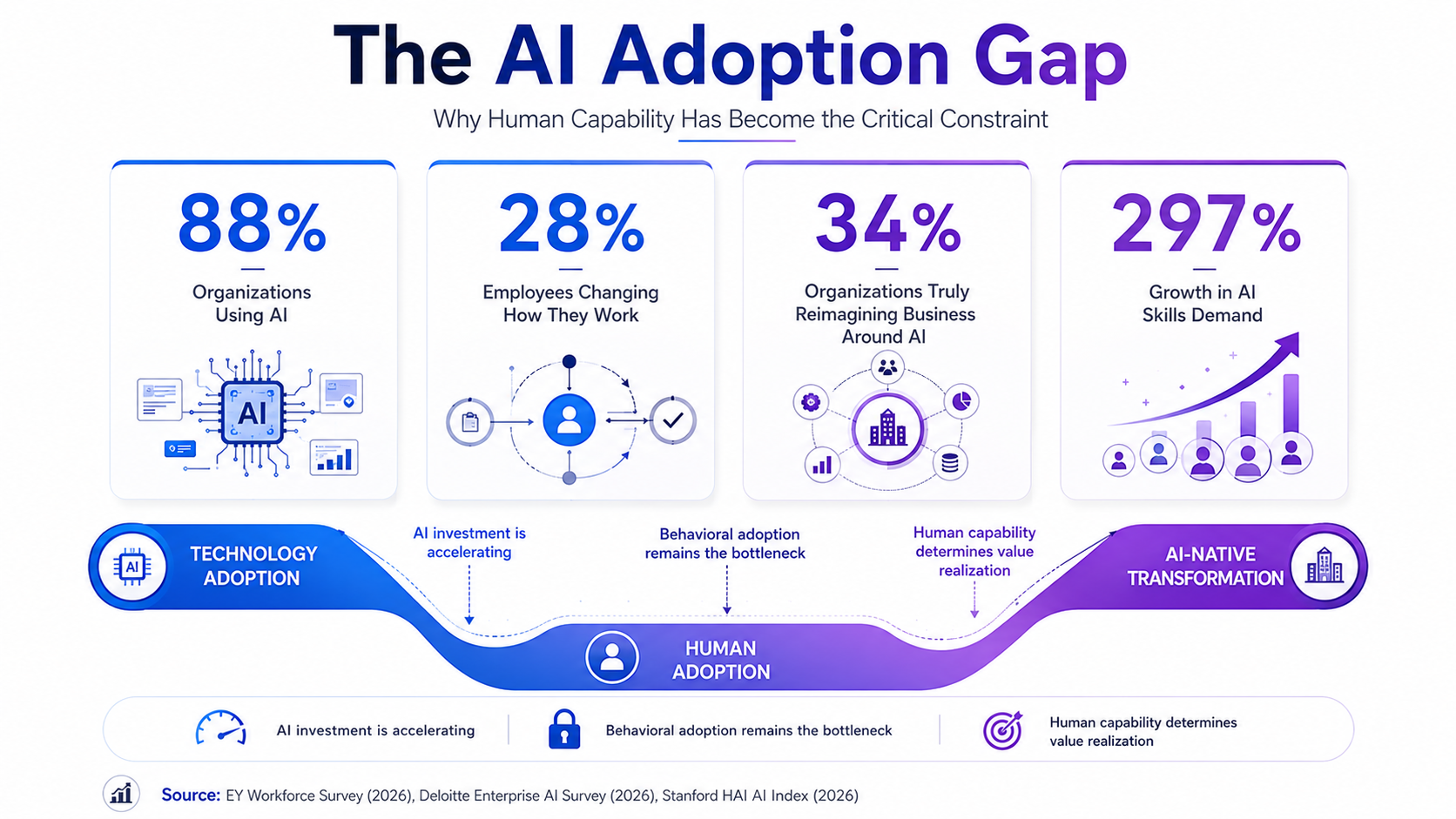
Despite record technology spend, most enterprise transformation programmes still miss their value targets. This pattern is repeating itself, faster and at higher stakes, as IT services firms race to become AI-native. EY's 2026 workforce survey found that 88 percent of organisations already use AI in the workplace, yet only 28 percent have managed to empower employees to actually change how they work because of it.
This article argues that IT services capability building is fundamentally a talent, learning, and behavioural design problem, not a procurement one. It maps five emerging talent archetypes; the learning culture and architectures needed to keep pace with fast-moving AI stacks; the behavioural risks that accompany scaled AI adoption; and the performance and leadership shifts required to sustain it. A phased implementation roadmap and a Human OS Capability Stack provide CIOs and CHROs with a practical framework for turning AI ambition into adopted, governed, value-generating practice.
1. Beyond AI Tools: Towards AI-Native Operating Models
Most enterprises today can point to a growing list of AI tools in their stack: copilots embedded in the IDE, chatbots fielding service tickets, models scoring risk in the background. None of that, on its own, makes an organisation AI-native. Buying capability and absorbing it are two different projects, and the gap between them is rarely technical. It is human.
An AI-native IT services organisation is one where AI is not a feature bolted onto existing workflows but a structural part of how decisions get made, how work gets distributed, and how value gets measured. Getting there requires more than procurement. It requires capability building at the level of talent, learning culture, and everyday behaviour — what this article calls the Human OS. Without it, AI adoption stalls in pilot purgatory: technically functional, organisationally inert. Deloitte's 2026 enterprise AI survey found that while most organisations are experimenting widely, only 34 percent say they are truly reimagining the business around AI rather than layering it on top of existing processes.
"The enterprises that win at IT services capability building will not be the ones with the most advanced models, but the ones whose people know how to work alongside them — critically, transparently, and without losing the judgment that makes the partnership worth having." — Deloitte Center for Technology, Media and Telecommunications, 2026 |
Consider a concrete example: a managed-services provider rolls out an AI-assisted code-review tool across its delivery teams. Adoption looks strong by licence count, but ticket data later shows senior engineers running the tool, glancing at the output, and overriding it without reading the reasoning — because performance reviews still reward lines reviewed per day, not defects caught. The tool is technically embedded; the organisation is not yet AI-native. Talent and behaviour decided the outcome, not the technology.
2. What Is an AI-Native IT Services Organisation?
Three characteristics separate genuinely AI-native IT services firms from firms that simply use AI:
• AI embedded in core workflows: not a side panel a few power users open occasionally, but a default step in how tickets are triaged, code is reviewed, or proposals are drafted.
• Decision augmentation at scale: models surface options, flag anomalies, and rank priorities across thousands of decisions a day, with humans retaining judgment on the ones that matter most.
• Data-driven governance: the organisation can see, audit, and explain how AI is being used, by whom, and with what outcomes — rather than relying on anecdote.
None of these characteristics are purely technical. Embedding AI into a workflow requires people willing to change how they work. Decision augmentation only functions if employees trust it enough to act on it, and are equipped to override it when it is wrong. Governance depends on people reporting honestly rather than working around oversight. In every case, talent and behaviour decide whether AI is adopted, tolerated, or quietly resisted.
BOARDROOM DIAGNOSTIC QUESTION |
If every AI licence in your organisation were cancelled tomorrow, which workflows would actually break — and which would simply revert to how they ran two years ago? The honest answer is a fast diagnostic for how AI-native the organisation really is. |
3. The Five Talent Archetypes of AI-Native IT Services
As AI moves into core workflows, a set of hybrid roles is emerging that does not map cleanly onto traditional IT services org charts. These archetypes describe a function more than a job title, and in practice they often live inside existing roles rather than as new headcount. Stanford HAI's 2026 AI Index found that AI-related skills now appear in roughly 2.5 percent of all job postings — a 297 percent increase over the past decade.
Archetype | Function and IT Services Application |
AI Translator | Converts model capabilities and limitations into decisions leaders can act on, and converts business problems into specifications engineering teams can build against. The bridge between technical AI output and business decision-making. |
Automation Designer | Identifies which parts of a workflow are suited to automation, designs the human checkpoints around them, and owns the handoff between machine output and human judgment. |
Data Storyteller | Turns dashboards and model outputs into narratives that drive action — closing the gap between data that is technically correct and data that is actually used by decision-makers. |
Responsible AI Steward | Holds the organisation accountable for how models are deployed — watching for bias, drift, and overreach, acting as an internal check before issues become external incidents or regulatory findings. Unlock the Full ResearchCreate a free account or sign in to access the complete methodology, deep-dive analysis, and key implementation frameworks. Don't have an account? It's free to join. O Organization Learning LabsResearch & Insights Division On this pageResearch DetailsIndustryInformation Technology AuthorOrganization Learning Labs PublishedJun 25, 2026 You Might Also Be Interested In Information Technology Designing the future-ready digital engineering organization Banking, Financial Service And Insurance A Systematic, Empirical Framework for Capability Development in Retail Banking Banking, Financial Service And Insurance Why Capability Beats Strategy in Retail Banking Organizations |
Comments