Human-AI Collaboration Capability Framework 2030

How organizations build human-AI collaboration as a core enterprise capability -- from AI literacy to agentic workflow orchestration, scenario labs, AI guilds, and governance frameworks.
Why AI Tool Training Is Not Enough: The Case for Human-AI Collaboration as a Core Organizational Capability
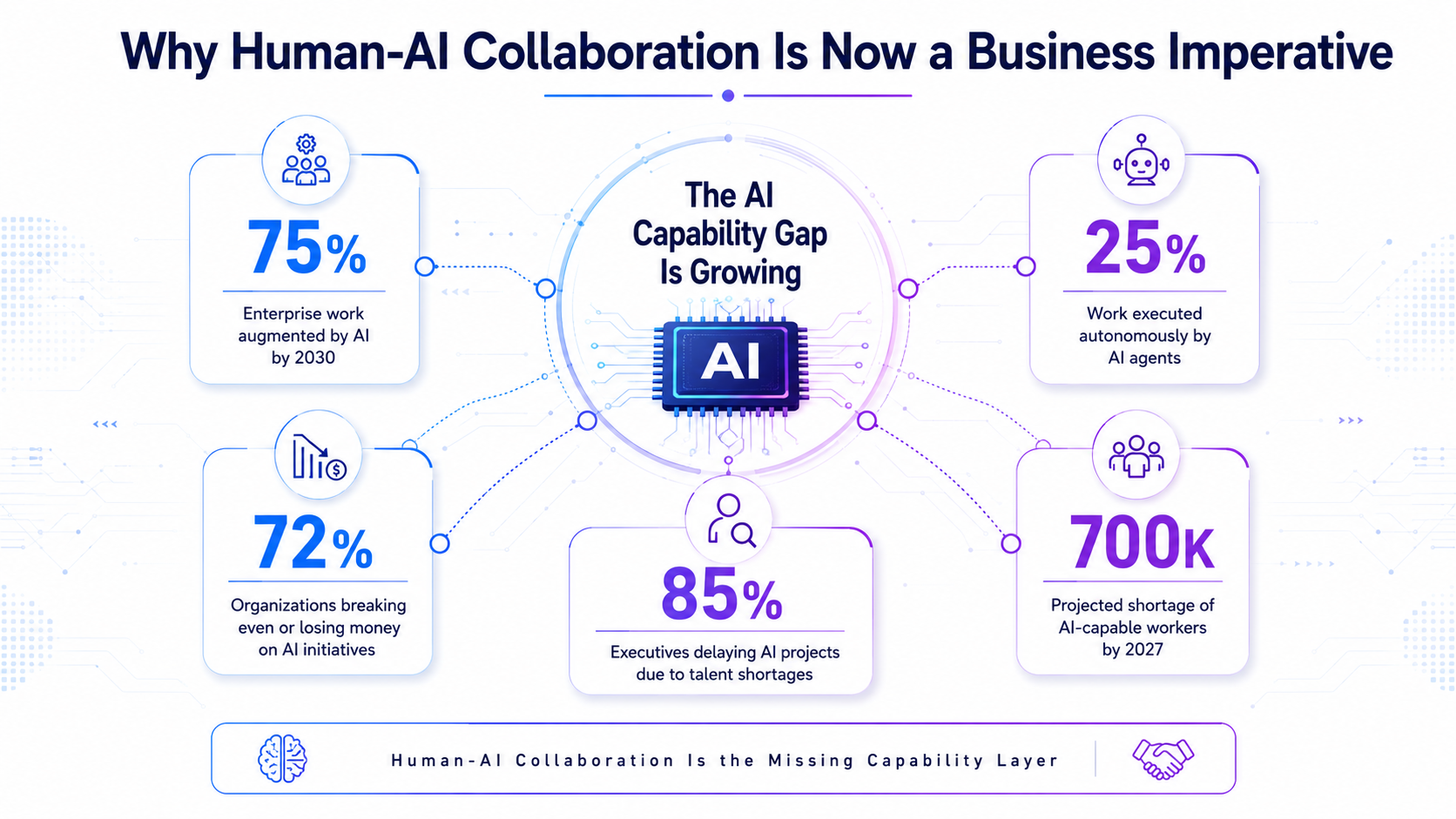
In July 2025, Gartner published findings from a survey of more than 700 CIOs that should recalibrate every executive team's AI investment priorities: by 2030, 75% of enterprise work will involve AI-augmented human employees, with a further 25% operating autonomously through AI agents. No IT work will remain purely human. This is not a distant possibility to be planned for during the next strategic cycle. It is a near-term operational reality that most organizations are materially underprepared to manage.
The evidence of underpreparedeness is equally precise. Despite rapidly growing AI investment, 72% of enterprises are breaking even or losing money on their AI initiatives (Gartner, 2025). Eighty-five percent of executives report delaying AI projects due to talent gaps. A projected shortfall of 700,000 AI-capable workers is expected by 2027. And 48% of employees in organizations actively deploying AI cite training insufficiency as the primary barrier to effective adoption.
The root cause of this gap is a fundamental mischaracterization of what AI capability actually requires at the workforce level. Organizations are training people to use AI tools -- to write better prompts, to navigate specific platforms, to understand AI-generated outputs. This is necessary but profoundly insufficient. The capability that will determine competitive outcomes in the AI decade is not AI tool proficiency. It is human-AI collaboration: the capacity to design workflows in which humans and AI systems each contribute optimally; to govern autonomous agents effectively; to apply human judgment at the critical moments where AI capability is insufficient or where AI outputs require challenge; and to orchestrate complex multi-agent systems toward organizational objectives.
72%Of enterprises are breaking even or losing money on their AI initiatives -- a direct consequence of investing in technology without building the human-AI collaboration capability to deploy it effectively (Gartner, 2025) |
"The workforce of 2030 will not be defined by humans who use AI tools, but by humans who orchestrate AI agents, design collaborative workflows, and apply judgment that keeps organizations ethical, adaptive, and strategically sound." -- World Economic Forum, Future of Jobs in the AI Era, 2025 |
What Are Agentic Workflows -- and Why Do They Change Everything?
Understanding why human-AI collaboration is a categorically different capability from AI tool literacy requires understanding agentic AI. Traditional AI tools respond to discrete, single-turn queries: you ask a question, the AI generates a response, you evaluate and use it. This is a passive tool interaction model that closely resembles using a search engine or a calculator.
Agentic workflows are fundamentally different. In agentic systems, AI agents take iterative, multi-step actions with varying degrees of autonomy: reasoning about a problem, decomposing it into subtasks, routing those subtasks to appropriate tools or sub-agents, gathering and synthesizing information from multiple sources, making interim decisions, and escalating to human judgment when the situation exceeds defined autonomy boundaries. The AI is not responding to a prompt -- it is executing a workflow.
Organizations implementing agentic AI orchestration in 2026 report 30-50% process time reductions and significant quality improvements in complex multi-step workflows (OneReach.ai, Kanerika, 2026). McKinsey's research on work partnerships between people, agents, and robots projects that the human-AI symbiosis enabled by agentic systems will unlock productivity gains that passive tool usage cannot approach -- precisely because agentic workflows leverage both the analytical scale of AI and the judgment, context sensitivity, and ethical reasoning of humans.
But this potential is realized only when the human side of the human-AI partnership is genuinely capable. An agentic workflow in which the human participants cannot effectively design the workflow architecture, establish appropriate autonomy boundaries, evaluate agent outputs with critical rigour, or intervene appropriately at escalation points will underperform -- and may generate significant governance, compliance, and reputational risk. Human-AI collaboration capability is not a nice-to-have complement to agentic AI deployment. It is the precondition for agentic AI generating positive organizational value.
What Does the Three-Layer Human-AI Collaboration Capability Framework Look Like?
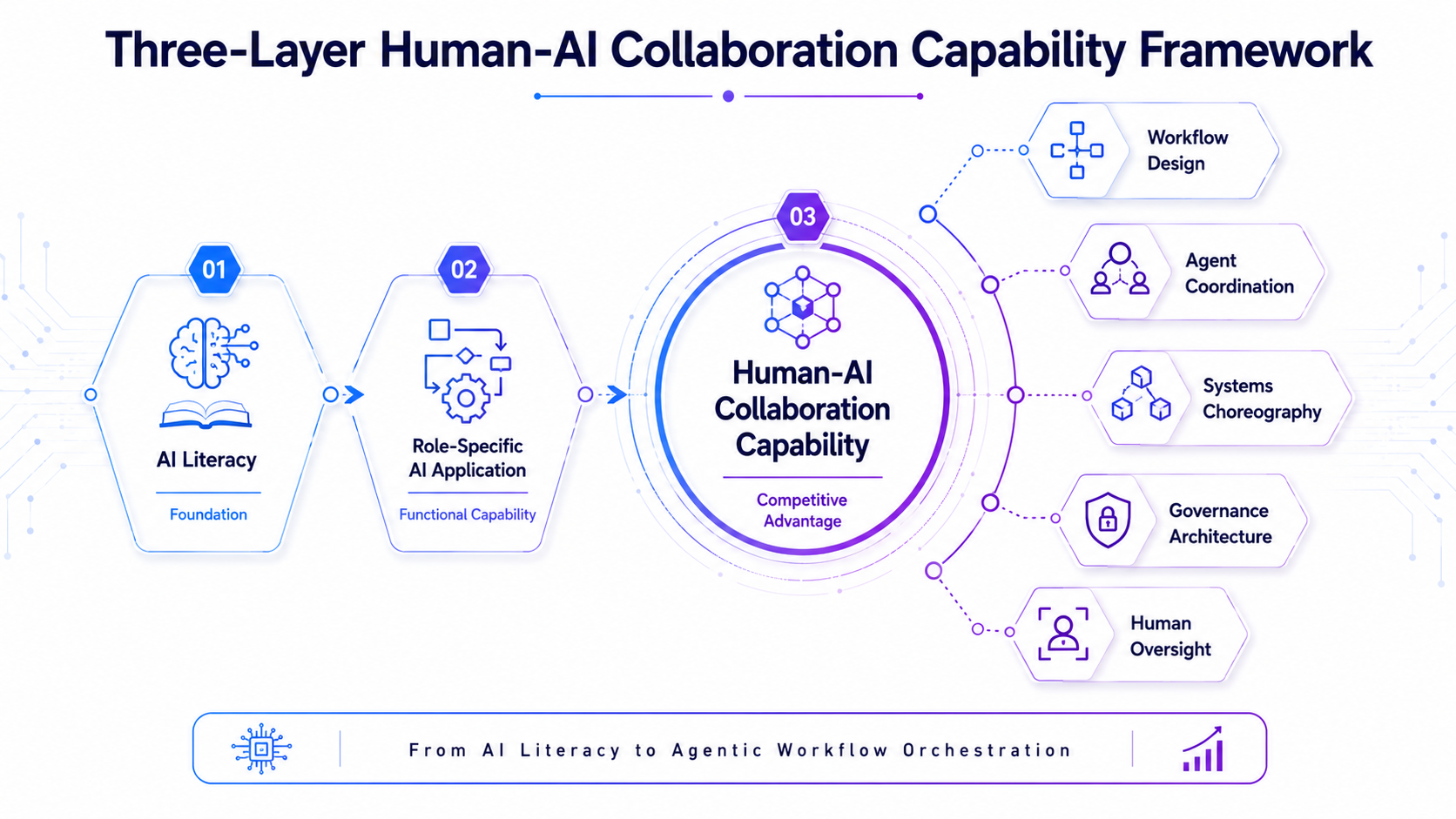
Building human-AI collaboration as a core organizational capability requires a structured framework that progresses from foundational awareness through functional application to orchestration proficiency. Organizations that treat AI capability development as a single-tier training initiative -- deploying generic AI literacy content across all functions -- consistently fail to develop the depth of capability that competitive AI deployment requires.
Layer 1: AI Literacy -- The Universal Foundation
Basic AI literacy encompasses the foundational knowledge that every employee requires to work effectively in AI-saturated environments: understanding how AI systems process information and generate outputs; recognizing the capabilities and limitations of AI in specific work contexts; identifying when AI assistance is appropriate versus when human judgment is required; engaging with AI outputs critically rather than accepting them at face value; understanding the basics of data privacy and cybersecurity in AI-augmented workflows; and applying fundamental prompt engineering techniques for common work tasks.
The Digital Learning Institute's AI Literacy Framework, aligned with UNESCO's Digital Capabilities Framework and the EU AI Act, provides a structured competency model for universal AI literacy that organizations can use to establish baseline standards. However, the critical insight from organisations that have successfully scaled AI literacy is this: literacy alone does not create capability. It creates awareness. The Forbes Human Resources Council research on organizational AI literacy emphasizes that genuine AI competency requires developing human judgment -- the ability to interpret AI results, formulate insightful questions about AI reasoning, and identify potential hazards in AI outputs -- not merely familiarity with AI interfaces.
Layer 2: Role-Specific AI Application -- Functional Depth
The second layer involves role-specific learning pathways that develop genuine functional proficiency in AI-augmented work within each domain. Rather than generic training applicable across all functions, Layer 2 develops the AI collaboration capabilities specific to how each role actually uses AI in practice: embedded software engineers learning to work with AI code generation tools (GitHub Copilot, AI pair programming) while maintaining safety-critical validation rigour; financial analysts learning to apply AI to data preparation, pattern recognition, and exception analysis while retaining human judgment for interpretation and decision-making; customer service professionals learning to evaluate and adapt AI-generated response recommendations in real-time customer interactions.
Unlock the Full Research
Create a free account or sign in to access the complete methodology, deep-dive analysis, and key implementation frameworks.
Don't have an account? It's free to join.
Organization Learning Labs
Research & Insights Division


Comments