Hospitality Talent Retention & Skills Development

79% of hoteliers face staff shortages. Learn how capability development -- not recruitment -- is the answer to hospitality's talent crisis through 2035.
Hospitality's Talent Crisis: Building Skills Faster Than Staff Leave
Every day, a hotel general manager watches another key team member hand in their notice. The housekeeper who finally landed a better work schedule. The front desk agent tired of 70-hour weeks. The kitchen supervisor pulled away by the promise of visible career growth. It is a pattern repeating across hotels, resorts, and hospitality businesses worldwide -- and the compounding cost is staggering.
This is not a hiring problem. It is a capability problem disguised as an attrition problem. Understanding the distinction is the first and most consequential strategic insight available to hospitality leaders today.
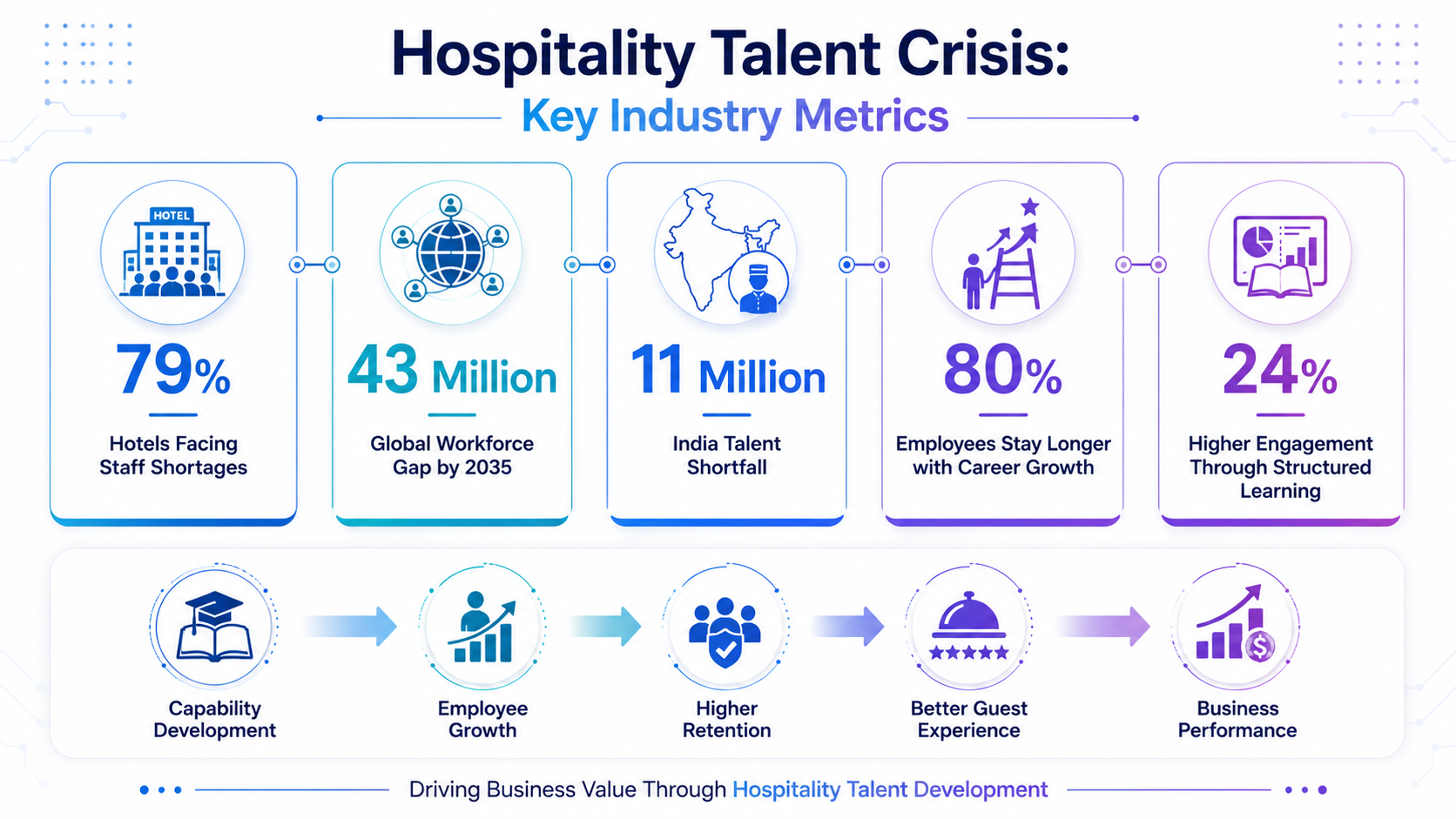
The World Travel and Tourism Council projects that the global travel and tourism sector will be short 43 million workers by 2035, with India alone facing a shortfall of 11 million positions. The American Hotel and Lodging Association reports that 79% of hoteliers are currently experiencing staff shortages, while vacancies in the UK hospitality market remain 48% above pre-pandemic levels. India's hospitality and tourism sector faces a 55 to 60% shortfall in skilled manpower. These are not temporary disruptions. They are structural signals of an industry that has not yet built the capability infrastructure to compete for talent on the terms that the modern workforce demands.
What Is Actually Happening: Erosion, Not Shortage
The framing of hospitality's workforce challenge as a shortage is partially correct and strategically misleading. Shortage implies a supply problem that recruitment can solve. What hospitality organizations are actually experiencing is erosion: a continuous outflow of capability from organizations that have not built strong enough reasons -- developmental, cultural, financial -- for experienced staff to stay.
In entry-level and seasonal roles, the hospitality industry reports annual turnover rates between 70 and 80%. In smaller and mid-sized hotels, monthly churn can reach 30 to 50%. These numbers do not represent a labor market failure. They represent an organizational design failure. In October 2024, the US accommodation and food services sector reached a point where the hiring rate equalled the separation rate at 4.9%, with 88% of departures being voluntary resignations rather than layoffs or retirements.
Staff are not being let go. They are choosing to leave. And the reasons are not primarily about compensation.
"People keep quitting at record levels, yet companies are still trying to attract and retain them the same old ways." -- McKinsey Future of Work Research, 2025
Why Experienced Professionals Actually Leave
Research consistently identifies three non-wage drivers of hospitality attrition:
• Absence of visible career progression: Only 36% of hotel management college seats were filled in India in 2023, reflecting a sector-wide perception problem. When young professionals see no credible path from entry-level to meaningful leadership, they redirect toward industries that demonstrate it.
• Work design and burnout: 70-hour weeks as the entry-level standard, unpredictable scheduling, and operational roles with no boundary between work and rest periods have made hospitality structurally unattractive compared to comparable-wage retail, logistics, and technology roles.
• Absence of developmental identity: The most retained hospitality professionals report a strong organizational identity built around learning and growth. The least retained report feeling interchangeable, not developed.
Compound this with demographic headwinds. The WEF's Future of Jobs Report 2025 identifies aging and declining workforces in developed economies as a significant driver of accelerating skill demand, with hospitality explicitly named as a growth sector where interpersonal and operational skills will command increasing premium. The pipeline of incoming talent is drying up precisely as demand for experienced service capability is accelerating.
Why Recruitment-First Strategies Are Failing
For decades, the hospitality playbook defaulted to external hiring when capability gaps appeared. Fill a vacancy, move on. That model has hit a structural wall. When skilled professionals decline in volume, hotels are forced to hire candidates who do not yet possess the full skill set required -- creating the very skills gap that drives the service failures that accelerate attrition. It is a reinforcing cycle, and recruitment alone cannot break it.
The financial arithmetic is also unfavorable. The cost of hiring a fully trained professional now frequently exceeds the cost of developing someone internally. Replacement costs for a single kitchen supervisory departure can reach thousands in lost productivity, recruiter fees, and retraining time. And the replacement, arriving without organizational context or relational capital, requires six to twelve months to reach the productivity level of the person who left.
Research from multiple sources, including Harvard Business Review, confirms that companies experience 24% higher engagement and materially lower turnover when they invest in structured learning as a visible organizational commitment. LinkedIn's Workforce Report data indicates that 80% of hospitality employees would stay longer with clear career progression. The capability investment case is not complicated. The implementation gap is.
Four Capability Moves That Change the Retention Equation
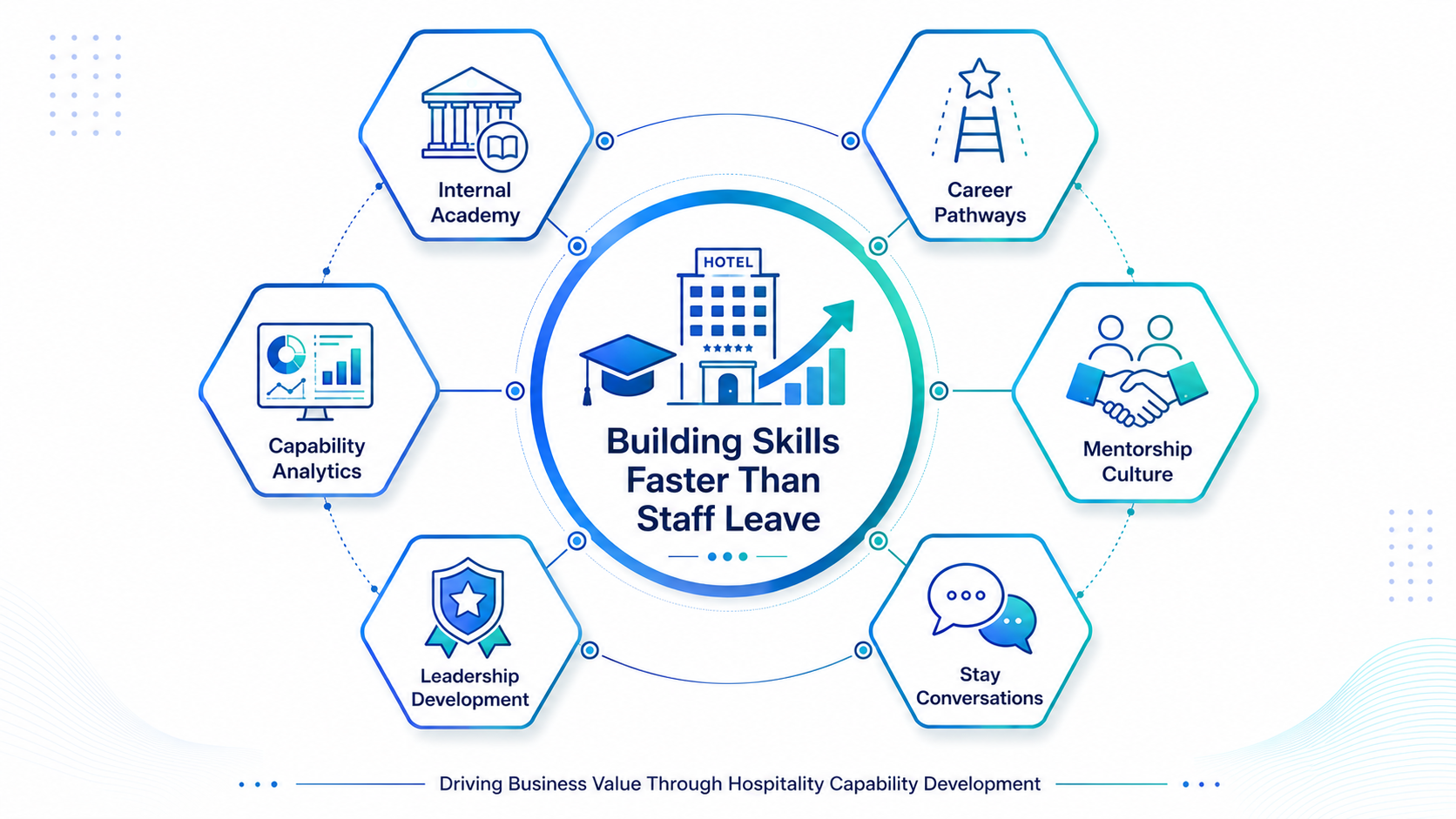
1. Build an Internal Academy -- Even at Modest Scale
Unlock the Full Research
Create a free account or sign in to access the complete methodology, deep-dive analysis, and key implementation frameworks.
Don't have an account? It's free to join.
Organization Learning Labs
Research & Insights Division


Comments