Healthcare Talent Shortage: Upskilling for Future-Ready Workforce

Explore how CXOs and healthcare leaders can tackle the global talent shortage by building upskilling, reskilling, and workforce transformation capabilities for 2035 and beyond.
Solving the Healthcare Talent Shortage: Upskilling and Reskilling for a Future-Ready Workforce
The global healthcare workforce is facing a convergence of pressures that no single policy intervention can resolve. Demographic ageing is inflating demand. Chronic underfunding of training pipelines constrains supply. Digital health transformation is simultaneously obsoleting existing skill profiles while creating entirely new ones. And burnout-driven attrition is accelerating exits faster than recruitment can compensate.
For healthcare executives, CHROs, and transformation leaders, this is not a human resources problem. It is a strategic capability crisis. Organizations that treat workforce shortages as a staffing puzzle to be solved through recruitment alone will find themselves perpetually behind. Those that reframe the challenge as a capability architecture imperative and invest in systematic upskilling and reskilling will build workforces resilient enough to lead healthcare transformation over the next two decades.
This article examines the structural drivers of the healthcare talent shortage, the evidence base for upskilling and reskilling as strategic responses, and the organizational capabilities leaders must build by 2035.
Why the Healthcare Talent Shortage Is a Strategic, Not Operational, Crisis
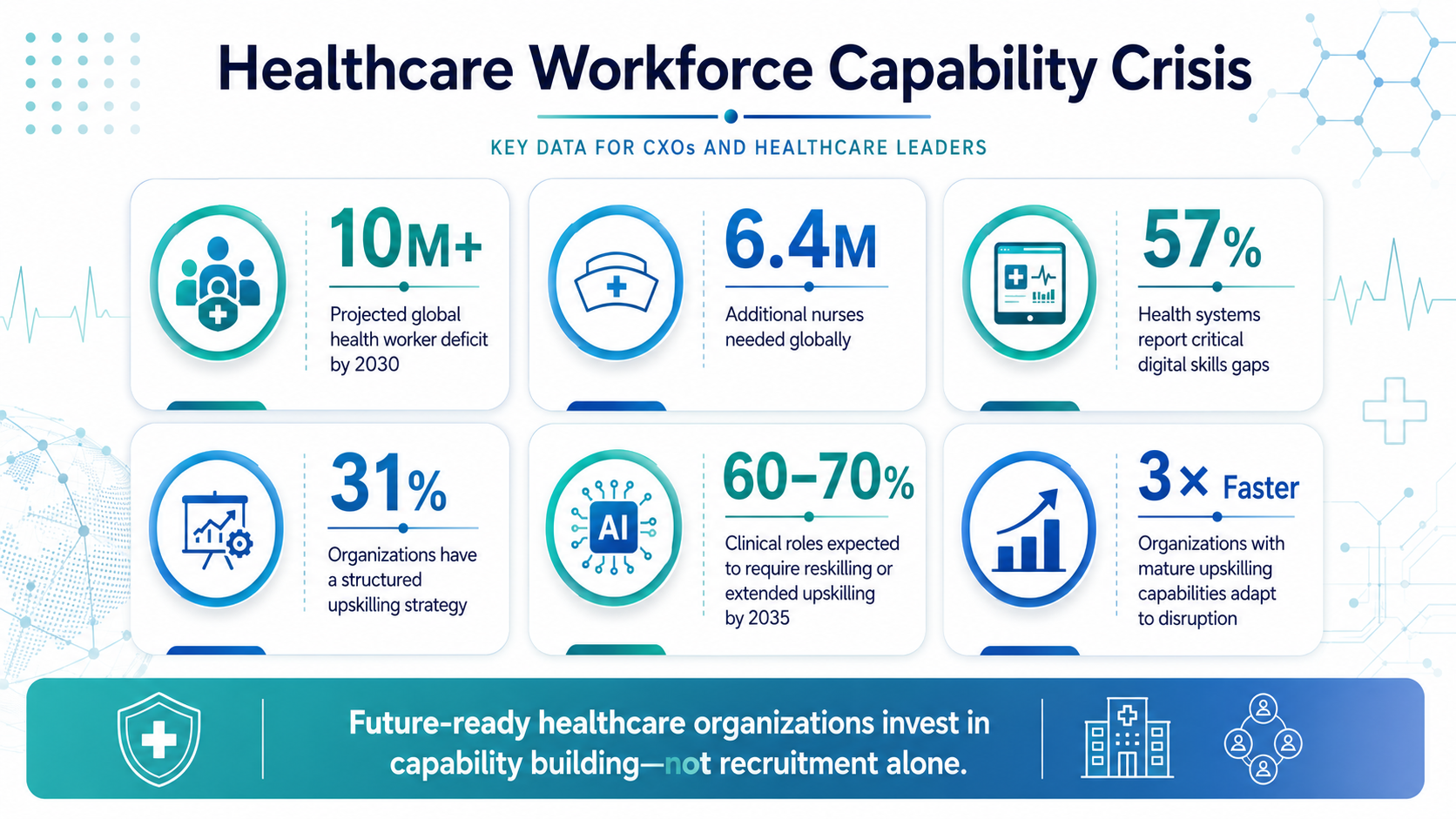
The WHO projected in 2023 that the world will face a shortfall of more than 10 million health workers by 2030, concentrated in low- and middle-income countries but increasingly visible in high-income systems as well. The International Council of Nurses estimates that 6.4 million additional nurses are needed globally to meet current demand. These numbers do not reflect a temporary disruption. They reflect the cumulative failure of healthcare workforce policy to anticipate structural change.
Three forces are accelerating the gap. First, ageing populations are simultaneously increasing demand for healthcare services and depleting the workforce as senior clinicians retire faster than trainees emerge. Second, technology is transforming the clinical role faster than training institutions are redesigning curricula. AI-assisted diagnostics, remote monitoring, precision medicine, and digital therapeutics each demand new competency profiles that existing workforce populations have not been trained for. Third, pandemic-era burnout and chronic workplace stress have driven voluntary attrition across nursing, allied health, and physician populations at rates exceeding pre-COVID baselines by 15 to 20 percent in many OECD systems.
According to Deloitte's 2024 Global Healthcare Sector Report, 57 percent of health systems surveyed identified critical gaps in digital health competencies as a top-five strategic risk. Yet the same survey found that only 31 percent had a structured upskilling strategy designed to address those gaps. This disconnect is the core of the strategic problem: leaders acknowledge the challenge but have not yet invested in systematic solutions.
"Workforce development is no longer a support function for healthcare. It is the foundation of clinical safety, service quality, and competitive positioning." — Deloitte Global Healthcare Outlook, 2024 |
The Evidence for Upskilling and Reskilling as High-Return Investments
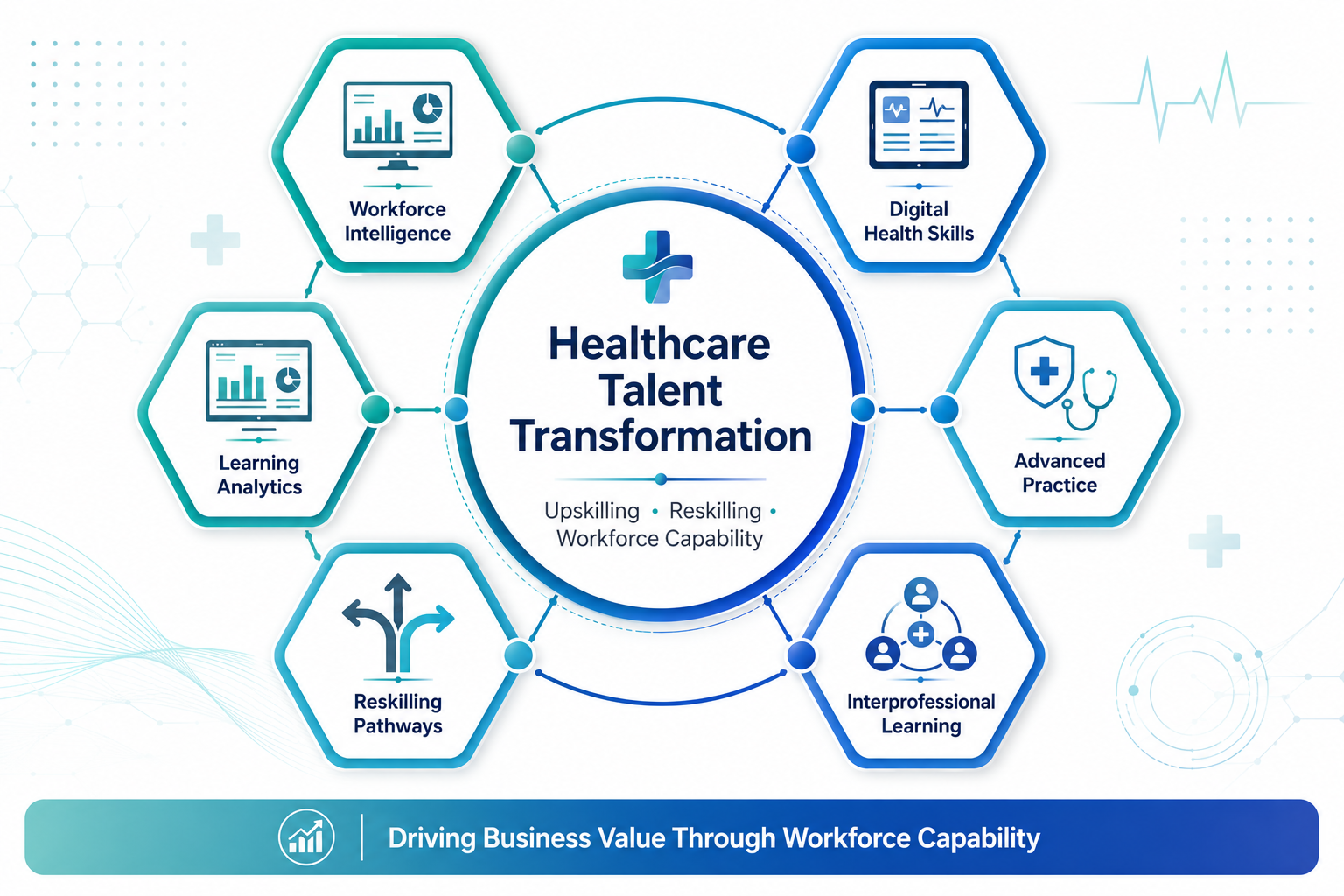
Upskilling and reskilling represent fundamentally different strategic choices. Upskilling deepens competence within existing roles, preparing clinicians and health managers for evolving responsibilities in their current domain. Reskilling prepares individuals for entirely new functions, repositioning displaced or surplus workers into high-demand areas rather than separating them from the organization.
Both generate returns that substantially exceed recruitment costs. McKinsey's 2023 analysis found that the fully loaded cost of replacing a nurse, including recruitment, onboarding, and productivity ramp-up, ranges from 1.3x to 1.9x annual salary. Structured reskilling programs, by contrast, cost 20 to 30 percent of this figure while retaining institutional knowledge, team relationships, and cultural alignment.
The evidence from leading health systems is instructive. The UK's NHS Long Term Workforce Plan, published in 2023, commits to training 24,000 more nurses and midwives annually and emphasizes the development of advanced practice roles across nursing, pharmacy, and allied health. Australia's National Workforce Incentive Program has demonstrated that incentivized upskilling of general practitioners in chronic disease management reduced specialist referrals by 18 percent, improving both patient outcomes and system efficiency.
Unlock the Full Research
Create a free account or sign in to access the complete methodology, deep-dive analysis, and key implementation frameworks.
Don't have an account? It's free to join.
Organization Learning Labs
Research & Insights Division


Comments