Healthcare Simulation Training: Infrastructure for Clinical Excellence

How simulation-based training in healthcare drives clinical skill mastery, reduces patient errors, and builds the high-reliability workforce required for 2035 and beyond.
Simulation-Based Training in Healthcare: The Non-Negotiable Infrastructure for Clinical Excellence
For generations, healthcare education followed an axiom that has long outlived its defensibility: clinicians learn by doing. The first cardiac arrest. The first central line. The first difficult airway. These were treated as rites of passage, necessary trial by experience, as if patient risk were an acceptable price for clinical learning.
In 2026, choosing to perpetuate this model is not a neutral tradition. It is an active decision to accept preventable errors, slower skill development, and avoidable harm, despite overwhelming evidence that a superior system exists.
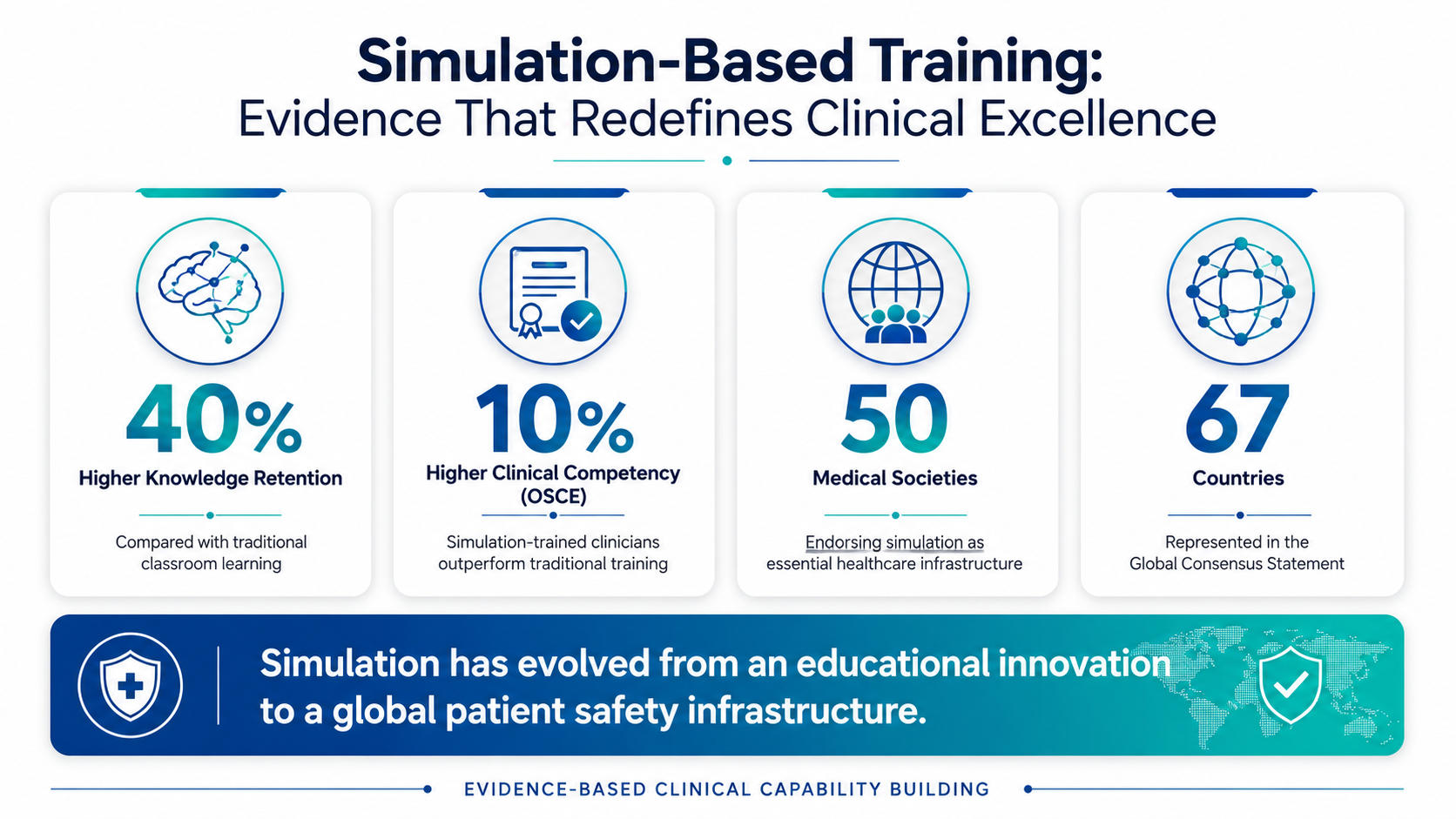
Simulation-based training in healthcare is that system. Endorsed in 2024 by 50 medical societies across 67 countries as essential infrastructure for safe care, simulation has completed its transition from innovation to standard of practice. The organizations that have not yet integrated it into their core capability architecture are not simply behind on a trend. They are carrying avoidable risk.
The Empirical Case: What the Evidence Actually Shows
The argument for simulation is not philosophical. It is empirical, and the evidence is robust.
A large meta-analysis in nursing education (Foronda et al., 2023) demonstrated that high-fidelity simulation significantly improved knowledge acquisition, clinical skills performance, and self-confidence relative to traditional instruction alone. Effect sizes for both knowledge and skills were large, reflecting substantive improvements in clinical competence rather than marginal gains. In practice assessment, students trained with simulation scored nearly 10 percent higher on Objective Structured Clinical Examinations, the gold standard for real-world clinical competency assessment, than peers trained using traditional methods (Asha et al., 2022).
The mechanism explains why: simulation develops situated cognition. Rather than memorizing protocols in isolation, clinicians practicing in simulation learn to recognize deterioration, prioritize competing demands, communicate under time pressure, and make decisions in conditions of uncertainty. This is precisely the cognitive architecture required in real clinical environments, and it transfers far more reliably than classroom knowledge.
McGaghie et al.'s 2024 analysis in the American Journal of Medical Sciences confirmed that simulation-based training consistently outperforms traditional education on long-term retention and real-world clinical performance. The 40 percent retention advantage over didactic approaches is not a research curiosity. It is a training design imperative.
"Your first attempt should never be on a live patient. Simulation exists precisely to ensure that it does not have to be." — Global Consensus Statement on Simulation-Based Practice in Healthcare, 50 Medical Societies, 2024 |
Where Simulation Generates the Greatest Strategic Value
Emergency Codes, Cardiac Arrest, and Resuscitation
High-stakes, low-frequency events are where simulation delivers its most compelling value. CPR, defibrillation, airway management, and multi-team resuscitation are events where teams perform rarely but must perform flawlessly. Simulation creates the rehearsal infrastructure that makes automatic response possible. Research consistently shows improved resuscitation performance and skill retention substantially beyond training completion.
Obstetric Crisis Management
Simulation-based team training for obstetric emergencies, including shoulder dystocia, postpartum hemorrhage, eclampsia, and cord prolapse, has produced some of the clearest patient outcome data in the simulation literature. Robertson et al.'s research demonstrated reductions in maternal mortality, neonatal deaths, and serious adverse outcomes in units with team-based simulation programs. In scenarios where minutes and coordination determine outcomes, the ability to rehearse team response before lives depend on it is not a training enhancement. It is an ethical obligation.
Medication Safety and Administration Competence
Unlock the Full Research
Create a free account or sign in to access the complete methodology, deep-dive analysis, and key implementation frameworks.
Don't have an account? It's free to join.
Organization Learning Labs
Research & Insights Division


Comments