Healthcare Learning Ecosystems: Continuous Capability Building Strategy

How healthcare leaders can move beyond episodic training to build integrated learning health systems that continuously develop capability, improve safety, and future-proof their workforce.
Designing Healthcare Learning Ecosystems: From One-Off Training to Continuous Capability Building
Healthcare no longer changes in cycles. It changes continuously. New clinical guidelines are released mid-year. AI-augmented diagnostics are redefining the boundaries of specialty roles. Digital therapeutics are entering formularies before clinicians have been trained to prescribe them. Novel therapeutics emerging from accelerated regulatory pathways require rapid workforce adaptation that traditional training calendars cannot accommodate.
Yet most healthcare organizations still manage learning through an episodic model. Annual compliance training. Orientation programs that front-load knowledge and assume experience will consolidate it. Periodic workshops that address yesterday's priority gap by the time they are delivered. This mismatch between the pace of clinical change and the cadence of training delivery is not simply inefficient. It is a structural risk.
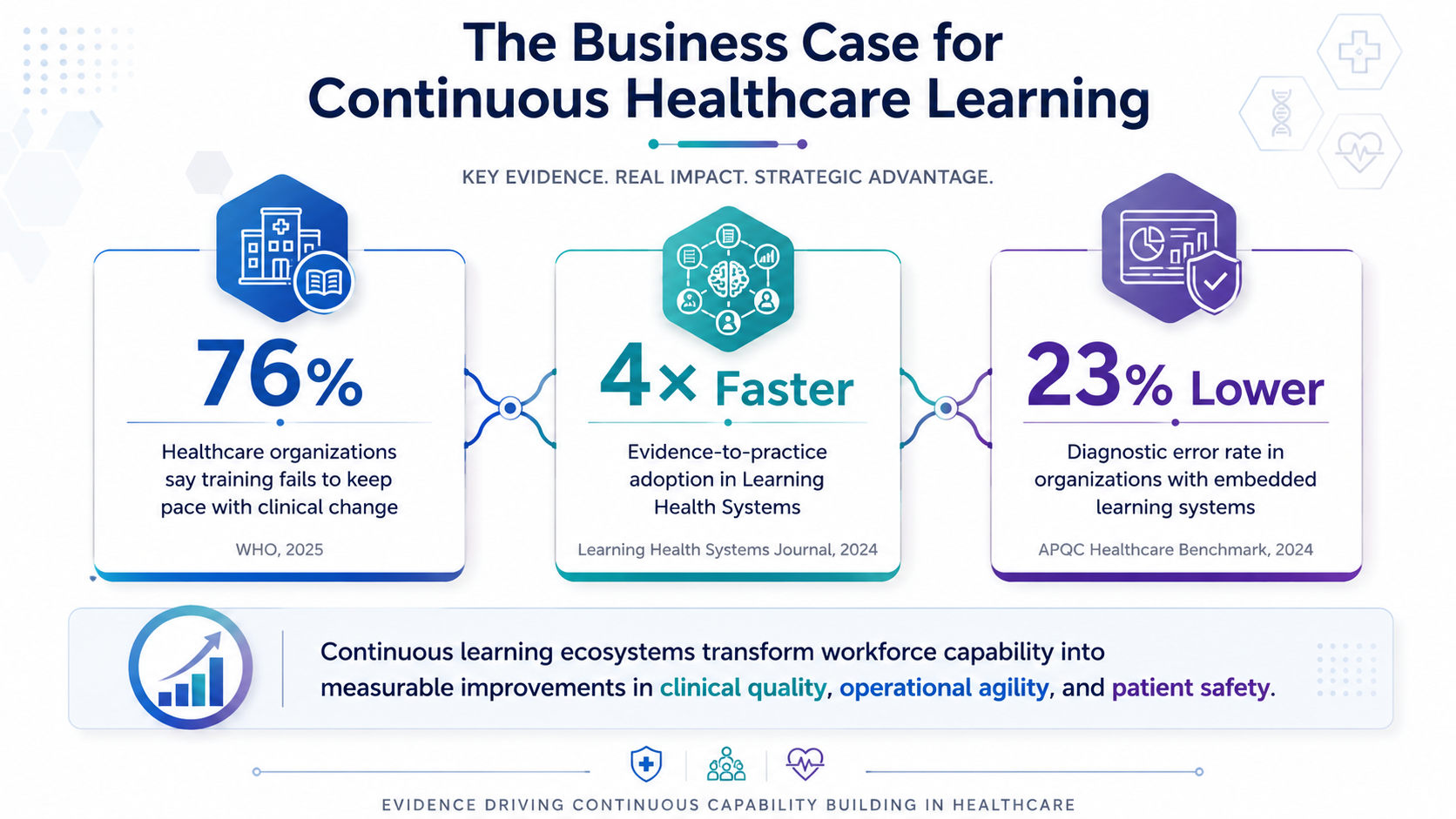
The WHO's 2025 Health Workforce Education and Training Report found that 76 percent of healthcare organizations globally reported that their training programs failed to keep pace with the rate of clinical and technological change. The consequences are visible in every health system: variable adherence to updated guidelines, delayed adoption of evidence-based practices, clinician frustration with the gap between what they know they should do and what they feel equipped to do, and patient risk embedded in that gap.
Learning health systems, where learning is continuous, embedded in clinical workflows, and directly linked to performance data, are the organizational response. This article examines what they are, what evidence supports them, and what healthcare executives must build to make them the operational standard by 2035.
Why the Episodic Training Model Has Reached Its Strategic Limits
The traditional training model is built on three assumptions that modern healthcare practice has invalidated. The first is that knowledge acquisition equals readiness: that a clinician who completes a training module is prepared to apply its content under clinical pressure. The second is that learning can be cleanly separated from work: that pulling clinicians out of clinical environments for scheduled training sessions is both logistically sustainable and pedagogically effective. The third is that attendance or completion confirms impact.
Evidence from learning science and healthcare implementation research refutes all three. Knowledge acquired in training contexts without connection to real workflow decays rapidly; studies consistently find retention rates of 20 to 30 percent within 6 weeks of conventional training. Separating learning from work increases cognitive distance from application and reduces transfer. And completion data correlates poorly with behavior change and not at all with patient outcomes.
In aviation, nuclear energy, and other high-reliability industries, learning long ago abandoned the episodic model in favor of continuous, scenario-based, and performance-data-linked systems. Healthcare's slower adoption of this approach reflects legacy institutional structures and funding models, not evidence that the episodic model works.
"A learning health system is not defined by how much training it delivers. It is defined by how effectively it converts clinical experience and performance data into continuously improving practice." — Learning Health Systems Journal, 2024 |
Four Foundational Components of a Learning Health System
1. Continuous Performance Intelligence
Learning health systems treat clinical performance data as a learning signal rather than a compliance metric. Protocol adherence rates, diagnostic accuracy trends, safety incident and near-miss data, patient outcome measures, and communication quality indicators are analyzed not simply to identify problems but to ask: what capability gap explains this performance pattern, and what learning intervention addresses it?
This approach converts performance management data into a continuous diagnostic of workforce capability needs, replacing the blunt instrument of calendar-scheduled training with responsive, targeted capability building. Organizations that have implemented this approach report that they can identify emerging skill gaps 60 to 90 days earlier than those relying on periodic training needs assessments.
2. Structured Feedback Loops and Reflection
Data becomes learning through interpretation. Learning health systems build structured mechanisms that convert performance signals into individual and team reflection. Case reviews linked to real patient outcomes, structured debriefs after adverse events and near misses, team discussions that surface cognitive biases and decision-making assumptions, and individual feedback conversations grounded in observed behavior all function as learning conversion mechanisms.
The critical design requirement is that reflection is not left to chance. It is protected, facilitated, and linked to specific learning actions. Organizations that attempt to embed learning culture without protecting reflection time and building facilitation capability find that performance data accumulates but learning does not emerge from it.
3. Learning Embedded in Clinical Workflows
Unlock the Full Research
Create a free account or sign in to access the complete methodology, deep-dive analysis, and key implementation frameworks.
Don't have an account? It's free to join.
Organization Learning Labs
Research & Insights Division


Comments