Healthcare Burnout to Resilience: Capability Building Strategy

Discover how healthcare leaders can transform burnout into organizational resilience through structured capability building, workforce wellbeing, and systemic learning investment.
From Burnout to Resilience: Capability Building for Nurses and Frontline Healthcare Staff
Burnout in healthcare is not a personal deficiency. It is an organizational failure with measurable strategic consequences. Across nursing, allied health, and frontline clinical roles, burnout has reached levels that threaten the structural integrity of healthcare delivery systems globally.
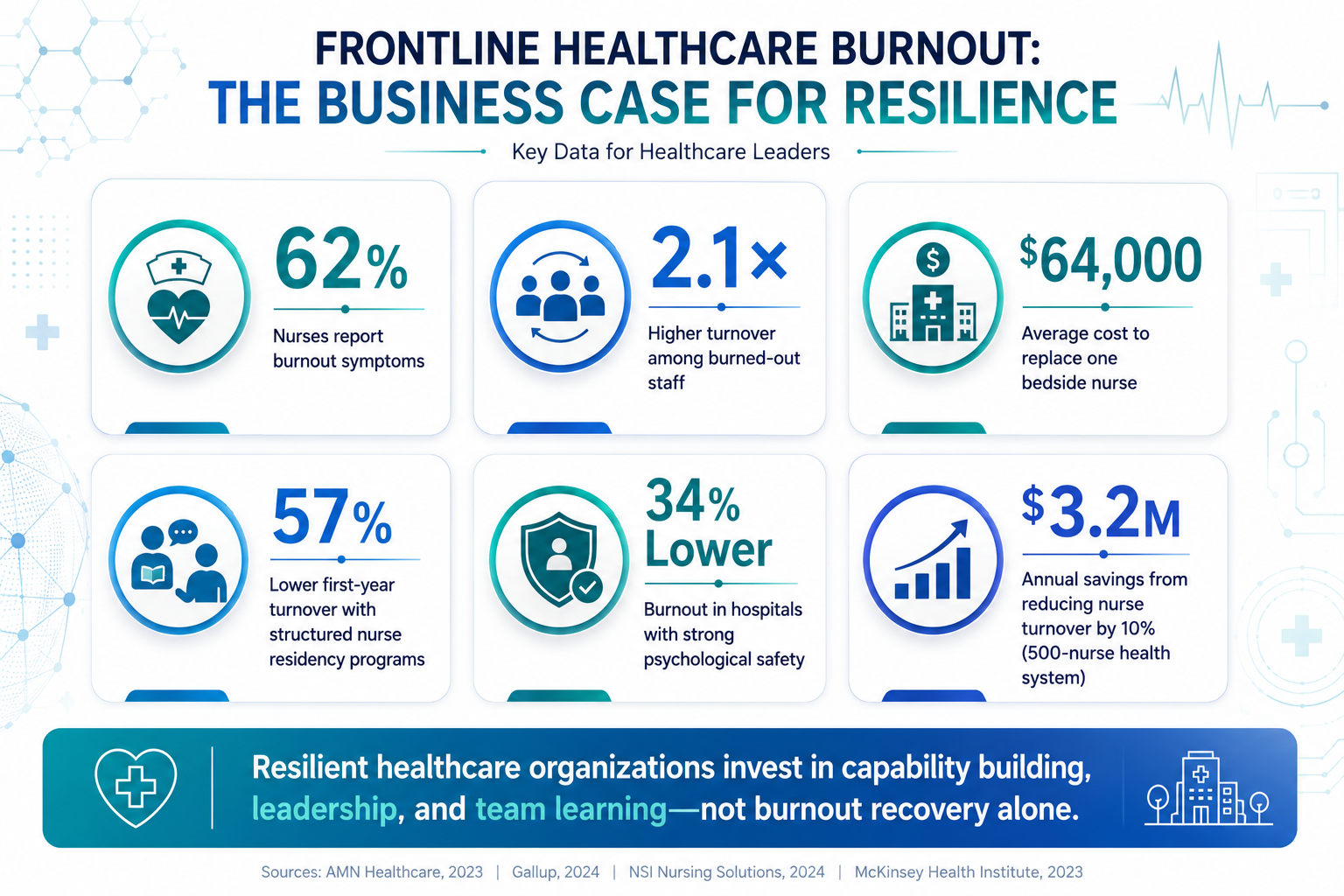
The 2023 AMN Healthcare Nursing Workforce Study found that 62 percent of nurses reported burnout symptoms, up from 49 percent in 2021. Among nurses under 35 years of age, intention to leave their current role within one year stood at 40 percent. This is not a post-pandemic anomaly. It is the surface expression of systemic gaps in how healthcare organizations develop, support, and retain their frontline workforce.
For healthcare executives and transformation leaders, the strategic imperative is clear: organizations that treat burnout as an individual wellbeing issue will continue to lose capability and capital to attrition. Those that redesign capability building systems to address the root causes of burnout at an organizational level will build resilient, high-performing workforces capable of sustaining quality care through continuous change.
Understanding Burnout as a Capability Deficit, Not a Character Flaw
The prevailing organizational response to burnout has been to offer employees wellness programs, resilience coaching, and mindfulness resources. The evidence suggests this approach addresses symptoms while leaving causes untouched. Maslach and Leiter's canonical research on burnout identifies six organizational mismatches that drive it: unsustainable workload, lack of control, insufficient reward, breakdown of community, absence of fairness, and value conflicts. None of these are individual problems. All of them are organizational design problems.
Research from McKinsey's Future of Work initiative found that burnout-driven attrition in healthcare costs the US system alone approximately 9 billion dollars annually in nurse replacement costs. Globally, the figure is multiples larger. Yet the majority of organizational investment remains directed at individual-level interventions that demonstrate limited durable impact.
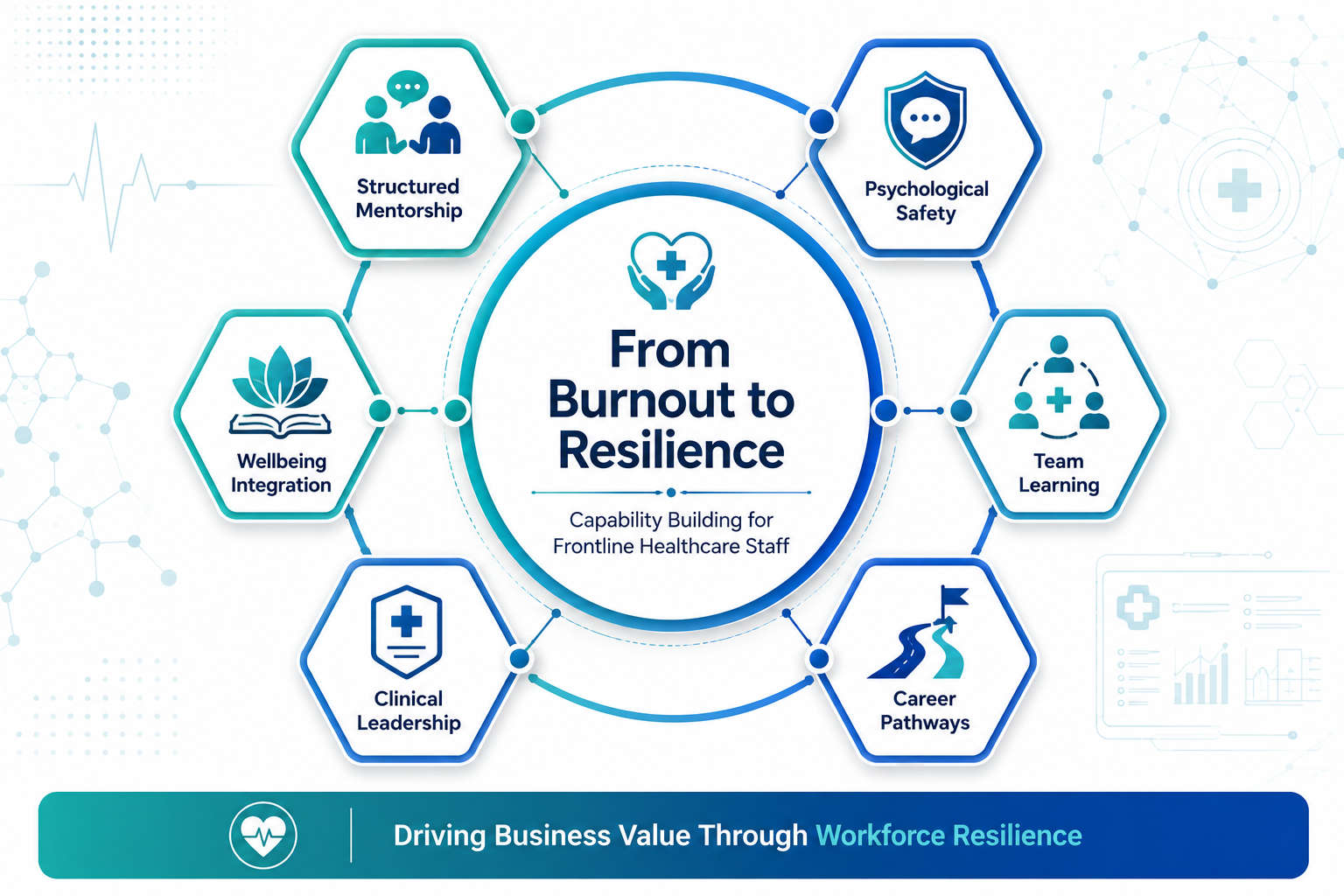
The reframe that leading organizations are beginning to make is this: burnout prevention is capability building. When staff have the skills to manage complexity, the confidence to escalate appropriately, the team relationships to share cognitive load, and the organizational support to grow professionally, burnout risk decreases significantly. The gap is not personal resilience. It is capability infrastructure.
"The most effective intervention for nurse burnout is not a mindfulness app. It is structural: reducing workload uncertainty, building team cohesion, and creating visible pathways for professional growth." — McKinsey Health Institute, Addressing the Global Healthcare Burnout Crisis, 2023 |
Evidence-Based Approaches to Building Frontline Clinical Resilience
Structured Mentorship and Preceptorship Programs
New graduate nurses entering clinical practice without structured mentorship experience first-year burnout and turnover rates approaching 36 percent across multiple countries. Evidence from the National Council of State Boards of Nursing Transition to Practice study demonstrated that nurse residency programs, which provide 6 to 12 months of structured preceptorship, competency development, and peer support, reduced first-year turnover by up to 57 percent compared to traditional orientation models.
The mechanism is instructive: structured mentorship reduces the experience of uncertainty, builds clinical confidence through supported practice, and creates relational ties to the organization that function as protective factors against disengagement. Organizations that design preceptorship as a capability development process, not a compliance checkpoint, produce outcomes that are significantly superior.
Unlock the Full Research
Create a free account or sign in to access the complete methodology, deep-dive analysis, and key implementation frameworks.
Don't have an account? It's free to join.
Organization Learning Labs
Research & Insights Division


Comments