Growing Capability Gaps in GCCs: Closing India's AI Skills Gap

Indian GCCs are reskilling IT services talent into AI-native roles. See the data on capability gaps, experience bands, and skills leaders must build by 2035.
Growing Capability Gaps in GCC Organizations: How India's GCCs Are Closing the AI Skills Divide From Within
Why the next wave of AI talent will come from inside the ecosystem, not outside it
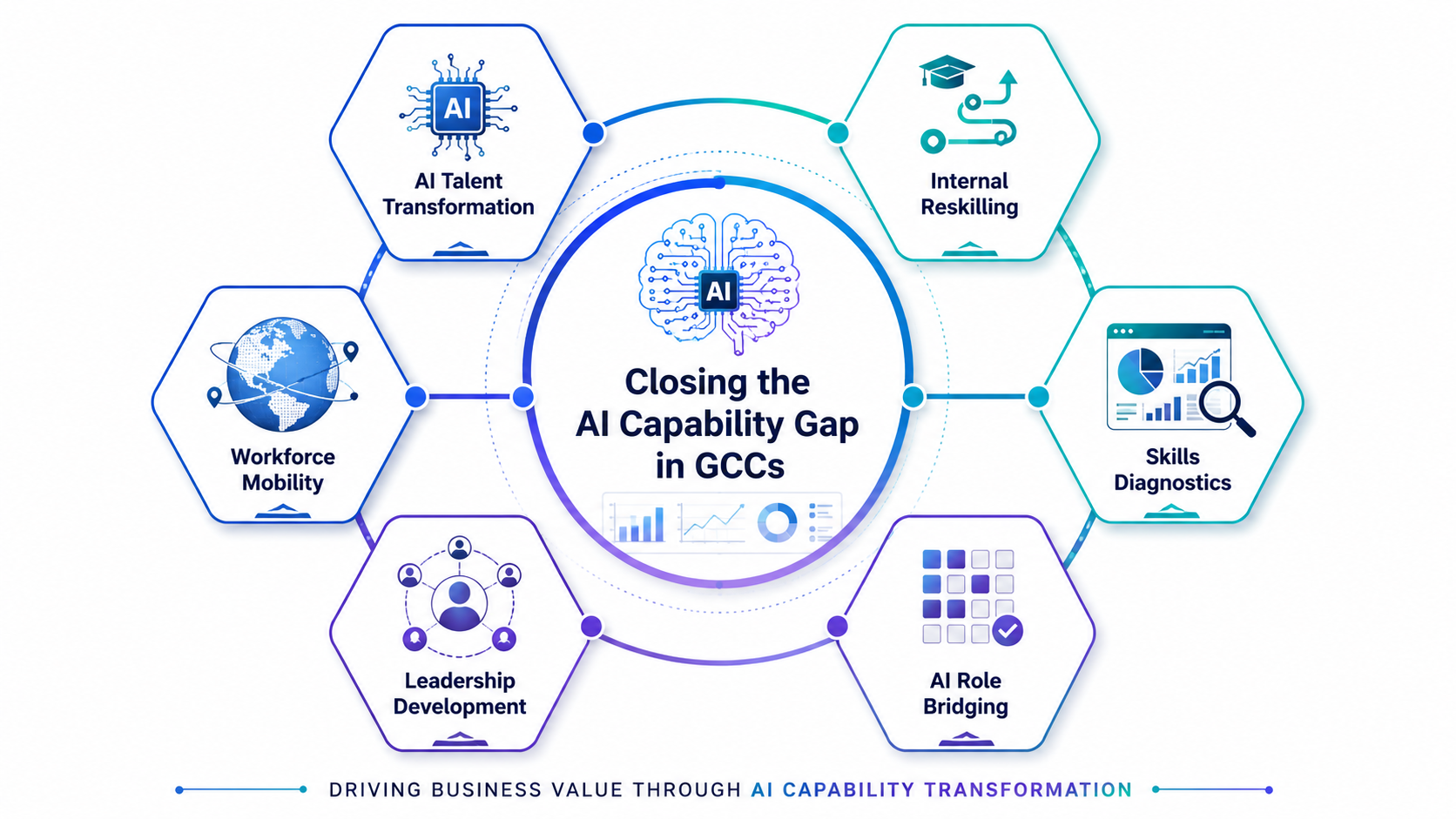
A CONSULTING-GRADE BRIEFING FOR CXOs, CHROs, CLOs & TRANSFORMATION LEADERS
Global Capability Centres in India are no longer just scaling headcount. They are re-engineering their existing talent base into next-generation AI roles faster than campuses or lateral markets can supply them, and the organizations that treat this as a capability discipline, not a hiring cycle, will define the next decade of enterprise technology leadership.
Executive Summary
For two decades, the default answer to “how do we scale a technology function” was to hire more people. Campus drives filled the bench. Lateral recruitment plugged specialist gaps. When demand outpaced supply, organizations simply widened the funnel. That playbook no longer works for the capability that matters most to enterprise competitiveness: production-grade artificial intelligence.
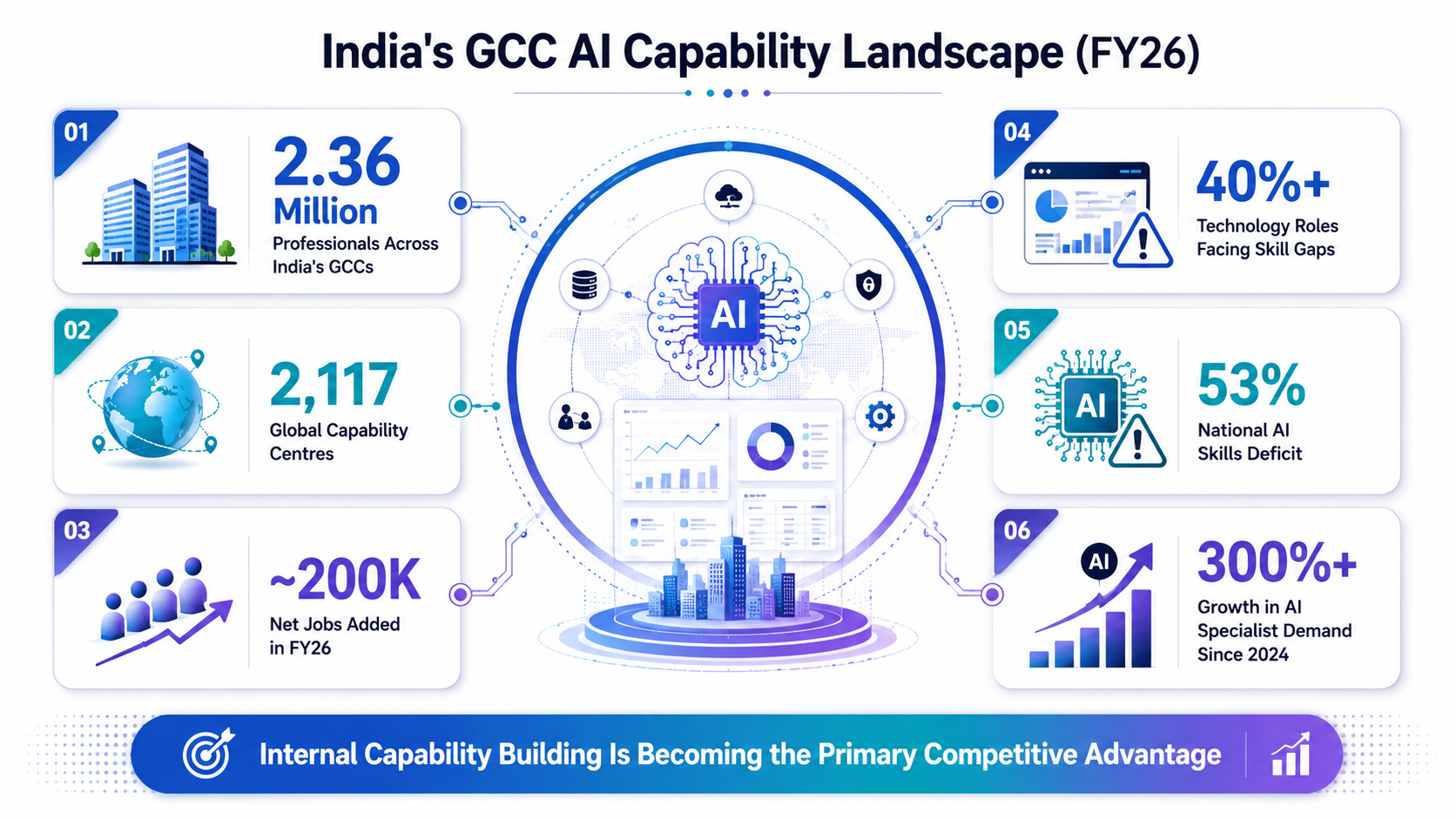
The pace of enterprise AI adoption has outrun the traditional education-to-employment pipeline, and nowhere is this more visible than in India's Global Capability Centre (GCC) ecosystem. GCCs added close to 200,000 net jobs in FY26, almost twice the number added by the country's IT services majors in the same period, extending a three-year run of GCCs out-hiring services firms for advanced technology roles.¹ But the headline hiring numbers conceal a more consequential shift. The GCCs driving this growth are not primarily hiring from campuses or from a thin pool of AI-native graduates. They are reaching into the delivery-ready talent already inside the ecosystem, including large pools sitting inside IT services vendors, and re-engineering it into next-generation AI roles. For CXOs, CHROs, and transformation leaders, this is not a hiring trend to monitor. It is a capability-building imperative that will shape competitive position through 2035 and beyond.
The Great Talent Reallocation: Why Internal Capability Now Beats External Hiring
Three forces are converging to make internal capability-building the default strategy rather than the fallback. First, the volume math has flipped: GCCs now account for an estimated 30 to 35 percent of all AI-related hiring in India, and they are doing it while the country's AI-ready talent pool, roughly 120,000 to 250,000 professionals depending on definition, remains far short of the one million-plus AI-related roles industry estimates project for the near term.² Second, the economics of building versus buying have become explicit. Upskilling an existing employee costs roughly 2.5 times less than hiring the equivalent skill externally, and employees who experience strong internal mobility stay with their employer roughly 60 percent longer, directly reducing the re-hiring cost that volatile external markets impose.³ Third, and most structurally, 78 percent of Indian GCCs are already reskilling internal teams specifically for generative AI adoption, treating internal capability-building as core infrastructure rather than an HR side-programme.³
This is happening in parallel with a visible contraction in traditional IT services hiring. Tata Consultancy Services, Infosys, Wipro, HCLTech, and Tech Mahindra have all shifted toward AI-augmented, leaner delivery models, reducing bench strength and fresher intake while simultaneously retraining existing engineers: TCS alone has put roughly 25,000 engineers through Microsoft Azure OpenAI training, and Infosys is building more than 100 generative AI agents to automate client workflows.⁴ Industry commentary is blunt about who is most exposed: mid-level professionals with four to twelve years of experience, concentrated in manual testing, infrastructure management, and conventional coding, are considered the most vulnerable segment as automation absorbs routine delivery work.⁴ That same experience band is precisely where GCCs are recruiting hardest for AI-native roles. The result is not a labour surplus and a labour shortage sitting side by side by coincidence. It is one talent pool being actively re-routed from a contracting delivery model into an expanding capability model, and the organizations that build a deliberate bridge between the two will capture that talent before their competitors do.
Bengaluru and the Corridor Effect: Where the Migration Is Concentrated
This shift is not evenly distributed across India. It is intensely localized around a small number of technology corridors, with Bengaluru functioning as the definitive epicentre. The city hosts more than 870 GCC units, roughly 36 percent of India's total GCC workforce, and about 40 percent of the country's engineering research and development talent.⁵ Most tellingly for an AI capability discussion, Bengaluru concentrates approximately half of India's entire AI and machine learning talent pool, which is why any GCC with serious AI ambitions treats a Bengaluru presence as close to non-negotiable.⁶
Hyderabad has emerged as the clearest secondary hub, now accounting for roughly 40 percent of all new GCC setups in India, while Pune, Chennai, and the Delhi-NCR region round out the primary corridor, each anchoring specific functional depth, engineering in Pune, BFSI and enterprise platforms in NCR, and diversified technology and product work in Chennai.⁷ A newer, forward-looking signal is the rise of tier-2 hubs, Coimbatore, Jaipur, and Indore among them, which are clocking roughly 21 percent year-on-year hiring growth as GCCs look to diversify away from saturated metro talent markets and rising attrition costs.⁷ For leadership teams, the geography matters less as a real-estate decision and more as a capability-sourcing decision: the depth of AI-ready mid-career talent available in a given city now directly shapes how fast a GCC can execute its AI roadmap.
The Experience Paradox: Why Mid-Career Talent Is the New Battleground
A counterintuitive pattern defines this transition: the sweet spot for AI capability-building is not entry-level talent, and it is not the most senior leadership either. It sits squarely in the middle of the career curve, but that middle itself splits into two distinct, and differently scarce, populations that CXOs need to treat as separate problems.
The first is the four-to-twelve-year band, professionals with enough hands-on delivery depth to be genuinely productive but early enough in their careers to be redeployable at scale. This is the band industry commentary consistently flags as both the most exposed to automation inside traditional IT services and the most heavily recruited for AI-native transition roles inside GCCs.⁴ The second, and structurally scarcer, population is the eight-to-fifteen-year “missing middle”: professionals who combine deep technical expertise with the cross-functional leadership required to translate strategy into execution, mentor junior engineers, and manage multi-geography delivery. Nearly 42 percent of GCC positions are held by professionals with zero to three years of experience, and senior leadership pipelines are comparatively well stocked, but this eight-to-fifteen-year layer remains a persistent structural bottleneck across the ecosystem.⁸ Without it, senior leaders get pulled into execution work they should not be doing, and junior engineers are pushed into roles they are not ready for.
The strategic implication is that a single reskilling curriculum cannot solve both problems. The four-to-twelve-year band needs volume-scale, role-specific technical bridging: moving people from one job title to a genuinely different one. The eight-to-fifteen-year band needs accelerated leadership and mentoring development layered on top of technical depth that mostly already exists. Organizations that run one generic upskilling programme against both populations tend to under-serve the more senior group and over-generalize the technical content for the larger group. The two require different diagnostics, different curricula, and different success metrics.
Quantifying the Capability Gap
The scale of the gap is easier to see in outcomes than in any single statistic. Nasscom places the share of Indian GCC tech roles facing an active skill gap above 40 percent, and the national AI skills deficit at close to 53 percent even as demand for AI specialists has more than tripled since 2024.² Neither number, on its own, tells a CXO what to do on Monday morning. What matters operationally is the transferability gap inside a single role transition, and that gap is consistently larger than most workforce plans assume.
Unlock the Full Research
Create a free account or sign in to access the complete methodology, deep-dive analysis, and key implementation frameworks.
Don't have an account? It's free to join.
Organization Learning Labs
Research & Insights Division


Comments