Green Collar Careers: Attract & Develop Clean Energy Talent

Clean energy jobs will reach 38 million by 2030. Learn how to attract, develop, and retain the next generation of green collar talent with modern employer branding and learning strategies.
Why the Green Talent Gap Is the Energy Transition's Most Underestimated Risk
The clean energy transition is the largest economic transformation of the 21st century. By 2030, the IEA projects global clean energy investment will need to reach $4.5 trillion annually -- three times current levels -- to place the world on a credible 1.5-degree pathway. But capital alone does not build solar parks, upgrade transmission grids, or manage battery storage systems. People do.
IRENA's 2023 Renewable Energy and Jobs Annual Review documents global renewable energy employment at 13.7 million jobs in 2022, on a trajectory to 38 million by 2030. The WEF's 2022 Accelerating the Green Transition report estimates that the transition will create over 100 million new jobs globally by 2035 across clean energy, energy efficiency, sustainable agriculture, and green infrastructure -- while displacing approximately 80 million jobs in fossil fuel and related sectors.
The net employment outlook is positive. The immediate operational challenge is not. The skills required in new green jobs are substantially different from those in displaced fossil fuel jobs. Geographic mismatches between job losses and job gains are significant. Education and training pipelines designed for a 20th-century energy system are producing graduates for roles that are declining, not the hybrid technical-digital professionals that clean energy operations actually require. And the competition for digitally fluent talent spans every sector of the modern economy, not just energy.
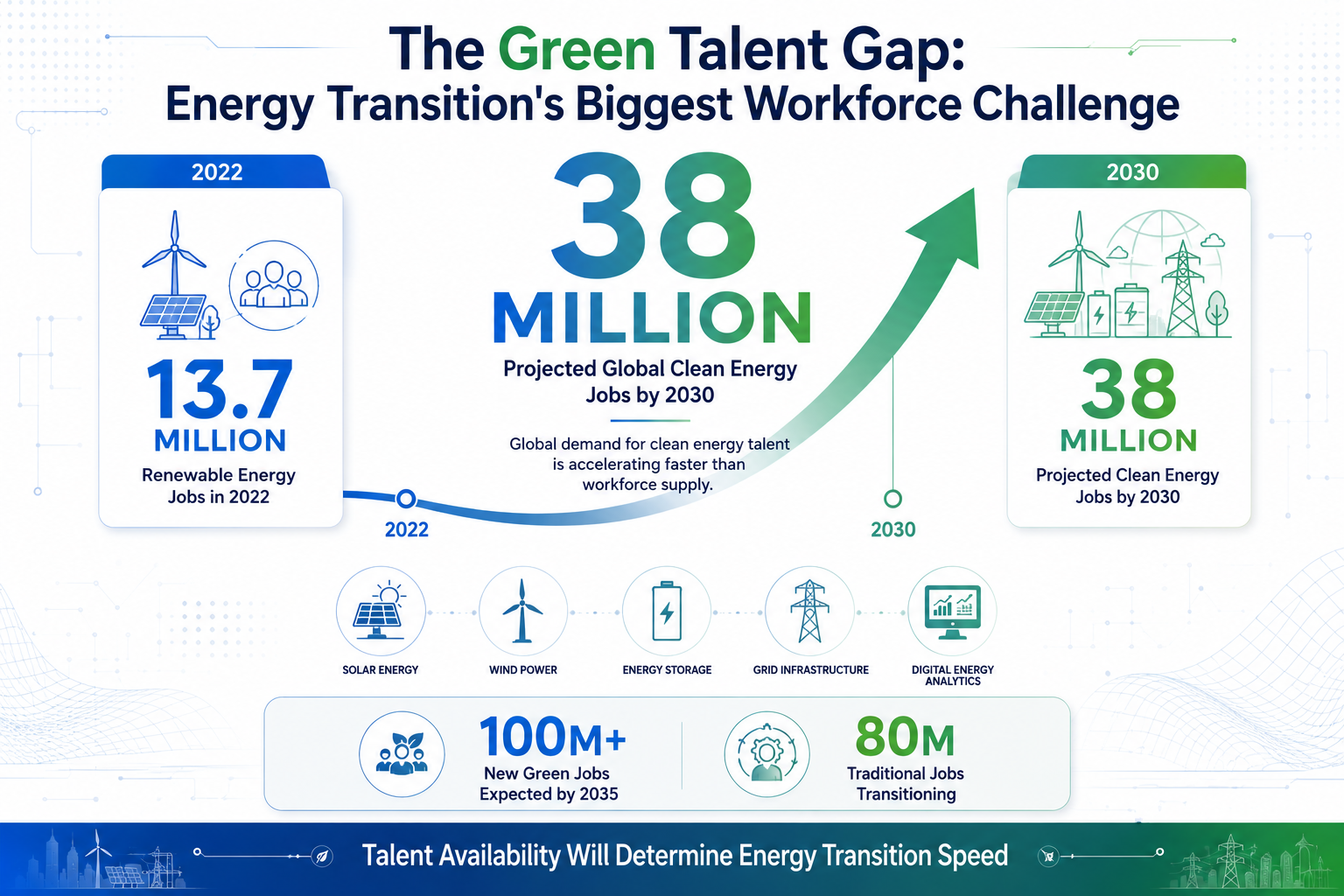
What Green Collar Work Actually Is in 2025
The term 'green collar' has evolved significantly beyond its early-2000s associations with manual environmental labor. Green collar careers today span a wide and technically sophisticated spectrum that challenges the sector's reputation for low-tech, low-status work.
Modern green collar roles include offshore and onshore wind turbine technicians operating advanced diagnostic systems and remote monitoring platforms; solar asset managers using performance analytics and satellite imagery to optimise multi-gigawatt portfolios; grid engineers designing and operating protection and control architectures for increasingly complex network topologies; battery storage systems specialists managing the power electronics, thermal systems, and control algorithms of grid-scale installations; energy data analysts developing the machine learning models that underpin predictive maintenance and demand forecasting; and hydrogen systems engineers designing and commissioning an entirely new energy vector infrastructure.
These roles combine physical infrastructure with advanced software, automation, and data-driven decision-making at a level that rivals the technical sophistication of aerospace, advanced manufacturing, and technology sectors. The challenge is that the sector's employer brand has not kept pace with the reality of its work.
Why Green Careers Are Uniquely Attractive to the Next Generation -- and Why the Sector Is Not Capturing That Attraction
Three factors make green careers inherently attractive to the millennial and Gen Z talent pool that will fill them:
Purpose and Impact
Purpose is among the strongest motivators for early-career professionals in every McKinsey, Deloitte, and WEF generational workforce survey conducted in the past decade. Clean energy careers offer a directness of societal impact that most sectors cannot match: contributing to decarbonisation, energy security, and community resilience provides daily meaning that financial services, retail, or traditional manufacturing cannot replicate.
ILO research on skills for a greener future consistently finds that purpose alignment is a significant positive factor in job choice for 18-35 year olds considering energy sector careers. The sector's challenge is not that purpose exists -- it is that the sector's employer communications rarely articulate it effectively.
Technology Frontier and Career Mobility
Modern energy systems rely on AI, IoT sensor networks, digital twins, advanced power electronics, grid-edge computing, and complex optimisation platforms. For graduates who want to work at the frontier of engineering and digital innovation, this environment is genuinely compelling. Skills developed in clean energy -- data analytics, control systems, power electronics, grid management -- are highly transferable across industries and geographies, aligning well with the portfolio career orientation of younger professionals.
Local Impact and Community Connection
Unlike many digital roles that feel abstract and remote from tangible outcomes, energy jobs are physically embedded in communities. Building a wind farm, upgrading a distribution network, or improving a school's energy efficiency has visible, local effects. This tangibility appeals to a generation that is sceptical of purely financial or digital value creation.
"The energy transition is the greatest job-creation opportunity of the 21st century. But the sector must fundamentally rethink how it tells this story, designs its career pathways, and builds its early talent pipelines if it wants to win the competition for the next generation of professionals." -- World Economic Forum, Accelerating the Green Transition, 2022 |
The Structural Barriers Preventing the Sector From Capturing Talent Interest
Despite genuine narrative advantages, the energy sector faces structural capability and branding challenges that prevent it from converting talent interest into employment. Understanding these barriers is the prerequisite for addressing them.
Barrier | Manifestation | Strategic Response Required |
Hybrid Skill Gap | Green collar roles require combinations of physical infrastructure skills and digital competency that existing education systems do not produce. Electricians now need digital diagnostics. Engineers need data fluency. Unlock the Full ResearchCreate a free account or sign in to access the complete methodology, deep-dive analysis, and key implementation frameworks. Don't have an account? It's free to join. O Organization Learning LabsResearch & Insights Division On this pageResearch DetailsIndustryOil and Gas AuthorOrganization Learning Labs PublishedJul 18, 2026 You Might Also Be Interested In Information Technology Designing the future-ready digital engineering organization Banking, Financial Service And Insurance A Systematic, Empirical Framework for Capability Development in Retail Banking Banking, Financial Service And Insurance Why Capability Beats Strategy in Retail Banking Organizations |
Comments