Gen Z Team Readiness India: Project Economy Strategy

Why India's Gen Z graduates are technically skilled but not team-ready -- and how GCC and IT leaders build the collaborative capabilities the project economy demands through 2035.
The Team-Readiness Paradox: Why India's Most Technically Skilled Generation Struggles in Project Teams
Across technology parks and GCC campuses in Bengaluru, Hyderabad, and Pune, a paradox plays out daily. A freshly hired Gen Z engineer -- digitally fluent, technically proficient, often certified in the latest tools and frameworks -- aces technical onboarding. They know Python, cloud architecture, and data pipeline design. Put them in a cross-functional sprint team with a tight deadline, ambiguous requirements, and a client on the other end of a video call, and something breaks. Not the code. The collaboration.
This is the defining talent challenge of India's project economy: a generation that arrives job-ready but not team-ready. The Mercer Mettl Graduate Skill Index 2025 captures this paradox precisely: overall graduate employability has declined from 44.3% in 2023 to 42.6% in 2024, even as technical proficiency in AI and ML domains has risen to 46%. The gain in technical capability is being offset by persistent deficits in the collaborative, communicative, and adaptive competencies that determine whether an individual contributor can function effectively as a team member.
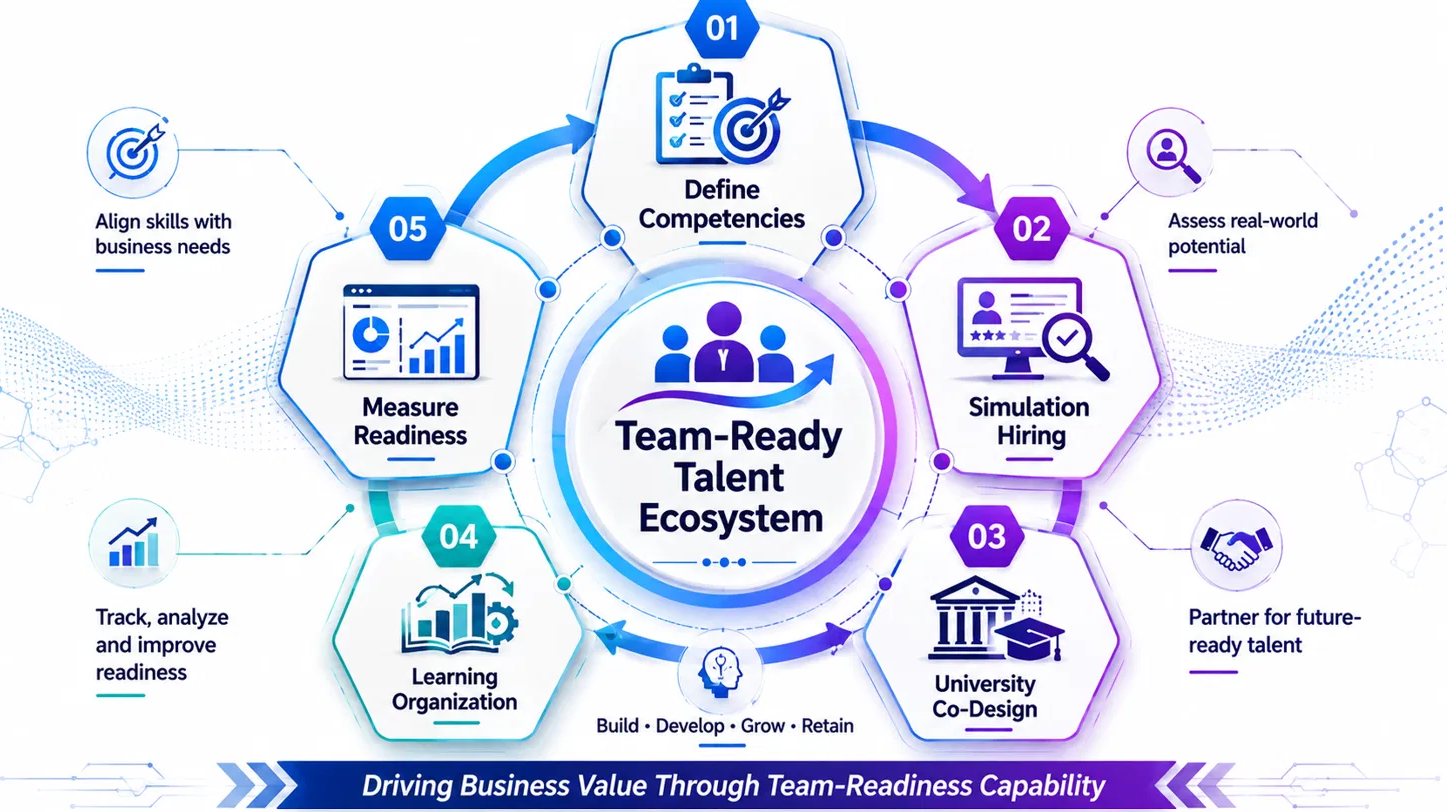
This is not an abstract HR observation. It has measurable business consequences. TCS reported 80,000 unfilled positions in 2024 attributable to the skills gap. The financial services sector saw 1.8 million vacancies go unfilled in a single year. These are not exotic, hard-to-fill roles. They represent a systemic mismatch between what India's education system produces and what India's project economy requires.
42.6%Overall graduate employability in India in 2024 -- declining despite technical proficiency gains, as soft-skills and teamwork deficits drag down overall workplace readiness (Mercer Mettl Graduate Skill Index 2025) |
"India is producing a generation that can do the work but struggles to do the work together. That gap -- between individual competence and team effectiveness -- is the defining workforce challenge of this decade." -- WEF Future of Jobs Report 2025 / PMI Global Talent Gap Report 2025 synthesis |
What the Data Shows: The Specific Gaps in Team-Readiness
The Mercer Mettl data breaks down the employability picture with precision that general employability statistics obscure. Communication proficiency: 55.1% of Indian graduates. Critical thinking: 54.6%. Creativity: 44.3%. Soft skills overall: approximately 50%. Learning agility: 46%. These are not marginal gaps -- they describe a structural situation in which approximately half of India's graduates are deficient in the competencies most directly associated with effective team contribution.
The India Skills Report 2025, based on assessments of over 6.5 lakh candidates by CII in collaboration with Wheebox and AICTE, projects overall employability at 54.81% -- a 7% improvement from previous years. But the CII Higher Education Summit 2025 was explicit about what lies beneath the headline: 40-50% of Indian graduates lack industry readiness due to outdated curricula and limited experiential learning. Business schools produce 400,000 graduates annually, of which 80-85% are assessed as work-experience deficient. Only 4.4% of Indian youth have undergone formal vocational training.
The Deloitte Global Gen Z and Millennial Survey 2025 adds the employee perspective: 94% of Indian Gen Z say on-the-job learning drives career growth, but nearly half report a significant gap between the guidance and mentorship they expect from managers and what they actually receive. More than 20% believe higher education simply did not equip them with skills for a fast-evolving technology landscape. The system produces individuals who know things. The project economy needs people who can do things together.
Why the Project Economy Makes Team-Readiness the Primary Capability Requirement
The shift to project-based work organization is not a trend -- it is a structural transformation of how value is created in knowledge-intensive economies. PMI's Global Talent Gap Report 2025 estimates that the world will need 30 million new project professionals by 2035. South Asia alone could see project management talent demand grow between 68% and 91%. The WEF Future of Jobs Report 2025 ranks project management as the 12th fastest-growing job globally. In IT services, consulting, and GCCs -- the primary employment destinations for India's technical graduates -- every significant unit of delivery is organized as a cross-functional project team operating against a defined outcome under real time and resource constraints.
In this environment, the unit of performance is not the individual contributor. It is the team. Individual technical excellence that cannot be integrated with team collaboration, stakeholder communication, and shared accountability does not create value proportionate to what the organization invested to acquire it. Companies like Infosys, Wipro, and TCS have drawn this conclusion explicitly: Infosys dedicates 15 days within its four-to-six-month onboarding specifically to behavioural training; Wipro's new-hire programme includes a two-month boot camp combining behavioural and technical development. These investments are not philanthropic. They are responses to the operational reality that technical skill without team-readiness does not translate to project delivery.
What Team-Readiness Actually Means: A Definable, Measurable Competency Set
Team-readiness is not a vague aspiration. The WEF Future of Jobs Report 2025 identifies the top employer-required core skills as: analytical thinking (cited by 70% of companies as essential); resilience, flexibility, and agility; leadership and social influence; creative thinking; and motivation and self-awareness. Critically, 39% of existing core skills will be disrupted by 2030, with resilience, leadership, and AI-plus-big-data capabilities showing the most substantial increases in importance.
Unlock the Full Research
Create a free account or sign in to access the complete methodology, deep-dive analysis, and key implementation frameworks.
Don't have an account? It's free to join.
Organization Learning Labs
Research & Insights Division


Comments